
 Ukraine
The debt collection procedure in Ukraine begins with an assessment of the debtor’s solvency, its scope of activity, the history of the enterprise, the availability of documentary evidence of the debt, current court cases and enforcement proceedings, as well as the possibility of disputing the debt. Such an assessment determines the strategy that will be used on behalf of the client in the collection process.
If the debtor has no current court cases or outstanding court decisions on debt collection, and is actively engaged in commercial activities, then it is advisable to use the out-of-court debt collection stage.
This stage includes active negotiations with the debtor in order to reach an agreement on payment of the creditor’s claims or other possible settlement options (e.g. return of goods, transfer of the debt to a third party, exchange of services or goods).
Interaction with the debtor begins after sending a written notice, demand letter or another communication by mail, email, phone or other means of communication. At this stage, it is important not only to conduct negotiations, but also to document the debtor’s position: acknowledgment of the debt, request for deferral, partial payment, objections or a restructuring proposal. The main objective is to establish contact with the persons authorized to make decisions, obtain documentary confirmation of the debtor’s position and choose the appropriate debt recovery strategy.
In practice, the informal out-of-court collection stage is often limited to a period of up to 60 days, unless the parties agree on installment payments, a repayment schedule or another longer settlement mechanism. If during this period the debtor does not demonstrate a real willingness to repay the debt, avoids communication or disputes the creditor’s claims without sufficient evidence, it is reasonable to prepare judicial debt recovery.
Before initiating judicial collection, it is necessary to check the limitation period. In Ukraine, the general limitation period is three years, but the law may establish special shorter or longer periods for certain categories of claims. The expiry of the limitation period does not prevent the creditor from filing a claim with the court; however, the court applies the consequences of such expiry if one of the parties requests this before the decision is issued. In such a case, the expiry of the limitation period may result in dismissal of the claim. The limitation period may be extended by written agreement of the parties. For claims that arose before 4 September 2025, the calculation requires additional attention because the Civil Code previously contained special wartime rules extending statutory limitation periods. Those transitional provisions were repealed with effect from 4 September 2025, so older debts should be assessed by reference to the dates on which the claim arose and the transitional rules applicable during the relevant period.
The limitation period is interrupted if the debtor performs an action indicating acknowledgment of the debt or another obligation. In practice, such evidence may include written confirmation of the debt, a signed reconciliation statement, partial payment, payment of interest, a request for deferral or another documented action by the debtor. After the interruption, a new limitation period begins to run, and the time that passed before the interruption is not included in the new period.
It should be taken into account that Ukraine is a party to the United Nations Convention on the Limitation Period in the International Sale of Goods of 1974. This Convention does not apply to all types of debts, but to claims arising from contracts for the international sale of goods or related to their breach, termination or invalidity. If the conditions for applying the Convention are met, the basic limitation period is four years.
Before filing a claim, it is necessary to check whether Ukrainian law requires a mandatory pre-trial procedure for the particular type of dispute. The contract may also provide for a claim, negotiation or other pre-trial procedure, which should be taken into account when preparing the case. However, such a contractual clause does not generally prevent the creditor from filing a claim with the commercial court. Procedural consequences for failure to complete a pre-trial procedure arise where Ukrainian law makes that procedure mandatory.
Ukrainian legislation provides several procedural routes for judicial debt collection: order proceedings, simplified claim proceedings and general claim proceedings. The choice of procedure depends on the amount of the claim, the nature of the evidence, the existence or absence of a dispute between the parties, the debtor’s status and the legal basis of the debt.
In commercial disputes between legal entities and individual entrepreneurs, order proceedings may be used for claims to recover a monetary debt arising from a contract concluded in writing or in electronic form, provided that the amount of the claim does not exceed one hundred times the subsistence minimum for able-bodied persons. This instrument is suitable for cases where the debt is confirmed by documents and there is no obvious dispute regarding the basis of the claim.
Simplified claim proceedings are intended for minor cases, cases of limited complexity and other disputes where a fast examination is a priority. The case may be considered without summoning the parties on the basis of the written case materials, if the court does not consider it necessary to hold a hearing with notification of the participants.
For more complex disputes, cases with a significant volume of evidence, active objections from the debtor or the need to examine additional circumstances, general claim proceedings apply. This procedure includes a preparatory stage and consideration of the case on the merits.
In simplified claim proceedings, the case must be considered within a reasonable time, but no later than 60 days from the opening of the proceedings. In general claim proceedings, the preparatory stage must be conducted within 60 days from the opening of the case and, in exceptional circumstances, may be extended by no more than 30 days; after that, the case proceeds to consideration on the merits. The practical duration of judicial debt recovery depends on notification of the parties, the debtor’s objections, the volume of evidence, expert examinations, possible appeals and the court’s workload.
After the court issues a decision, each party has the right to file an appeal. In commercial proceedings, an appeal against a court judgment is filed within 20 days, and an appeal against a court ruling is filed within 10 days from its pronouncement. If only the introductory and operative parts of the decision were announced, or if the case was considered without summoning the participants, the period is calculated from the date when the full court decision is prepared. An appeal against a judgment of the court of first instance is considered within 60 days from the opening of appellate proceedings.
After appellate review, the decision of the appellate court enters into force from the date of its adoption; however, the participants in the case may file a cassation appeal if the grounds provided by law exist. Cassation is not a repeated full examination of the dispute on the merits: the cassation court verifies the correct application of substantive and procedural law within the arguments of the cassation appeal.
In commercial proceedings, a cassation appeal against a court decision is filed within 20 days from its pronouncement. If only the introductory and operative parts of the decision were announced, or if the case was considered without summoning the participants, the period is calculated from the date when the full court decision is prepared. A cassation appeal against a judgment must be considered within 60 days, and an appeal against certain rulings within 30 days from the opening of cassation proceedings. The cassation court may suspend the enforcement of the challenged decision or its effect until the cassation review is completed.
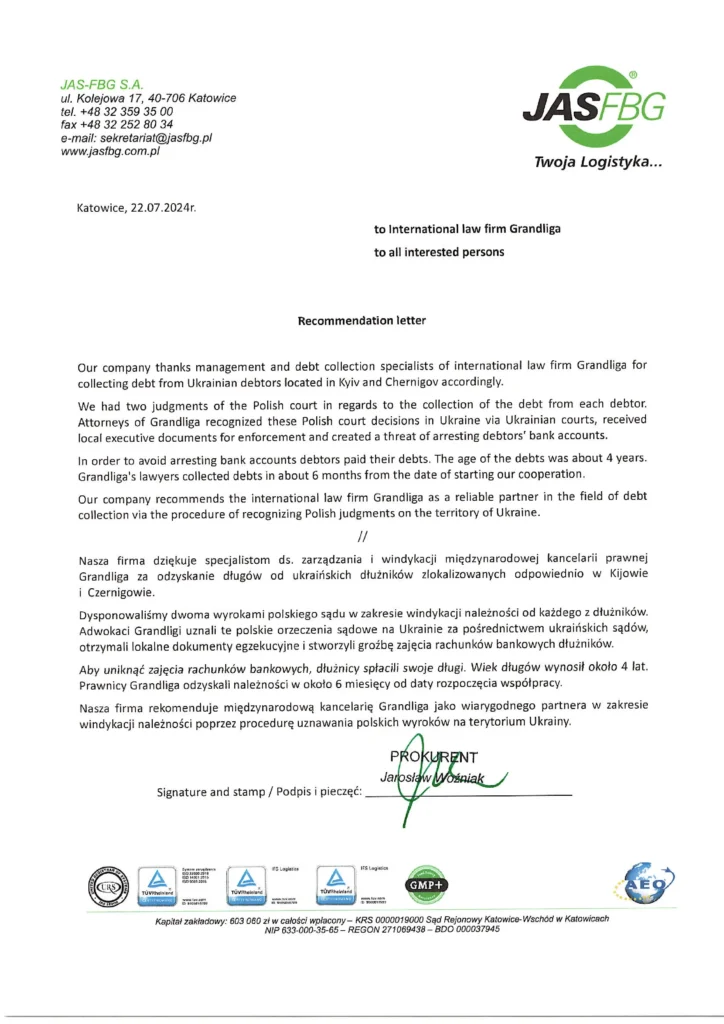
After the court decision on debt collection enters into force, it is necessary to obtain an enforcement document and, on its basis, open enforcement proceedings. If the creditor is a non-resident of Ukraine and has obtained a court decision against a Ukrainian debtor in another country, it is usually necessary to recognize the foreign court decision in Ukraine and obtain permission for its enforcement. This procedure is carried out within a separate court process and is based either on an international treaty binding on Ukraine or on the principle of reciprocity. If recognition and enforcement of a foreign court decision depend on the principle of reciprocity, Ukrainian procedural law presumes that reciprocity exists unless the contrary is proven. Therefore, not only reciprocity is important, but also proper notification of the Ukrainian debtor in the foreign proceedings, the finality of the decision and compliance with the period for presenting it for enforcement in Ukraine.
At the enforcement stage, a state or private enforcement officer enforces the decision using the instruments provided by law, including recovery from funds, securities, other property, property rights, corporate rights, property rights of intellectual property and the debtor’s income, as well as restrictions on the debtor’s disposal or use of property. Information on enforcement documents and stages of enforcement proceedings is recorded in the automated enforcement proceedings system, and data on debtors may be included in the Unified Register of Debtors, which is used to publish information on unfulfilled property obligations and prevent alienation of property.
In practice, individual debtors may transfer assets to controlled persons to prevent recovery, while managers or owners of a debtor company may strip the company of assets and transfer control to nominal (dummy) owners or managers. As a result, a creditor may complete the main stages of debt collection without obtaining satisfaction of the claim.
In such circumstances, alternative debt recovery options may need to be considered, including:
- Initiating bankruptcy proceedings against the debtor company, during which it may be possible to hold the company’s management or owners subsidiarily liable for the company’s debts.
- Raising the issue of criminal liability in case of intentional non-compliance with a court decision that has entered into force or obstruction of its enforcement. This mechanism does not mean criminal liability for the mere existence of a debt; it may be considered when, after obtaining a court decision, there are signs of conscious evasion of its execution or creation of obstacles to compulsory recovery.
- Detecting fraudulent agreements. In other words, this refers to transactions where the debtor company, aware of its debt to the creditor, takes actions to alienate its assets to prevent any payments in future claims from that creditor. In such a case, the creditor has the right to initiate a court process to declare such transactions invalid and return the transferred assets back to the debtor. Consequently, the creditor can satisfy their demands by selling such assets (this option is also applicable to debtors – individuals).
If you have any questions or need support in debt collection or recognition of a foreign court decision in Ukraine, our company is ready to provide its expert assistance for the effective resolution of your financial issue. Contact us to receive additional information and professional support from lawyers of the leading debt collection agency.