
 United Arab Emirates
The debt collection procedure in the United Arab Emirates begins with a legal and practical assessment of the debtor, the debt documents and the proper forum for recovery. Before choosing a recovery route, it is important to determine whether the debtor is an individual, an onshore company, a free zone company, or an entity connected with DIFC or ADGM, whether the debt is confirmed by a contract, invoices, delivery documents, correspondence, account statements, cheques or another written or electronic record, and whether there are ongoing court cases, enforcement files or insolvency risks. This assessment forms the recovery strategy that will be used on behalf of the creditor to recover the debt.
In UAE debt recovery, jurisdiction is not always limited to the ordinary onshore courts. Many commercial debts are handled before the UAE onshore courts, but certain disputes may fall within the jurisdiction of the DIFC Courts or ADGM Courts if the debtor, transaction, contract or jurisdiction clause is connected with those financial free zones. Therefore, the first legal step is to identify the competent forum, the governing documents and the assets available for enforcement.
If there are no ongoing lawsuits against the debtor or court decisions on debt collection, and if he is actively engaged in his business, then it is advisable to use amicable debt collection.
This stage is based on active negotiations with the debtor to reach an agreement regarding payment of the creditor’s claims or other settlement options (for example, return of goods, transfer of debt to a third party, exchange of services or goods).
Interaction with the debtor usually begins with a written payment demand sent through available communication channels, including mail, email, telephone or messenger contacts, where this is appropriate for the case. The purpose of this stage is not only to request payment, but also to record the debtor’s position, confirm the amount claimed, preserve evidence of communication and create a basis for settlement, a payment schedule, return of goods, security for the debt or another legally acceptable arrangement.
The out-of-court stage may be used as a practical preliminary step where the debtor is still operating, can be contacted and there is no immediate risk of limitation, asset dissipation or insolvency. Its duration depends on the debtor’s response, the quality of the documents, the amount in dispute and the probability of voluntary settlement. If the debtor ignores the demand, disputes the debt without sufficient grounds, refuses to provide payment security or if urgent enforcement risks appear, a formal legal recovery route should be considered.
Before initiating judicial debt collection in the UAE, the applicable limitation period should be assessed by reference to the type of claim and the supporting documents. As a general rule under the UAE Civil Transactions Law, a claim is not heard, if denied, after the lapse of fifteen years without a lawful excuse, unless a special rule applies. Shorter periods may apply to certain categories of rights, including five years for periodical renewing rights and certain professional-service or tax-overpayment claims, and two years for specified claims such as some merchant, craftsman, hotel, restaurant and wage-related claims. If there is a written acknowledgement or paper proving the rights referred to in the relevant shorter-period provisions, the claim is not heard after the lapse of fifteen years from the date on which those rights become due.
The limitation period generally begins from the day on which the right becomes due for exercise. An express or implied admission by the debtor may interrupt the running of time, and a judicial claim or another judicial step taken by the creditor to enforce the right may also interrupt it. The court does not apply the time-bar defence of its own motion; the legal consequences of missing the limitation period are applied when the debtor or another interested party invokes that defence.
UAE legislation provides several judicial routes for debt collection, including the simplified writ of debt procedure and the general litigation route where the dispute requires full court examination.
The writ of debt procedure may be used where the creditor’s right is well established in writing, whether electronically or on paper, due for payment, and the claim concerns a specified amount of money or a clearly defined movable property. Before filing the petition, the creditor must serve the debtor with a payment notice giving at least five days for payment. The petition is then filed with proof of the debt and proof that the payment notice was served. The writ of debt must be issued not later than three business days after the petition filing date and must specify the amount ordered to be paid or the movable property to be delivered. If the writ of debt is not served on the debtor within three months from its issuance, it becomes null and void.
If the value of the writ of debt falls within the jurisdictional amount of the Court of First Instance, the debtor may file a grievance within fifteen days from the date of service of the writ of debt. If the value exceeds that amount, the writ may be challenged according to the ordinary rules and time limits for appealing judgments. The filing of a grievance or appeal does not automatically suspend enforcement, although the competent court or judge may order a temporary stay of execution where the statutory conditions are met.
In cheque-backed debt cases, the recovery strategy may differ from an ordinary contractual claim. A cheque falling due in the UAE must generally be presented for payment within six months from the date stated in the cheque as the date of issue. If the drawee states that the cheque has no or insufficient balance, the cheque may operate as an executive instrument, and the bearer may request enforcement in whole or in part under the rules of the Civil Procedure Law. This makes the cheque, the bank statement of dishonour and evidence of the underlying debt especially important in UAE debt recovery.
The general litigation route is used where the claim cannot be resolved through settlement or does not satisfy the requirements for a writ of debt. It is commenced by filing a statement of claim before the competent court. As a practical orientation, first-instance proceedings may take approximately 60 to 90 days in straightforward cases, but the duration may increase where the debtor disputes the claim, service of process is difficult, technical issues require the appointment of an expert, evidence must be translated or additional hearings are necessary. A first-instance judgment may become enforceable if no appeal is filed within the applicable appeal period.
An appeal against a first-instance judgment may be considered within approximately thirty to sixty days as a practical orientation, depending on the court schedule, service of the appeal, the scope of the debtor’s objections and whether additional submissions are required. The appellate court may uphold, amend or overturn the first-instance judgment, and its decision may be enforceable unless a further challenge or stay of execution affects enforcement.
For proceedings before the UAE onshore courts governed by the federal Civil Procedure Code, a cassation appeal may generally be filed within thirty days where the statutory requirements for cassation are met, including where the value of the claim exceeds AED 500,000 or the claim has an indeterminate value. Proceedings before the DIFC Courts and ADGM Courts follow their own procedural and appellate rules, which differ from the standard onshore framework. In the onshore court system, filing a cassation appeal does not by itself stay enforcement of the appellate judgment unless a stay is granted under the applicable rules.
After the judgment, writ of debt or another enforceable instrument becomes enforceable, compulsory execution may be initiated before the competent execution court. The execution process normally starts with the service of the execution writ, and the debtor is required to satisfy the claim within seven days from the date of service. The duration of enforcement depends on the debtor’s assets, bank accounts, receivables, real estate, movable property, cooperation level and any objections raised during execution. Accurate information about the debtor’s assets can significantly shorten the recovery process.
As part of the enforcement process, recovery may be carried out through attachment of bank accounts, seizure and sale of movable or immovable property, garnishment of amounts owed to the debtor by third parties, enforcement against available assets and other measures permitted by the execution court. In appropriate cases, the creditor may also seek protective or coercive measures such as a travel ban or debtor detention, but these measures are applied under statutory conditions and should not be treated as automatic consequences of every debt claim.
For foreign creditors, a separate recovery route may be the recognition and enforcement of a foreign judgment, order, arbitral award or notarized instrument in the UAE. The application is submitted to the Execution Judge, and the enforcement order may be issued after the required conditions are verified, including jurisdiction of the foreign court, proper summons or representation of the parties, finality and enforceability of the foreign decision, absence of conflict with an existing UAE judgment or order, and compliance with UAE morals and public order. Foreign arbitral awards and foreign notarized instruments are also addressed by the Civil Procedure Code, subject to the applicable conditions and any relevant treaty rules.
Bankruptcy or restructuring may become relevant where ordinary enforcement is insufficient and the debtor has defaulted on debts that meet the statutory threshold. Under the current UAE financial restructuring and bankruptcy framework, an ordinary creditor or a group of ordinary creditors may apply to initiate restructuring proceedings or declare the debtor bankrupt if the unpaid debt or total unpaid debts are not less than AED 1,000,000. If the debtor is subject to a regulatory authority, the threshold is AED 10,000,000. For a debtor’s own application, the Executive Regulation provides separate thresholds of AED 300,000 for a natural person, AED 500,000 for a legal person and AED 5,000,000 where the debtor is controlled by a regulatory authority.
Where the debtor is a company, the effect of bankruptcy on its partners depends on the company’s legal form. Bankruptcy proceedings concerning the company’s debts may also extend to partners who are personally liable for those debts, including the active partners covered by the UAE bankruptcy framework. Partners in a general partnership are jointly and severally liable with their personal assets for the company’s obligations, while in a limited partnership this personal liability applies to the general partners. Limited partners are generally liable only to the extent of their capital contributions. Partners in a limited liability company are likewise generally liable only to the extent of their contributions to the company’s capital, subject to specific statutory exceptions.
Personal liability may also arise for directors, managers, persons responsible for the actual management of the company or liquidators, but only where the statutory grounds for such liability are established. If a company is declared bankrupt, the Bankruptcy Court may require such persons to pay an amount proportionate to the fault attributed to them where conduct specified by the bankruptcy legislation is proven, including certain prejudicial disposals of assets, preferential payments, inadequately assessed high-risk business practices or serious mismanagement before the company stopped paying its debts. This is a case-specific liability mechanism and does not automatically transfer the company’s debts to its management or partners.
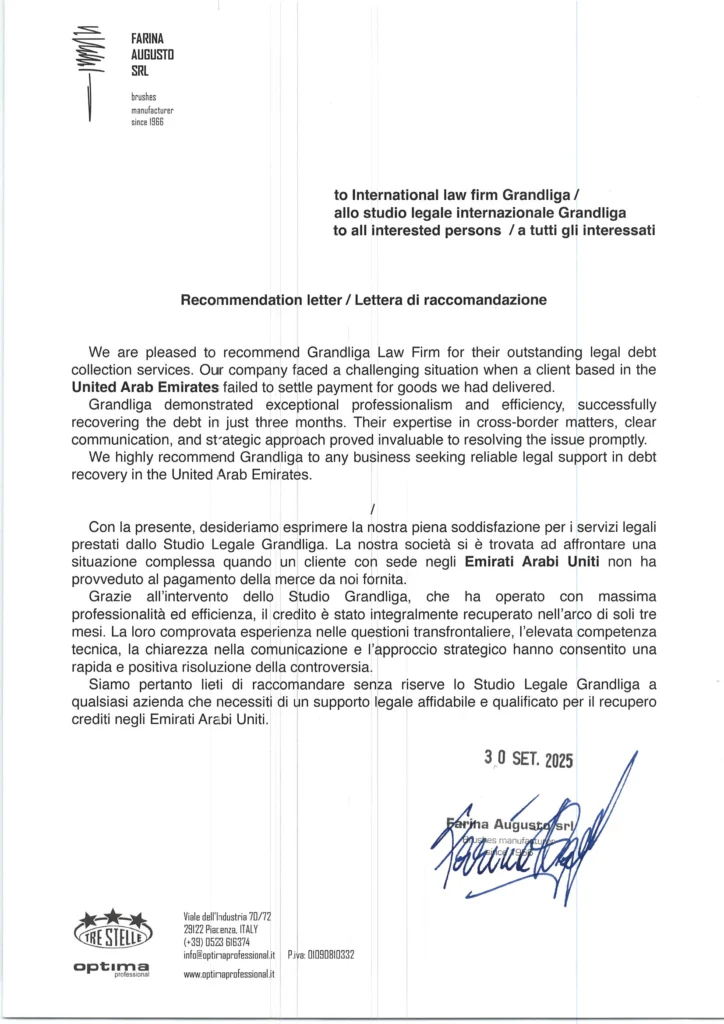
If you need support with debt collection in the UAE, our team can assess the debtor’s status, available evidence, jurisdiction, limitation period, settlement options, court route, enforcement prospects and cross-border recovery strategy. The appropriate recovery route depends on the documents, debtor profile, assets and procedural position of the case, so the first step should be a structured legal and practical assessment of the claim.