

The debt collection procedure in Colombia begins with a legal and financial assessment of the debtor: correct identification of the individual or legal entity, address for service of notices, actual business activity, availability of assets that may be seized, pending court or enforcement proceedings, signs of insolvency, and the quality of documents proving the obligation. In Colombia, this assessment is especially important because the recovery route may differ depending on whether the creditor has a document that allows direct enforcement, a small contractual monetary claim, or a dispute that first requires a court declaration.
It is also necessary to check whether the debt is supported by a contract, invoice, promissory note, delivery act, debt acknowledgment, settlement agreement, court judgment, arbitral award, or another document showing a clear, express, and enforceable obligation. If the file is well documented, the creditor may prepare a more direct recovery strategy. If the evidence is incomplete, it may first be necessary to strengthen the evidentiary position through formal payment demands, debt acknowledgment, settlement discussions, or additional commercial documents.
If the debtor has no pending court cases or outstanding judgments related to the same debt and continues active business operations, it may be reasonable to begin the out-of-court debt collection stage. This stage allows the creditor to verify the debtor’s real willingness to pay, obtain a documented response, negotiate a payment schedule, security, return of goods, assignment of rights, or another commercial solution that reduces litigation risk.
Communication with the debtor should be organized through a clear and verifiable payment demand, followed by documented correspondence by mail, email, phone, or other communication channels. The purpose of this stage is not informal pressure, but the recording of the creditor’s position, identification of decision makers, confirmation of notice details, receipt of a payment proposal, or evidence of the debtor’s refusal to pay.
In Colombia, information about electronic addresses and proof of sending or accessing an electronic message may become important at the court stage. Law 2213 of 2022 allows certain personal notices to be served by electronic message to the indicated electronic address and requires evidence of how that address was obtained, as well as proof of sending or access to the message.
The average term for informal out-of-court collection may be up to 60 days, unless the parties agree on payment by installments or a longer negotiation period. If this stage does not produce results, if the debtor denies the debt, hides assets, becomes insolvent, or it is clear from the beginning that negotiations will not be useful, it is necessary to assess moving to judicial debt collection.
Before initiating judicial collection, it is necessary to check the applicable limitation period. As a general rule of Colombian civil law, an enforcement claim is time-barred after five years, and an ordinary claim is time-barred after ten years. An enforcement claim becomes an ordinary claim after five years and, once converted, lasts only another five years. The consequences of limitation may be invoked by a person with a legal interest either as a claim or as a defense. If the limitation period is interrupted or waived, the relevant period begins to run again. For debts documented by negotiable instruments, special limitation periods may apply: for example, a direct claim based on such an instrument is time-barred three years after the payment due date.
Colombian law does not limit judicial debt collection to one universal court procedure. The appropriate route depends on the available documents, the amount of the claim, the existence of a clear, express, and enforceable obligation, the debtor’s position, and whether the creditor first needs a court declaration on the existence, amount, or breach of the debt.
Persons who must participate in the proceedings must do so through a legally authorized lawyer, unless the law allows direct participation. In cross-border debt collection, this means that the litigation strategy should be coordinated in advance with the preparation of powers of attorney, corporate documents, and proof of representative authority.
If the creditor has a document showing an express, clear, and enforceable obligation, enforcement proceedings may be considered. In this procedure, when the claim is filed with a document that has enforcement force, the court may issue an enforceable payment order and require the debtor to perform the obligation in the form requested or in the form considered lawful by the court.
If the creditor does not have a document allowing direct enforcement, but claims a contractual monetary obligation that is determined, due, payable, and of small value, payment order proceedings may be considered. If the application meets the legal requirements, the court requires the debtor to pay within ten days or to state specific reasons for denying the debt in whole or in part. If the debtor does not pay and does not justify the refusal, the court may issue a decision with final effect.
When the debt is disputed, the documents do not have enforcement force, or the creditor needs the court first to establish the existence of the obligation, contractual breach, amount due, or liability of the debtor, the matter may be handled through ordinary declaratory proceedings. This procedure is relevant when it is not enough to demand payment directly and it is first necessary to obtain a court decision recognizing the right and ordering the debtor to pay.
In ordinary oral proceedings, the process begins with filing the statement of claim and supporting documents with the competent court. If the claim meets legal requirements, the court admits it and grants the defendant twenty days to respond. During this period, the defendant may answer the claim, admit or deny facts, raise defenses, dispute the amount claimed, submit evidence, and set out the arguments of defense.
If the dispute concerns a minimum-value contentious matter or a matter for which the law provides a simpler procedure, summary oral proceedings may apply. This procedure is heard in one instance and has its own rules on the claim, response, taking of evidence, and hearing. It should not be confused with payment order proceedings or enforcement proceedings.
To determine the amount of the case, Colombian procedural law distinguishes between minimum, lower, and higher value claims. Monetary claims not exceeding forty current statutory monthly minimum wages are minimum-value claims. Claims exceeding forty but not exceeding one hundred and fifty current statutory monthly minimum wages are lower-value claims. Claims exceeding one hundred and fifty current statutory monthly minimum wages are higher-value claims. The applicable minimum wage is the one in force at the time the claim is filed.
Municipal civil courts hear, among other matters, contentious lower-value cases, while circuit civil courts hear contentious higher-value cases. Therefore, before filing a debt collection claim in Colombia, it is necessary to correctly calculate the principal debt, interest, penalties, and other amounts claimed.
In the response, the defendant must clearly state the position on the claims and facts, indicating which facts are admitted, which are denied, and which are unknown. Failure to respond, denials contrary to reality, or the absence of a clear position may be considered by the court when assessing the evidence.
At any time before the first-instance judgment, the defendant may expressly admit the claims and their factual basis. In that case, the court may issue a decision in accordance with the admitted claims, while retaining the power to review the evidence if there are signs of fraud, collusion, or harm to third parties participating in the proceedings as principal parties.
Hearings allow the court to attempt settlement, define the relevant facts, resolve procedural matters, take or assess evidence, and hear the parties’ arguments. If the case is ready for decision, the judgment may be issued at the hearing under the rules of the applicable procedure.
First-instance judgments may be appealed, except for judgments issued in equity and cases where the law provides for a single instance. If the decision is issued at a hearing, the appeal must be filed orally immediately after the decision is pronounced. If the decision is issued outside a hearing, the appeal must be filed before the judge who issued it, either at the time of personal notice or in writing within three days after notice through the official notification system.
When appealing a judgment, the appellant must briefly identify the specific objections to the decision. If the judgment was issued at a hearing, those objections must be stated at the same hearing. If the judgment was issued outside a hearing, they must be stated within three days after the hearing ends or after notice of the judgment. The later argument before the higher court must correspond to those specific objections. If the appeal is not properly and timely argued, it may be declared abandoned.
An appeal may be granted with suspensive, non-suspensive, or deferred effect. In property-related disputes, many appeals against judgments allow the proceedings to continue, although money or other property may not be delivered until the appeal is decided. Once an appeal against a judgment is admitted, the second-instance court schedules a hearing for argument and decision. If evidence is ordered, it is taken at the same hearing, the parties’ arguments are heard, and a judgment is issued under the applicable procedural rules.
Review by the Supreme Court of Colombia is not an ordinary third instance. Extraordinary review before the Supreme Court is available against certain judgments issued by higher courts in second instance, including judgments in declaratory proceedings. It must be filed within five days after notice of the judgment. In claims that are essentially economic, this review is available when the current value of the part of the judgment unfavorable to the applicant exceeds one thousand current statutory monthly minimum wages.
Once the request is admitted, a common period of thirty days is granted to file the extraordinary review brief. After that brief is admitted, the opposing parties have fifteen days to respond. The Supreme Court examines the matter within the statutory grounds, including direct or indirect violation of a substantive rule, inconsistency of the judgment with the claims, worsening of the position of the sole appellant, or unremedied procedural nullities. In a judicial debt collection case, the usefulness of an appeal or extraordinary review depends on the type of proceedings, the amount in dispute, the content of the judgment, costs, time limits, and the real impact of the remedy on recovery prospects.
In international cases, if the creditor already has a court judgment issued outside Colombia, the recovery strategy does not always begin with a new debt collection claim. It may first be necessary to seek recognition and enforcement of a foreign judgment. Foreign judgments have in Colombia the force granted by applicable international treaties and, in the absence of a treaty, the force that the country of origin gives to Colombian judgments.
For a foreign judgment to have legal effect in Colombia, several requirements must be met: the judgment must not concern rights in property located in Colombia at the beginning of the foreign proceedings, must not conflict with Colombian public order, must be final under the law of the country of origin, must be submitted in a legalized copy, must not concern a matter within the exclusive jurisdiction of Colombian courts, and must show that the debtor was duly notified and had an opportunity to defend the case.
The recognition application is filed with the Civil Chamber of the Supreme Court of Colombia, unless an international treaty assigns jurisdiction to another court. If recognition is granted and the foreign judgment requires enforcement, further enforcement is carried out before the competent court under the general rules. Documents not issued in Spanish must be submitted with a legally valid translation.
Once there is a final court judgment, a document with enforcement force, or a recognized foreign judgment where required, the creditor may proceed to enforcement proceedings. In Colombia, enforcement is based on the existence of a clear, express, and enforceable obligation or on a court decision that allows payment to be demanded. If the enforcement claim is filed with a document that has enforcement force, the court may issue an enforceable payment order against the debtor.
Within enforcement, the creditor’s claims may be satisfied through measures against the debtor’s money, bank accounts, movable property, real estate, securities, property rights, and other assets that may be seized. In practice, the effectiveness of this stage depends on locating assets in Colombia, correctly identifying the debtor, finding registered accounts or assets, and promptly requesting protective or enforcement measures.
If the debtor shows signs of insolvency, it is advisable to assess whether it is more appropriate to continue individual enforcement or participate in insolvency-related proceedings. In Colombia, the business insolvency regime includes, among other routes, reorganization and judicial liquidation, and the opening of such proceedings may change the way the creditor must file, prove, and enforce the claim.
Cessation of payments exists when the debtor fails to perform, for more than ninety days, two or more obligations in favor of two or more creditors, incurred in the course of business activity, or when at least two enforcement claims have been filed by two or more creditors for payment of obligations. In any case, the total value of those obligations must represent at least ten percent of the debtor’s total liabilities according to the financial statements submitted with the application.
In judicial liquidation, the opening decision provides, among other measures, for the appointment of the liquidator, restrictions on the debtor’s ordinary activity, protective measures over its assets, and publication of the opening notice. Creditors have twenty days from the removal of that notice to file their claims with the liquidator, together with evidence of the existence and amount of the claim.
If the assets are insufficient to pay the debtor’s obligations, the liquidator must require the company’s shareholders or members to pay the unpaid value of shares or interests and any additional liability provided by the bylaws. For this purpose, the liquidator brings enforcement proceedings before the judge handling the judicial liquidation, based on final inventories and valuations and the relevant accounting certification.
In addition, if the insolvency or judicial liquidation situation was caused by acts of the parent or controlling company due to subordination, in the interest of that company or any of its subsidiaries and against the benefit of the debtor company, the parent or controlling company may be subsidiarily liable for the debtor’s obligations. This claim is heard by the judge handling the insolvency proceedings and may be brought within four years.
During insolvency proceedings, claims may also be brought to revoke or declare simulated acts of the debtor that harmed creditors, affected the order of payment priority, or reduced the assets available for payment. Such acts include transfers, payment through transfer of property, creation or cancellation of security interests, restrictions on ownership, or contracts preventing the purpose of the proceedings made within eighteen months before the opening of the proceedings; gratuitous acts made within twenty-four months before the opening; and bylaw amendments registered within six months before the opening when they reduce assets or change the liability regime to the detriment of creditors.
If such a claim is upheld, the court may order cancellation of registrations, return of rights to the debtor’s estate, and other measures necessary to restore the asset pool. The creditor who brought the claim may also be entitled to a reward equal to forty percent of the commercial value of the recovered asset or of the benefit obtained directly or indirectly for the debtor’s estate.
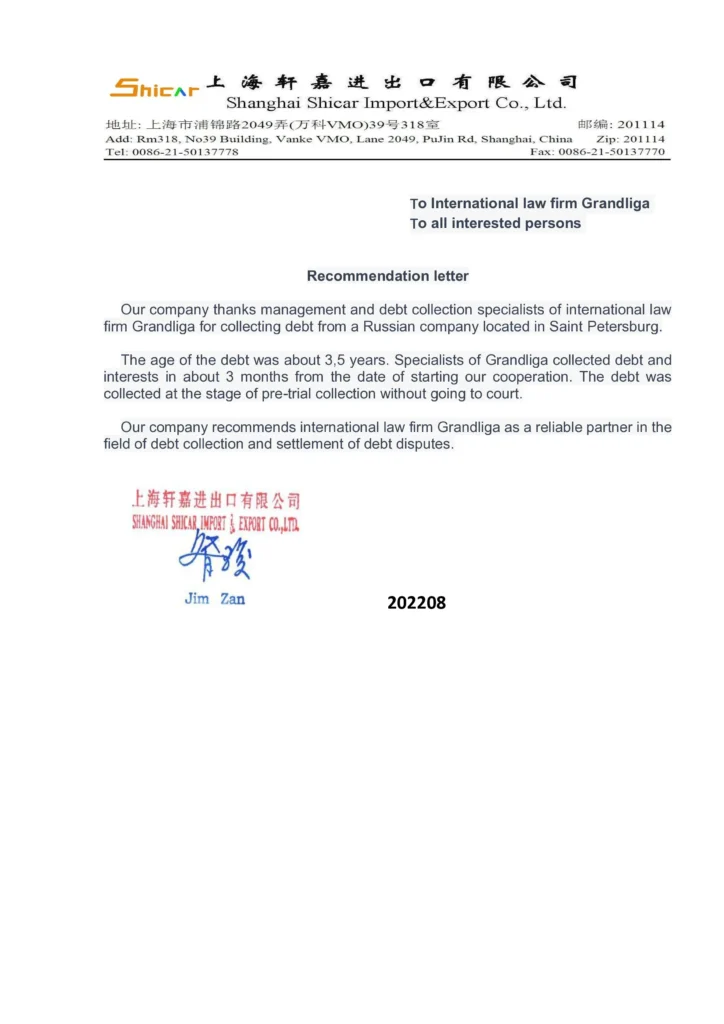
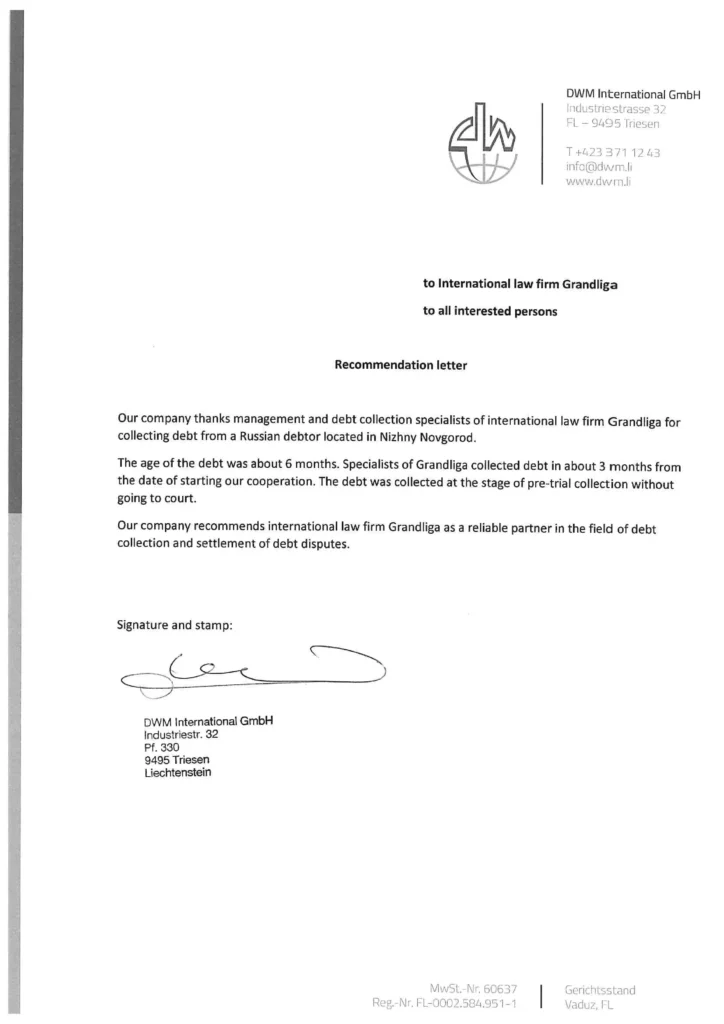
If you need support in a debt collection case in Colombia, Grandliga can assist the creditor at all relevant stages: analysis of the debtor and documents, out-of-court negotiations, choice between enforcement proceedings, payment order proceedings, or ordinary declaratory proceedings, preparation of the court strategy, recognition of a foreign judgment, enforcement against assets in Colombia, and actions related to insolvency, reorganization, or judicial liquidation of the debtor. Each strategy should be built according to the type of debt, available evidence, debtor’s location, existence of assets that may be seized, and realistic recovery prospects.