Let's discuss your case
We will analyze and give recommendations

International arbitration is one of the most widely used mechanisms for resolving cross-border commercial disputes. Thanks to its flexibility, neutrality, privacy and the ability to choose arbitrators with relevant expertise, this mechanism can help companies from different countries resolve conflicts outside ordinary litigation on the merits in national courts. At the same time, the efficiency of arbitration depends on the arbitration agreement, the chosen rules, the seat of arbitration, the complexity of the dispute, the conduct of the parties and the later recognition and enforcement of the arbitral award.
What is international arbitration?
International arbitration is the process of resolving disputes between parties from different countries through an independent arbitral tribunal or an arbitration institution. The parties agree in advance to submit their disputes to arbitration and, as a rule, not to bring the same dispute before a state court for a decision on the merits. However, this does not completely exclude state courts, because they may still be involved in supporting the arbitration, considering interim measures, reviewing challenges to the award or handling recognition and enforcement.
To use arbitration services, the parties must enter into an arbitration agreement or include in the contract an arbitration clause that defines the appropriate international commercial arbitration for the consideration of a future potential dispute between the parties.
Advantages and disadvantages of international arbitration
One of the main advantages of international arbitration is the speed and confidentiality of dispute resolution. Compared to the national judicial process, arbitration takes significantly less time, since its decisions, in most cases, are final and are not subject to appeal through the appellate and cassation procedures.
At the same time, as practice shows, the arbitration procedure may not always be faster than the national one. In particular, this applies to cases where the place of arbitration is in the plaintiff’s country, and the defendant does not take part in the process or has not ensured the appearance of his arbitration lawyer. This circumstance entails longer breaks between court hearings in order to comply with the requirements for proper notification of the defendant about court events or sending procedural documents received from the plaintiff.
If the amount in dispute is not significant or the dispute is not complex, national courts may sometimes consider such cases under simplified or accelerated procedures. In arbitration, the availability of a simplified or expedited procedure depends on the chosen arbitration rules and the agreement of the parties. Modern arbitration rules increasingly provide such mechanisms: for example, ICC arbitration may apply expedited procedure provisions in qualifying cases, while the UNCITRAL Arbitration Rules now include expedited arbitration rules that apply when the parties expressly agree to them.
Moreover, a quick resolution of a dispute in arbitration does not always mean a quick completion of the procedure as a whole. In the event that the defendant does not voluntarily comply with the arbitral award, the plaintiff will have to initiate a separate legal process in the national court at the location of the defendant regarding recognition of the arbitral award and obtaining permission to enforce it in the defendant’s country.
Recognition and enforcement of foreign arbitral awards is facilitated by the New York Convention on the Recognition and Enforcement of Foreign Arbitral Awards of 1958, which has more than 170 parties. Under the Convention, arbitral awards must generally be recognized as binding and enforced in accordance with the procedural rules of the country where enforcement is sought. At the same time, recognition and enforcement may be refused on limited grounds, including invalidity of the arbitration agreement, lack of proper notice, inability to present the case, excess of the tribunal’s mandate, irregular composition of the tribunal, setting aside or suspension of the award at the seat, non-arbitrability of the dispute or contradiction with public policy.
At the enforcement stage, the defendant may try to resist recognition and enforcement by relying on the grounds allowed under the New York Convention or under the procedural law of the enforcing jurisdiction. This is why the creditor should prepare the arbitration case with enforcement in mind from the beginning: the arbitration agreement, notice of the proceedings, composition of the tribunal, scope of the claims and form of the award may all become important when the award is later presented for enforcement.
For judicial decisions of national courts, the situation is different. If a court decision is enforced within the same country, it is usually enforced after it becomes final or after the relevant enforcement document is issued under domestic procedural law. If the same court decision must be enforced abroad, a separate recognition and enforcement procedure may still be required, depending on the applicable treaty, regional legal regime or national law of the country where enforcement is sought.
Such circumstances allow us to conclude that the international dispute resolution in arbitration may take longer than in the national court and at the same time consist of two procedural stages independent from each other.
With regard to the confidentiality of the arbitration procedure, there is also a simultaneous indicator of advantage and disadvantage.. On the one hand, arbitration institutions provide a high level of confidentiality, which allows the parties to hide the commercial and business component of their relationship from the public. On the other hand, when concluding a transaction, the parties are deprived of the opportunity to check the historical reliability of their future counterparty based on an analysis of similar cases, since arbitration decisions are hidden.
The advantages of international commercial arbitration also include the ability to select an arbitrator or arbitrators to consider a dispute based on their highly specialized competence and the specifics of the conflict dispute.
An additional advantage of arbitration is the right of the parties to choose the language of the arbitration. In this case, it should be understood that if the language of the proceedings differs from the national language of the defendant, then in the process of recognition of the arbitration award this will entail additional costs for the creditor for the translation of procedural documents for the national court of the debtor.
One of the disadvantages of arbitration is the risk of inconsistent decisions, since they may be based on the personal views of the arbitrators rather than generally accepted legal principles. Therefore, the combination of this circumstance with the fact that the decision of the arbitration center is final and not subject to appeal creates the risk that a party to the case, which predicts its position on the basis of the established judicial practice of general courts, in fact receives a final decision made on the basis of the personal position of the arbitrators, which may differ radically from the established judicial practice of national courts.
Although, on the other hand, the arbitrator’s independent approaches to law enforcement can have positive consequences depending on the position of the party, since the established practice of national courts does not always take into account the specific features of the dispute and lead to a fair decision.
The key disadvantage of international arbitration is the cost of arbitration and registration fees, which can be significantly higher than court fees in national litigation, especially in complex or high-value disputes. This trend is not the same in all arbitration institutions. It should also be taken into account that the cost of arbitration lawyers and specialized arbitration firms is often higher than the cost of legal representation in ordinary national court proceedings.
An additional disadvantage of the arbitration procedure is the impossibility of implementing interim measures (for example, a ban on certain actions, seizure of the defendant’s accounts and assets) directly in such arbitration. Such actions should be carried out in the national court at the location of the defendant and provided that the national legislation of the defendant provides for the possibility of implementing interim measures while the dispute is being considered in international commercial arbitration. This situation complicates the process as a whole and essentially forces the creditor to initiate additional litigation in the defendant’s country and incur additional costs for the implementation of such an event.
In conclusion, it should be noted that despite a fairly significant list of shortcomings, international commercial arbitration is an effective tool for international dispute resolution between parties from different countries. Due to its neutrality, flexibility and ability to ensure confidentiality, arbitration is becoming increasingly popular among international companies. However, it is necessary to carefully approach the choice of the location of the arbitration institution, arbitrators and procedures in order to ensure a quick and fair resolution of the dispute.
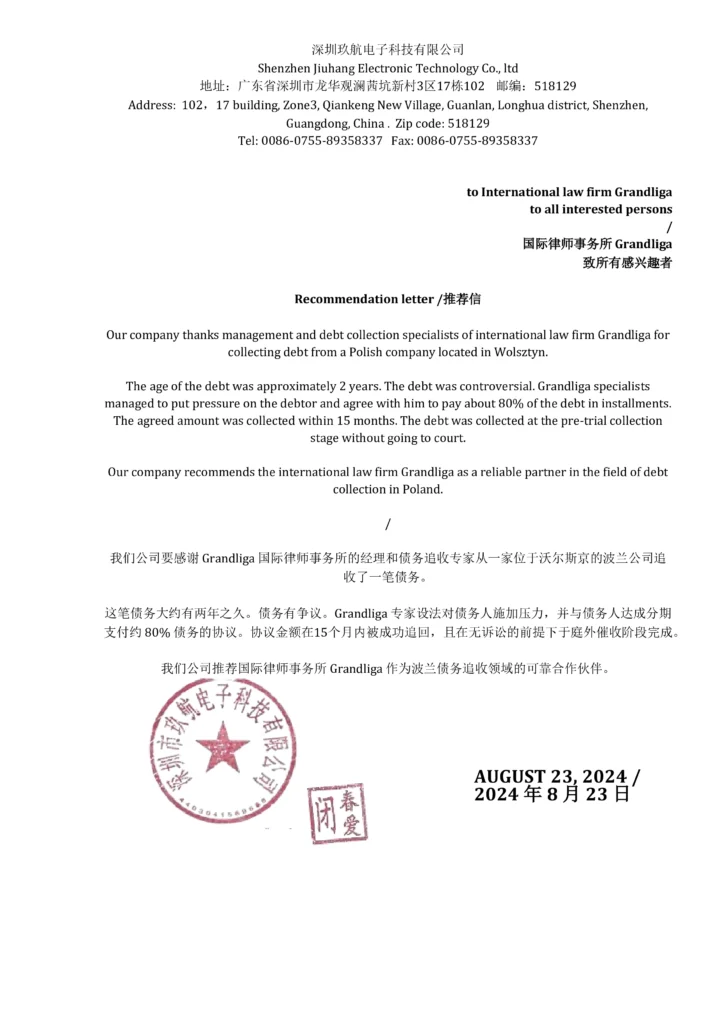
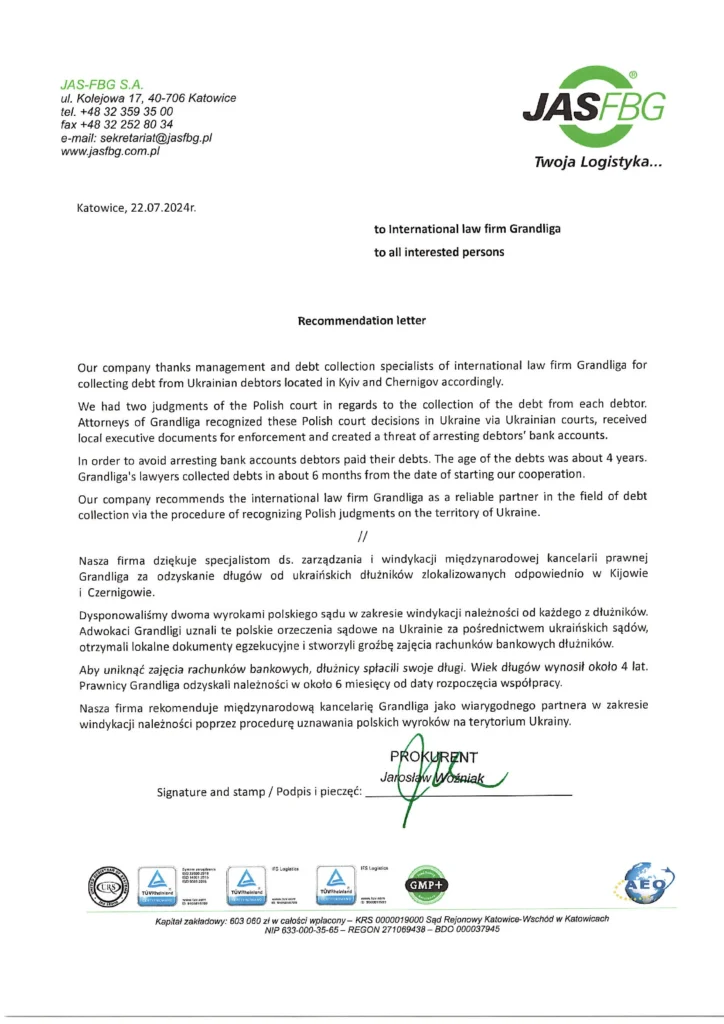
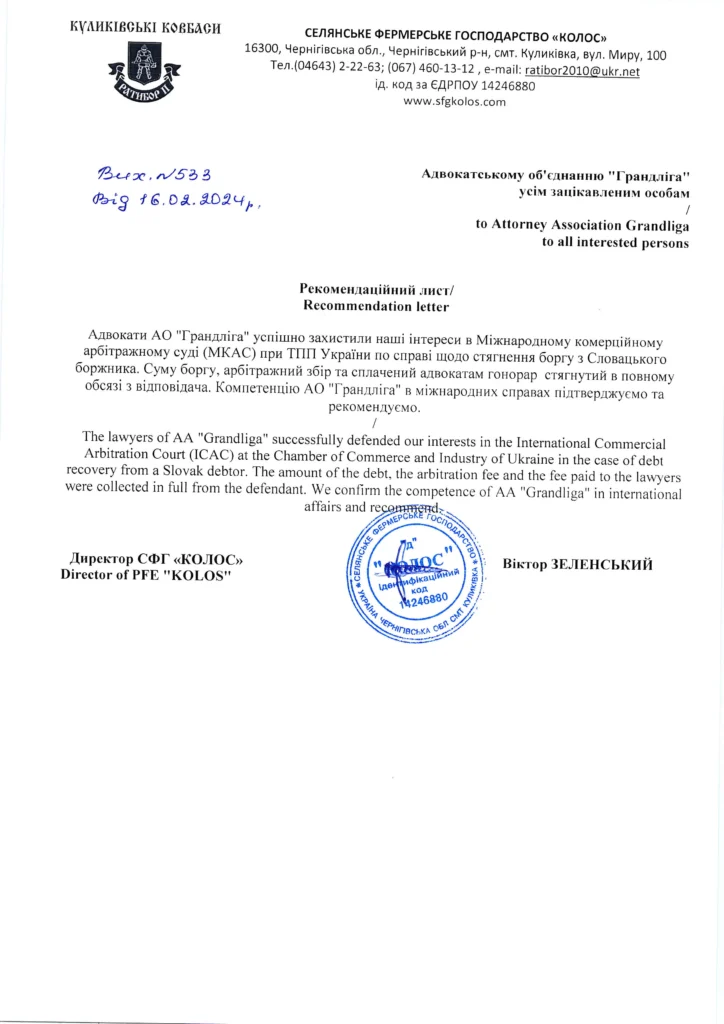
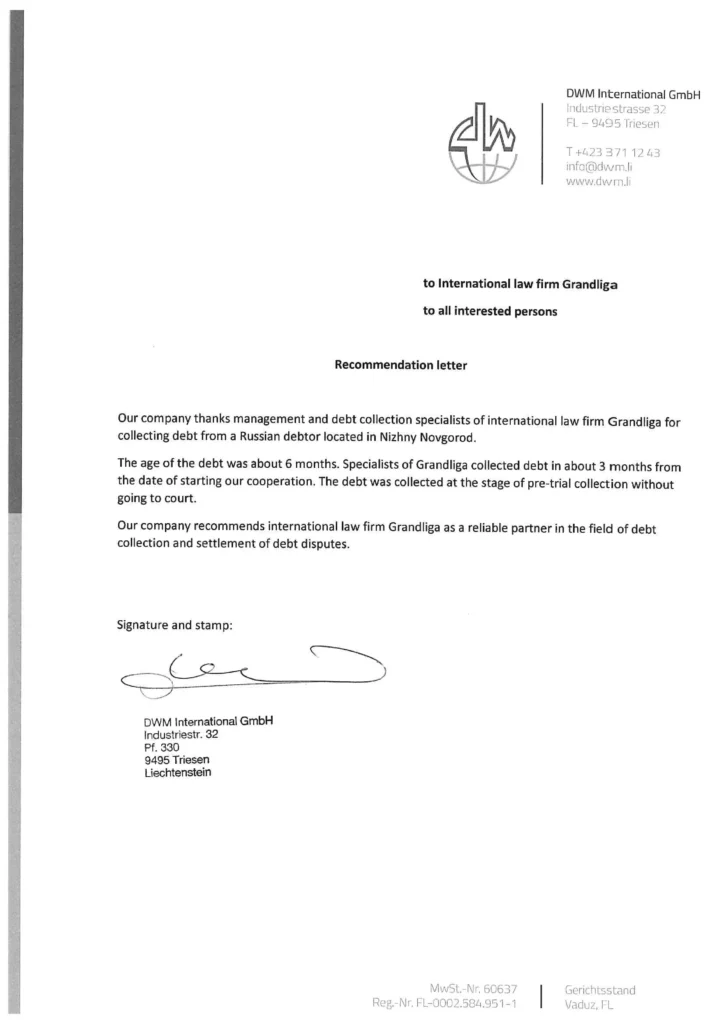
The international law firm Grandliga specializes in handling cases before international arbitration centers, participates in international legal associations and cooperates with arbitration lawyers in different jurisdictions. This allows the client to receive coordinated support for an international dispute in one place, including arbitration case management, applications for interim measures before national courts, recognition and enforcement of the arbitral award in the country where the debtor or assets are located, and practical support at the enforcement stage.
If you have any questions or need assistance in international arbitration, please contact us to discuss your case.
 1380
1380


We will analyze and give recommendations