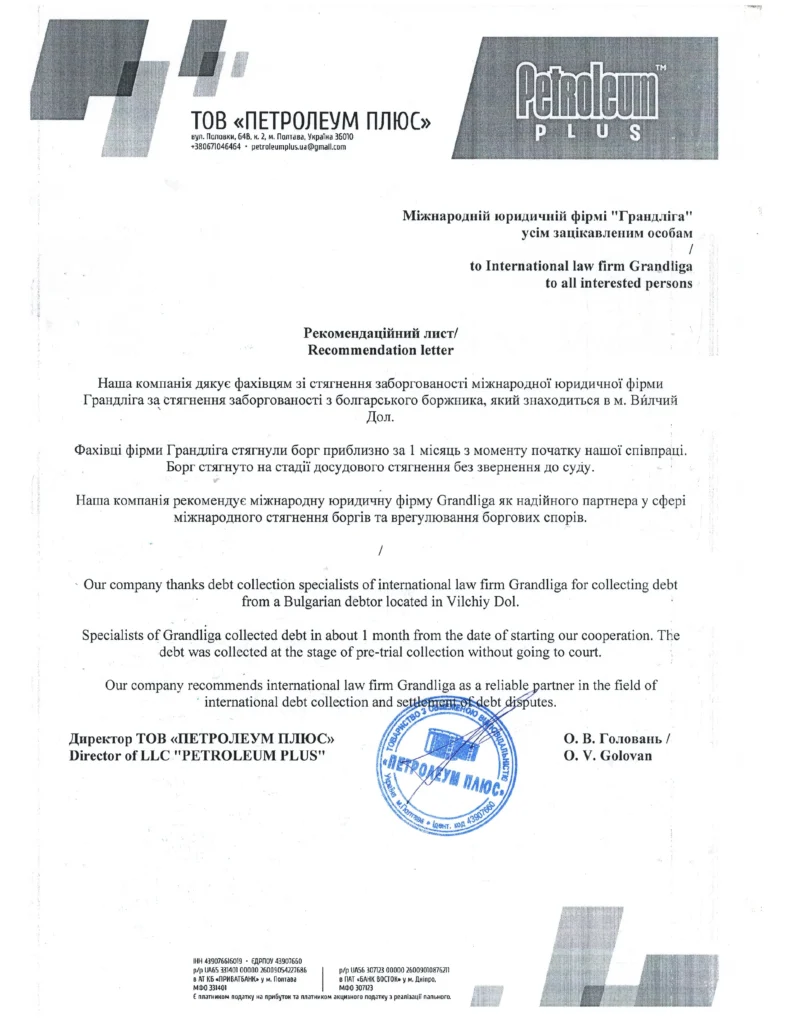

 Bulgaria
Debt collection in Bulgaria should begin with an assessment of the debtor’s legal and financial position: registration or place of business in Bulgaria, financial condition, available assets, funds in bank accounts, real estate, shares in companies, pending court cases, existing enforcement proceedings and documents confirming the debt. This assessment helps determine the appropriate recovery strategy: out-of-court negotiations, national order for payment proceedings, ordinary court proceedings, a European payment order procedure or subsequent enforcement.
If the debtor is not involved in significant court or enforcement proceedings, continues to operate and has identifiable assets or cash flow, it may be reasonable to start with an out-of-court stage. This stage helps verify the debtor’s willingness to pay, collect additional evidence and assess whether the dispute can be resolved without immediately bringing the case before a court.
The out-of-court stage is based on targeted negotiations with the debtor, with the aim of obtaining payment of the debt or reaching another practical settlement, such as payment by instalments, return of goods, delivery of documents, set-off, transfer of the debt to a third party or another agreed solution. At this stage, it is advisable not to rely only on informal reminders, but to record in writing the position taken, the amount claimed, the basis of the debt and the consequences of non-payment.
Communication with the debtor may begin after a written notice or demand letter has been sent by post, email, through representatives, by telephone or through messaging channels, if such communication is appropriate in the specific case. The purpose of this stage is not to apply improper pressure, but to document the creditor’s position, confirm the amount of the debt, identify the persons who can make payment decisions and check whether there is a realistic solution without immediate court proceedings.
The out-of-court stage should be kept within a reasonable time frame. Excessively long negotiations may lead to loss of time, deterioration of the debtor’s financial position or limitation period risks. If the debtor does not respond, disputes the debt without convincing grounds, avoids communication, transfers assets or breaches an agreed payment schedule, it is advisable to consider moving to court recovery or to another procedure suitable for the specific type of claim.
Before initiating court recovery, it is advisable to assess the limitation period. Under Bulgarian law, the general limitation period is five years, unless a special period applies to the specific claim. For certain categories of claims, including interest, rent and other periodic payments, a three-year limitation period applies. Expiry of the limitation period does not automatically extinguish the debt itself, but it may prevent judicial or enforcement protection of the claim if the debtor raises the relevant objection before the court or the bailiff. The limitation period may not be shortened or extended by agreement between the parties.
The limitation period may be suspended or interrupted in cases provided by Bulgarian law. For debt recovery, the most relevant circumstances include acknowledgement of the debt by the debtor, filing a court claim or objection, lodging a claim in insolvency proceedings and taking enforcement actions. After interruption, the limitation period starts to run again. For this reason, evidence of debt acknowledgement, timely filing of a court claim and active monitoring of enforcement proceedings may be important for the creditor.
Court recovery of debt in Bulgaria may be carried out through several procedures: ordinary court proceedings, national order for payment proceedings under the Bulgarian Civil Procedure Code and, in cross-border disputes between parties from European Union states, the European payment order procedure. The choice of procedure depends on the nature of the debt, the available written documents, the likelihood of objections from the debtor, the location of the debtor and assets, and whether the dispute is domestic or cross-border.
An important tool for debt recovery in Bulgaria is the national order for payment procedure. Under Article 410 of the Bulgarian Civil Procedure Code, a creditor may apply for an order for payment for monetary claims that fall within the jurisdiction of the district court. In this procedure, it is not always necessary to attach the full set of evidence at the time of filing, but the application must describe the basis and amount of the claim. If the debtor lodges an objection, the creditor usually has to proceed with ordinary court proceedings to have the claim established.
If the creditor has documents listed in Article 417 of the Bulgarian Civil Procedure Code, such as a notarial deed, an agreement with notarised signatures, a bank document, a promissory note, a mortgage deed or another document provided by law, the creditor may request immediate enforcement and issuance of a writ of execution. This makes document preparation particularly important: the stronger the written evidence, the higher the chance of choosing a faster recovery procedure.
The national order for payment procedure is not suitable for every international situation. An order is not issued if the debtor has no permanent address, habitual residence, registered office or place of business in Bulgaria. Therefore, before choosing this procedure, it is important to establish the debtor’s real connection with Bulgaria and the existence of assets against which enforcement may be directed.
Ordinary court proceedings are appropriate when the claim is disputed, the debtor denies the existence or amount of the debt, the documents require full assessment by the court, or the order for payment procedure is not suitable for the specific case. The statement of claim is filed with the competent Bulgarian court and should set out the facts, the legal basis of the claim, the calculation of the amount due and the supporting documents.
The parties may use voluntary mediation or conclude a court settlement if this allows the dispute to be resolved faster and in an orderly manner. If the settlement covers only part of the claims, the court may continue to examine the remaining part of the case.
The case is considered in a court session with the parties summoned and their positions heard. As a result of consideration of the case, the court makes a decision, which comes into force two weeks after it is served on the party, provided that it is not appealed.
The decision of the appellate court may be challenged before the Supreme Court of Cassation under the conditions provided by procedural law, usually within one month from the date of service of the decision on the party. Procedural rules also allow a request to suspend enforcement of the appealed decision, usually subject to provision of security corresponding to the awarded amount.
Cassation review in Bulgaria is limited by the value of the claim and the category of the dispute. In lower-value cases, a cassation appeal may be inadmissible: as a reference, the thresholds correspond to 2,556.46 euros for civil disputes and 10,225.84 euros for commercial disputes. The decision of the Supreme Court of Cassation is final and is not subject to further appeal.
In cross-border disputes within the European Union, the creditor may use the European payment order procedure if the monetary claim is uncontested and the debtor is located in another European Union state, except Denmark. To start the procedure, the applicant completes a standard form, identifies the parties, the nature and amount of the claim, and submits the application to the competent court. In Bulgaria, the application is filed with the district court based on the debtor’s permanent address, registered office or the place of performance.
After the order is issued, the court serves it on the debtor. The debtor has 30 days to lodge an objection. If an objection is lodged, the case may continue under ordinary civil proceedings, be handled under the European small claims procedure or be discontinued, depending on the creditor’s choice and the applicable rules.
If the debtor does not lodge an objection within the required period, the order becomes enforceable and may be used for recovery in European Union states without a separate recognition procedure, except Denmark. Enforcement is then carried out under the national rules of the state where the debtor or assets are located.
After a court decision, order for payment or another enforceable instrument becomes effective, a writ of execution or another enforceable title must be obtained and a written application filed with a state or private bailiff. The application may specify the preferred method of enforcement, such as attachment of bank accounts, movable property, real estate, company shares, income or other assets of the debtor. After enforcement proceedings are opened, the bailiff sends the debtor a written invitation for voluntary compliance, which must usually be satisfied within two weeks of receipt.
At the enforcement stage, the creditor’s claim may be satisfied by attaching the debtor’s bank accounts and collecting available funds, attaching and selling movable property or real estate, enforcing against company shares, securities and other assets that may legally be subject to enforcement. A private bailiff, acting on the creditor’s instruction, may examine the debtor’s property status, search registers, obtain documents and choose enforcement measures. Precautionary and enforcement measures must be proportionate to the amount of the debt.
If enforcement proceedings do not result in payment and the debtor company shows signs of insolvency or over-indebtedness, the creditor may consider initiating insolvency proceedings. In Bulgaria, commercial insolvency applies to traders, including companies and sole traders, where the conditions provided by law are met. For the creditor, this procedure may be useful when individual enforcement is ineffective, but the debtor still has assets, suspicious transactions or signs of asset transfers.
In insolvency proceedings, the conduct of the debtor’s management before the opening of the procedure may be important. If the company is insolvent or over-indebted, the duty to file an insolvency application in due time may affect the liability of the persons managing the debtor. Transactions completed before the opening of insolvency proceedings may also be examined if they harmed creditors, reduced the available estate, created unjustified advantages for certain persons or diminished the assets available for creditor satisfaction.
Transactions that may be relevant for the creditor include gratuitous transactions, transactions with related persons, transactions on clearly disadvantageous terms, provision of security to selected creditors and other actions that may have reduced the debtor’s assets or violated equal treatment of creditors. If the debtor is an individual, it is also important to consider that since 2025 Bulgaria has had a separate legal framework for insolvency of individuals. That procedure is designed for insolvent debtors acting in good faith and is initiated by the debtor, not as an ordinary pressure tool used by a creditor.
The criminal law aspect of non-payment of debt in Bulgaria may be relevant only when the conditions provided by Article 293a of the Bulgarian Criminal Code are met. This is not a standard method of putting pressure on the debtor, but a situation where a person has already been ordered by a final court act to perform a monetary obligation, fails to do so for one year after the act enters into force, and at the same time has money or assets that could be used to satisfy the debt.
For this conduct, Article 293a of the Bulgarian Criminal Code provides for imprisonment for up to one year or probation. This mechanism should therefore be viewed as an exceptional legal tool connected with non-compliance with a final court act, not as a substitute for civil proceedings or enforcement.
If you need to recover a debt in Bulgaria, it is important to assess the documents, limitation period, debtor’s status, available assets, the possibility of using order for payment proceedings, and the prospects of court and enforcement recovery in advance. Grandliga assists creditors with international debt collection, helps determine a practical strategy, prepare documents, coordinate communication with local specialists and choose the procedure that corresponds to the nature of the claim and the debtor’s position.