


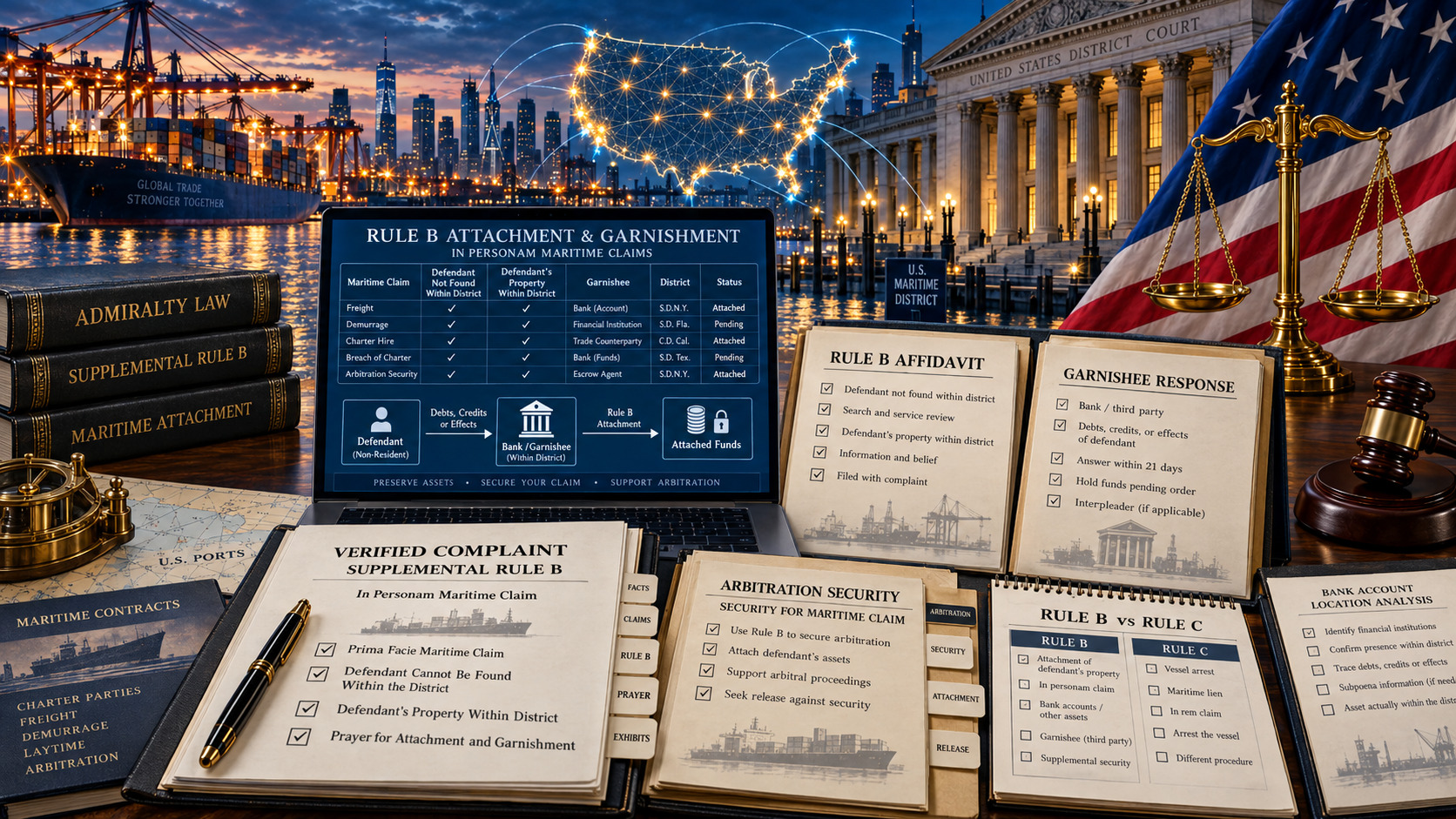
A foreign charterer fails to pay freight, hire or demurrage under a maritime contract. The creditor expects the dispute to be decided in arbitration outside the federal district where the debtor’s property is located. The debtor itself has no office or readily available presence there, but it may have money in a local bank account or other property within the district.
Can the creditor attach those assets before obtaining a final judgment or arbitral award?
In some cases, yes.
Supplemental Rule B of the Federal Rules of Civil Procedure provides a distinctive maritime remedy known as attachment and garnishment. It allows a plaintiff with an in personam maritime claim to attach tangible or intangible personal property belonging to a defendant that cannot be found within the district, subject to the requirements of Rules B and E.
Unlike an arrest under Rule C, the procedure is not based on a maritime lien against the property itself. The target is property belonging to the defendant, and the attachment operates as part of a claim against that defendant.
For international maritime creditors, that difference can make Rule B particularly important where the debtor is abroad but identifiable assets are located in the United States.
Rule B is available only for a maritime claim
The starting point is the underlying claim.
Rule B is part of the Supplemental Rules for Admiralty or Maritime Claims. It is not a general prejudgment asset-freezing procedure for ordinary commercial debts.
The plaintiff must have a legally sufficient maritime or admiralty claim against the defendant.
Typical examples may include disputes arising from:
- charterparties;
- unpaid freight;
- demurrage;
- vessel hire;
- maritime transportation contracts;
- certain vessel services;
- marine construction or offshore contracts when the claim falls within admiralty jurisdiction;
- other contractual or maritime obligations within federal admiralty jurisdiction.
Whether a particular contract is maritime can itself become disputed.
That question should be resolved before relying on Rule B because the attachment can be challenged quickly after it is executed, and the creditor will then have to justify the maritime basis of its claim.
Four questions usually determine whether attachment can survive
Federal courts commonly analyze Rule B attachment through four core requirements.
The creditor generally must be able to show that:
- it has a valid prima facie admiralty claim against the defendant;
- the defendant cannot be found within the district;
- property belonging to the defendant can be found within the district;
- no statutory or general maritime law rule prohibits the attachment.
These requirements make Rule B much narrower than a general request to freeze assets.
It is not enough to identify a foreign debtor and a bank operating somewhere in the United States.
The creditor must connect the maritime claim, the defendant and the specific property to the requirements of the Rule.
“Not found within the district” is a separate legal requirement
One of the most important conditions is that the defendant cannot be found within the district when the verified complaint requesting attachment and the Rule B affidavit are filed.
Rule B requires the plaintiff or its attorney to file an affidavit stating that, to the best of the affiant’s knowledge or based on information and belief, the defendant cannot be found within the district.
The Rule itself does not provide a single nationwide definition of when a defendant is “found” there.
Courts have developed the concept through case law, and local admiralty rules can impose additional requirements concerning the efforts that must be made to locate and serve the defendant.
Questions may include whether the defendant is subject to personal jurisdiction in the relevant district and whether it can actually be served there.
The analysis can therefore depend on the district, the defendant’s business activities, its agents, the applicable service rules and current jurisdiction law.
A creditor should not assume that a company is absent from the district merely because it is incorporated abroad.
The issue should be investigated before filing because the relevant point in time is when the verified complaint seeking attachment and the required affidavit are filed.
Rule B attaches the defendant’s property, not just any related asset
A second critical issue is ownership.
Rule B permits attachment of the defendant’s tangible or intangible personal property, up to the amount sued for.
This can potentially include different types of property, but the creditor must establish that the property actually belongs to the defendant.
That becomes especially important in international corporate groups.
The fact that a parent company, subsidiary, affiliate, shareholder or related vessel-owning entity is connected with the debtor does not automatically make that entity’s property available to satisfy the debtor’s obligation.
If the creditor attempts to attach an affiliate’s property on an alter-ego or veil-piercing theory, it must have a sufficiently supported legal basis for treating the property as attributable to the defendant.
The Ninth Circuit’s 2024 decision in Sikousis Legacy, Inc. v. B-Gas Limited illustrates the risk. Creditors holding arbitration awards attempted to attach a vessel owned by a different corporate entity on an alter-ego theory. The attachment was vacated after the creditors failed to make the required showing that the vessel owner could properly be treated as liable for the debtor’s obligations.
The practical lesson is simple: asset tracing and legal ownership analysis must come before the attachment application, not after it.
The property must actually be within the relevant district
Rule B is geographically specific.
Rule E provides that maritime attachment and garnishment process may be served only within the district.
This means that identifying a garnishee with a presence in the district is not necessarily enough. The property that the creditor seeks to attach must also satisfy the applicable requirement of being located within the court’s geographical jurisdiction.
This issue has become particularly important for bank accounts.
Modern banking makes the location of intangible funds much less obvious than the location of physical property.
A foreign bank may operate an agency or office in a U.S. city while the debtor’s actual account is maintained abroad and cannot be accessed through the U.S. office.
In that situation, the existence of the bank’s U.S. presence does not necessarily mean that the foreign account is attachable.
Ultra Deep Picasso: a bank’s U.S. office was not enough
The Fifth Circuit addressed this problem directly in Ultra Deep Picasso Pte. Ltd. v. Dynamic Industries Saudi Arabia Ltd. in 2024.
Ultra Deep alleged that it had performed more than $10 million of subsea diving support work and had not been paid. It sought Rule B attachment in the Southern District of Texas of funds allegedly held for the defendant by Riyad Bank.
Riyad Bank had an agency in Houston.
But the Houston agency did not hold deposits, allow customers to withdraw funds or have access to the defendant’s Saudi accounts.
The creditor argued that the bank’s presence in Houston should be enough to permit attachment.
The Fifth Circuit rejected that position.
It held that Rule B requires the property itself to be found within the district, in addition to the court having the necessary jurisdiction over the garnishee.
Applying Texas law to the situs of the bank account, the court accepted the principle that an account may be considered located where its funds are available for withdrawal by the depositor.
Because the creditor failed to show that the defendant could access its Saudi funds through the Houston agency, the attachment was vacated.
For a creditor investigating a possible Rule B filing, this creates an important practical question:
Where is the debtor’s money legally located for attachment purposes, not merely where does the bank have an office?
New York intermediary transfers are another important trap
New York once became a major venue for maritime attachments because U.S.-dollar electronic transfers frequently passed through intermediary banks in Manhattan.
That practice changed significantly after the Second Circuit’s decision in Shipping Corp. of India Ltd. v. Jaldhi Overseas Pte Ltd.
The court held that an electronic funds transfer temporarily passing through an intermediary bank in New York is not property of the originator or beneficiary for purposes of a Rule B attachment under New York law.
As a result, a creditor should not assume that an international payment can be attached merely because a dollar transfer happens to pass through a New York intermediary bank.
The distinction is important.
A debtor’s actual deposit account may present one legal question. A payment temporarily moving through an intermediary bank may present a very different one.
Before naming a bank as garnishee, the creditor should therefore identify the nature of the asset, the account relationship and the law governing the location and ownership of the funds.
Rule B can secure a maritime arbitration claim
Rule B can be particularly valuable where the underlying maritime dispute is subject to arbitration.
The attachment does not necessarily mean that the federal district court will decide the merits of the contract dispute itself.
Instead, the property may provide security while the substantive claim proceeds in the agreed arbitral forum.
A recent example is Bunge S.A. v. XCoal Energy and Resources, decided by the U.S. District Court for the Southern District of Texas in May 2025.
The dispute arose from a maritime sub-charter involving approximately 80,000 metric tons of coal transported from Virginia to China.
The contract provided for arbitration in New York.
Bunge nevertheless sought Rule B attachment of XCoal’s accounts at PNC Bank in Texas as security for its arbitration claim.
The court had issued the attachment, and XCoal later sought to vacate it.
After examining the maritime nature of the claim and the evidence presented at the Rule E hearing, the court allowed the attachment to remain, although it reduced the amount of security to approximately $2.09 million.
The case demonstrates an important function of Rule B: the attachment can secure a maritime claim even when the merits will ultimately be resolved in arbitration elsewhere.
That possibility can be particularly significant in international transactions where the contractual forum and the debtor’s assets are located in different places.
A verified complaint and affidavit come before the attachment
Rule B contains its own filing requirements.
The plaintiff seeking attachment must file a verified complaint requesting the remedy.
The plaintiff or its attorney must also sign and file an affidavit stating that the defendant cannot be found within the district.
The court reviews the complaint and affidavit before ordinary process of attachment and garnishment is authorized.
If the Rule B conditions appear to exist, the court enters an order authorizing the process.
This judicial review is important because Rule B may operate before the defendant has had an opportunity to contest the claim.
There is a narrow exception for exigent circumstances when prior judicial review is impracticable. In that situation, the plaintiff or its attorney may make the certification required by Rule B, but the plaintiff will later bear the burden of showing at a Rule E(4)(f) hearing that genuine exigent circumstances existed.
The exception should therefore not be treated as a routine method of obtaining faster attachment.
Garnishment places the third party holding the asset into the procedure
Rule B is not limited to direct seizure of physical property.
It expressly permits attachment of tangible or intangible personal property in the hands of a garnishee.
A bank is a common example, but a garnishee may also be another person or entity that owes a debt to the defendant or holds qualifying property belonging to it.
Once process is served, Rule B requires the garnishee to answer within 21 days and disclose relevant debts, credits or effects of the defendant in its hands, including responses to properly served interrogatories.
If the garnishee admits holding property or owing funds to the defendant, those assets are generally held subject to further order of the court or may be paid into the court registry.
The defendant must generally serve its answer within 30 days after execution of process by attachment or service on the garnishee.
This makes identification of the correct garnishee a central part of Rule B strategy.
A creditor needs more than a list of banks or commercial counterparties. It needs a defensible basis for believing that a particular garnishee actually holds attachable property of the defendant within the relevant district.
The debtor can demand a prompt hearing
Rule B attachment is not a final determination that the creditor is entitled to the property.
Rule E(4)(f) gives a person claiming an interest in attached property the right to a prompt hearing.
At that stage, the creditor bears the burden of showing why the attachment should not be vacated or other relief granted.
The debtor may challenge issues such as:
- whether the underlying claim is genuinely maritime;
- whether the defendant could in fact be found within the district;
- whether the attached property belongs to the defendant;
- whether the property was actually located within the district;
- whether service and attachment complied with Rules B and E;
- whether the amount of security is excessive;
- whether another statutory or maritime rule prevents attachment.
The precise evidentiary standard applied at a Rule E hearing can vary by circuit.
For example, the Ninth Circuit held in Sikousis Legacy that a creditor defending a challenged prejudgment maritime attachment must demonstrate probable cause — a reasonable probability of success on the relevant claim, though not proof by a preponderance of the evidence.
The important practical point is that a creditor should expect a Rule E challenge and prepare the evidentiary record before filing.
Security can replace the attached property
A Rule B attachment is often intended to secure the creditor rather than permanently immobilize a particular asset.
Rule E(5) permits attached property to be released when acceptable security is provided.
The parties may agree on the amount and nature of the security. If they cannot agree, the court may determine it.
The amount is designed to cover the plaintiff’s fairly stated claim together with accrued interest and costs, subject to the limits in Rule E.
This can change the commercial dynamics of the dispute.
Once property has been attached, the defendant may prefer to provide a bond, letter of undertaking or other acceptable security so that its account, vessel or other property can be released.
For an international creditor, obtaining reliable security may be more valuable than continuing to hold the original asset throughout the underlying litigation or arbitration.
Rule B is not the same as arresting a vessel under Rule C
Rule B and Rule C solve different problems.
Rule B is based on an in personam maritime claim against the defendant and allows qualifying property belonging to that defendant to be attached when the Rule’s conditions are met.
Rule C is an in rem proceeding against maritime property itself, commonly a vessel, and typically requires a substantive basis such as a maritime lien.
A creditor may therefore have a valid maritime contract claim against a shipping company without having any right to proceed against a particular vessel under Rule C.
In that situation, Rule B may still be relevant if the defendant cannot be found within the district and its own property is located there.
Conversely, where the creditor has a maritime lien enforceable against the vessel itself, the analysis concerns vessel arrest under Supplemental Rule C rather than attachment of the debtor’s unrelated assets.
The distinction should be made before the creditor chooses the procedure and the property to target.
What should be investigated before filing a Rule B application?
The most useful Rule B work usually takes place before the complaint is filed.
A foreign maritime creditor should normally establish:
- the legal basis and maritime nature of the underlying claim;
- the exact identity of the contractual debtor;
- whether that defendant can be found within the proposed federal district;
- what investigation has been carried out to locate and serve the defendant;
- the specific property proposed for attachment;
- evidence that the property belongs to the defendant;
- the legal situs of that property;
- the identity of the garnishee actually holding or owing the property;
- whether funds in a bank account can be accessed within the relevant district;
- whether any affiliate or alter-ego theory is genuinely supportable;
- the amount of the claim and the appropriate amount of security;
- applicable local admiralty rules;
- whether the underlying contract contains an arbitration or forum clause;
- the evidence needed to defend the attachment at an immediate Rule E hearing.
For bank assets, the investigation should go beyond identifying the name of the financial institution.
The creditor should determine where the relevant account is maintained, whether the debtor can withdraw the funds through the branch or office located in the district, whether the institution actually holds the defendant’s property there and what forum-state law says about the situs of the account.
Rule B is a security tool, not a general worldwide asset freeze
Rule B can be powerful because it allows a maritime creditor to act against property before obtaining a final determination of the claim.
But its reach is specific.
The creditor needs a maritime claim, a defendant that cannot be found within the district, property belonging to that defendant within the district and compliance with the detailed procedural requirements of the Supplemental Rules.
A foreign creditor should not assume that every U.S. bank presence, every asset of a corporate affiliate or every dollar payment moving through the American financial system can be attached.
Modern decisions such as Ultra Deep Picasso show that courts examine where the property is actually located, while cases such as Bunge v. XCoal demonstrate how a properly supported Rule B attachment can provide meaningful security for an international maritime arbitration.
For broader questions involving litigation, judgment recognition and enforcement against debtors in the United States, see Grandliga’s guide to debt collection in the USA.
Where a maritime debtor is abroad but its own identifiable assets may be present in a U.S. federal district, the priority is to investigate the property and the defendant’s presence before filing. In Rule B cases, getting those two factual questions right can determine whether the attachment survives the first challenge.


