

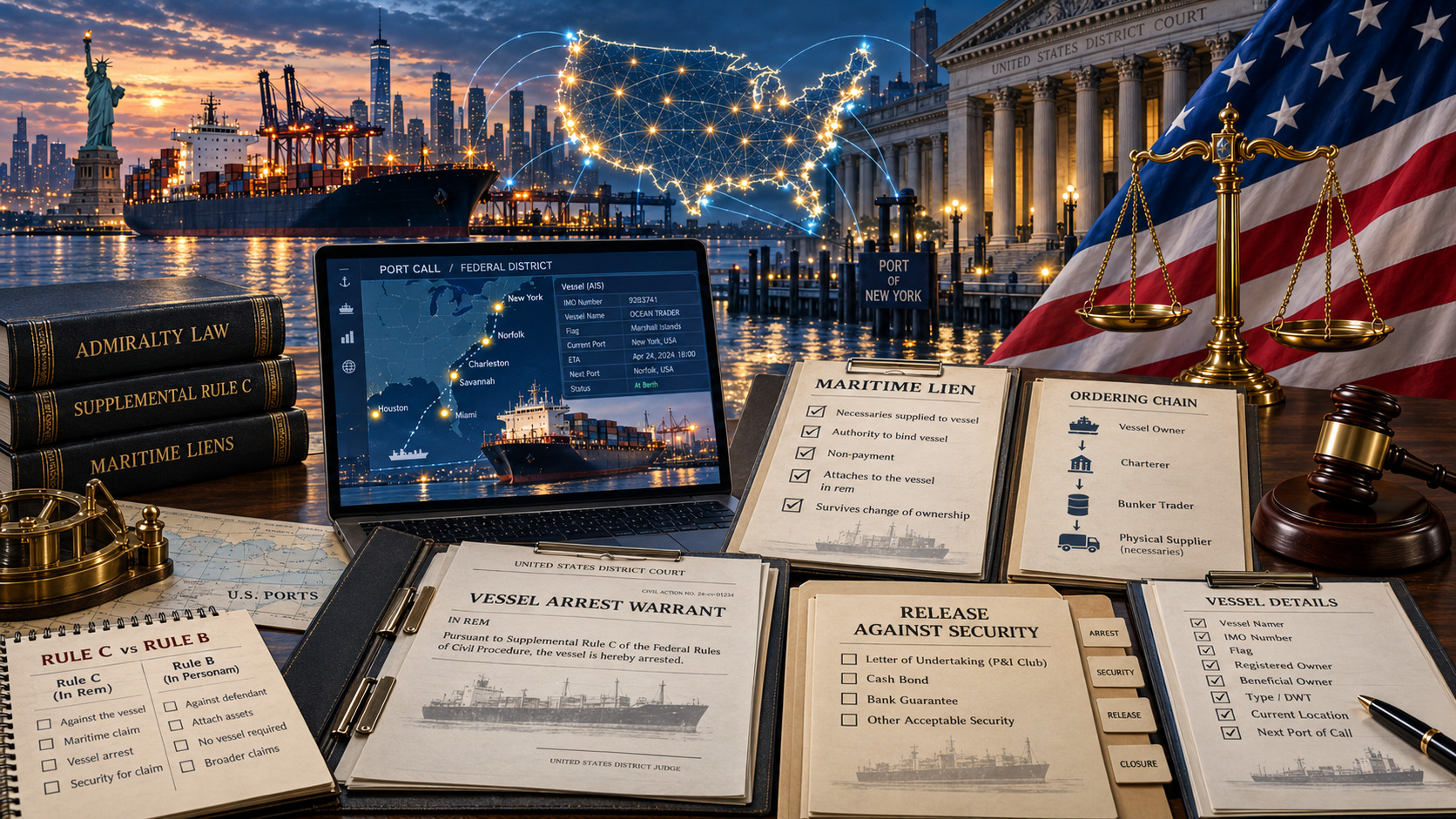
A foreign supplier delivers bunker fuel to a vessel outside the United States. The invoice remains unpaid. Months later, the same vessel is expected to call at a U.S. port.
Can the supplier bring a claim against the vessel itself and have it arrested before it sails again?
Potentially, yes — but an unpaid maritime invoice alone is not enough.
Supplemental Rule C of the Federal Rules of Civil Procedure provides the procedural mechanism for an action in rem against a vessel or other maritime property. In a typical creditor case, however, the creditor must first establish that substantive maritime law gives it a valid maritime lien against the vessel.
That distinction is critical. Rule C tells a creditor how an in rem arrest may be carried out. It does not itself create the lien that makes the arrest legally available.
Why a creditor can sometimes proceed against the vessel itself
Ordinary debt litigation is generally directed against the person or company that owes the money.
An admiralty action in rem is different. Where a valid maritime lien exists, the proceeding may be brought against the vessel itself as the property subject to that lien.
Supplemental Rule C(1) permits an action in rem to enforce a maritime lien and in other situations where a federal statute expressly provides for a maritime action in rem.
For an international creditor, this can create a powerful enforcement opportunity. A debtor may be incorporated abroad, difficult to serve or financially weak, while the vessel connected with the maritime obligation may enter a U.S. federal judicial district where an arrest can be executed.
This does not mean that every debt connected with shipping follows the vessel.
The first question is therefore not simply whether money is owed. It is whether the claim gives rise to a maritime lien enforceable against that particular vessel.
Supplying “necessaries” can create a maritime lien
One important statutory basis is the Commercial Instruments and Maritime Liens Act.
Under 46 U.S.C. § 31342, a person providing necessaries to a vessel on the order of the owner or a person authorized by the owner may have a maritime lien on the vessel and may bring a civil action in rem to enforce it.
The statutory term “necessaries” is broader than emergency supplies. Under 46 U.S.C. § 31301, it includes repairs, supplies, towage and use of a dry dock or marine railway, and the list is not intended to be exhaustive.
Depending on the circumstances, commercially necessary goods and services supplied to the operation of a vessel may therefore fall within the concept.
But three issues should be separated:
- whether the goods or services qualify as necessaries;
- whether they were provided to the particular vessel;
- whether they were ordered by the owner or by a person with sufficient authority to bind the vessel.
The third issue is often where apparently straightforward claims become difficult.
Who ordered the goods or services may decide whether the lien exists
Section 31341 identifies persons presumed to have authority to procure necessaries for a vessel. They include the owner, the master, a person entrusted with management of the vessel at the port of supply, and certain officers or agents appointed by an owner, charterer, owner pro hac vice or agreed buyer in possession.
Modern shipping transactions, however, frequently involve several contractual layers.
A vessel owner may charter the vessel. The charterer may use a bunker trader. That trader may contract with another intermediary, which in turn engages the physical supplier.
The company physically delivering the fuel may therefore be several contracts removed from the vessel owner.
This matters because physical delivery to the ship does not automatically establish a maritime lien.
In Valero Marketing & Supply Co. v. M/V Almi Sun, the U.S. Court of Appeals for the Fifth Circuit considered a bunker supplier that had physically supplied fuel to the vessel but had contracted through an intermediary. The court concluded that the supplier had not shown that the necessaries were provided on the order of the owner or a person authorized by the owner and therefore did not have the claimed maritime lien.
The practical lesson is important: delivery receipts alone may not prove the right to arrest the vessel.
Before relying on Rule C, a creditor should reconstruct the complete ordering chain and determine who selected the supplier, who gave instructions, who acted for the charterer or owner, and what evidence exists of actual, apparent or statutorily presumed authority.
A 2026 case shows how an international supply claim can reach a U.S. vessel arrest
The Fifth Circuit revisited these issues in Three Fifty Markets, Ltd. v. M/V Argos M in February 2026.
The dispute was international at almost every level. The vessel was Liberian-flagged, the supplier was based in the United Kingdom, entities connected with the bunker purchase included companies in Germany and the United Arab Emirates, and the fuel was supplied in Las Palmas, Spain.
The invoice was not paid.
The vessel was subsequently arrested in the Port of New Orleans after the supplier filed an in rem action in the Eastern District of Louisiana.
The shipowner challenged the maritime lien, including the authority of the entity involved in ordering the bunkers and the applicable law. After examining the contractual and agency relationships, the Fifth Circuit affirmed the judgment recognizing the supplier’s maritime lien.
The case does not establish that every foreign bunker supplier can arrest a vessel in the United States. It demonstrates something more useful: a transaction may be overwhelmingly international and still produce a U.S. Rule C proceeding if the vessel comes within the relevant federal district and the creditor can establish the substantive legal basis for the lien.
It also shows why contract terms, agency evidence and choice of law should be examined before the vessel arrives.
A no-lien clause should not be ignored
Charterparties may contain provisions intended to prevent a charterer from creating liens against the vessel.
The existence of such a clause does not by itself answer every lien dispute.
Questions may arise as to who was authorized to purchase the necessaries, whether the supplier knew about restrictions on that authority, what law governs the relevant contractual relationship and how the particular federal circuit treats the evidence.
In Three Fifty Markets, for example, the charter contained no-lien provisions, but the Fifth Circuit nevertheless upheld the lien on the facts before it. The court examined apparent authority, the parties’ conduct and the legal effect of the contractual arrangements rather than treating the presence of a no-lien clause as automatically decisive.
For a creditor, this means that the underlying documents should be collected before any arrest application is prepared. Relevant evidence may include the charterparty, bunker confirmations, purchase orders, emails, broker communications, delivery receipts, invoices, terms and conditions, notices issued by the vessel or owner, and evidence showing who actually authorized the transaction.
Rule C requires the vessel to be within the federal district
A valid lien is only part of the analysis.
Rule C(2) requires the verified complaint to describe the property with reasonable particularity and state that it is within the district or will be within the district while the action is pending.
Rule E adds an important territorial limitation: admiralty process in rem may be served only within the district.
This makes vessel tracking and timing operationally important.
A creditor that learns that a vessel may call at Houston, New Orleans, Miami, New York or another U.S. port must identify the relevant federal judicial district and determine whether there is enough time to prepare the verified complaint, supporting evidence, proposed arrest papers and the arrangements required for execution of the warrant.
A port call may be short. If the vessel leaves the district before process is executed, the immediate arrest opportunity may disappear.
Local admiralty rules must also be checked. Federal Rule C provides the national framework, but individual district courts may impose additional requirements concerning proposed orders, Marshal deposits, substitute custodians, notices, documentation and other operational steps.
How the warrant for arrest is issued
Rule C does not normally allow a creditor simply to instruct the U.S. Marshal to seize a vessel.
The court must first review the verified complaint and supporting papers.
If the conditions for an in rem action appear to exist, the court directs the clerk to issue a warrant for arrest of the vessel or other property.
For a vessel, the warrant and supplemental process are delivered to the U.S. Marshal for service.
There is a narrow procedure for exigent circumstances where prior judicial review is impracticable. In that situation, the plaintiff or its attorney may make the certification required by Rule C, but the creditor then carries the burden of proving at a post-arrest hearing that the exigent circumstances actually existed.
This exception should not be treated as an ordinary shortcut.
The normal strategy is to prepare the case before the vessel arrives so the court can review the papers and the arrest can be coordinated lawfully and efficiently.
Arrest does not determine that the creditor has won
The arrest places the vessel under the control of the court, but it does not finally determine the validity or amount of the creditor’s claim.
Rule E(4)(f) gives a person claiming an interest in arrested property the right to a prompt hearing.
At that hearing, the plaintiff must show why the arrest should not be vacated or why other relief should not be granted.
The vessel owner may challenge issues such as:
- whether a valid maritime lien exists;
- whether the plaintiff is the proper lienholder;
- whether the person ordering the necessaries had sufficient authority;
- whether the goods or services were actually provided to the vessel;
- whether the correct substantive law applies;
- whether the complaint and arrest procedure complied with the federal and local rules;
- whether the amount claimed is properly supported.
This is why a creditor should be ready to prove the lien immediately, not merely after months of ordinary litigation.
The vessel can often be released against security
Commercial vessels usually generate revenue by trading, not by remaining under arrest.
For this reason, an arrest often creates an immediate dispute over security.
Under Rule E(5), arrested property may be released when approved security is provided or when the parties agree on a stipulation or other acceptable security.
If the parties cannot agree on the amount, the court may fix security sufficient to cover the fairly stated claim together with accrued interest and costs. The federal rule also places a ceiling on the principal amount of the bond: it may not exceed the lesser of twice the plaintiff’s claim or the appraised value of the property.
The practical result is that the vessel itself does not necessarily remain detained until final judgment.
A shipowner or its insurer may arrange security, the vessel may be released, and the litigation can continue with the security effectively standing in place of the arrested property.
For a creditor, obtaining adequate security may therefore be one of the most commercially significant consequences of a properly founded Rule C arrest.
There are strict steps after an arrest
Rule C also establishes deadlines for the parties claiming possession or ownership of the arrested property.
A person asserting a right of possession or ownership generally must file a verified statement of interest or right within 14 days after execution of process unless the court allows a different period. The answer generally follows within 21 days after that statement is filed.
If the property has not been released within 14 days after execution, Rule C also requires public notice of the action and arrest, subject to the detailed conditions of the rule and any directions of the court.
These deadlines are part of a procedure designed to move quickly because an arrested commercial vessel can generate substantial custody costs and operational losses.
Rule C is different from Rule B maritime attachment
Rule C should not be confused with Supplemental Rule B.
Rule C is an in rem mechanism directed against the vessel or other property that is itself subject to a maritime lien or another qualifying statutory in rem claim.
Rule B addresses a different situation: an in personam maritime claim against a defendant where the conditions for maritime attachment and garnishment of the defendant’s property are satisfied.
The distinction becomes important where a creditor has a maritime claim against a company but cannot establish a maritime lien against the vessel itself. The existence of a debt does not allow the creditor to convert an ordinary claim against the debtor into a Rule C action simply because a vessel is commercially connected with the transaction.
For a detailed explanation of this different mechanism, see Rule B maritime attachment in the U.S., including its legal basis, target property and procedural conditions.
What a foreign creditor should check before the vessel reaches the U.S.
A Rule C strategy is highly dependent on preparation and timing.
Before seeking an arrest, an international creditor should normally identify:
- the exact vessel, including its IMO number and ownership details;
- the legal basis on which the claimed maritime lien arose;
- the complete contractual and ordering chain;
- who had authority to procure the relevant goods or services;
- invoices, delivery documents and evidence of non-payment;
- applicable terms and conditions and any choice-of-law provision;
- charterparty provisions or no-lien notices that may affect the claim;
- the vessel’s expected U.S. port and federal judicial district;
- any known mortgages, prior liens or competing claims;
- the likely amount of Marshal, custody and security expenses;
- the realistic value of the claim compared with the vessel’s value and competing priorities.
Choice of law deserves particular attention in international cases.
A creditor should not assume that the legal treatment of a maritime lien will be identical merely because the vessel can physically be arrested in the United States. The governing law, contractual structure and federal maritime choice-of-law principles may materially affect whether the asserted lien exists.
Vessel arrest is a targeted remedy, not ordinary debt enforcement
Rule C can create substantial leverage because the proceeding is directed against maritime property itself and can require the owner to provide security before the vessel is released.
But it is not a general method for collecting any unpaid shipping invoice.
The creditor needs a legally enforceable in rem claim, must identify the correct vessel, establish the underlying lien, act in the federal district where the vessel is or will be located, and be prepared for an immediate challenge after arrest.
For creditors dealing with wider U.S. recovery issues, recognition of judgments, ordinary litigation and post-judgment enforcement are separate mechanisms discussed in Grandliga’s guide to debt collection in the USA.
Where the claim is genuinely maritime and a vessel carrying the lien is expected to enter a U.S. port, however, the Rule C analysis should be performed before the port call rather than after the vessel has sailed. In practice, the ability to prove the lien and prepare the arrest documents in advance can determine whether the creditor has a usable enforcement opportunity at all.


