Let's discuss your case
We will analyze and give recommendations

Debt collection in Guinea-Bissau begins with an assessment of the claim, the creditor’s documents and the debtor’s actual position. At this stage, it is important to verify the basis of the debt, the contract, invoices, delivery or service documents, business correspondence, any acknowledgment of debt, the debtor’s correct identity, its real business activity, existing court cases, enforcement proceedings and facts that may be used to dispute the claim.
For a foreign creditor, the initial analysis should also establish the connection between the claim and Guinea-Bissau. This connection may arise from the debtor’s registered office, assets or accounts in the country, performance of the contract in Guinea-Bissau, a local representative, a local business establishment or another basis for using a local recovery procedure. It is also important to determine whether the debtor is a private company, an individual, a public entity or a business structure holding assets in more than one jurisdiction, because this affects negotiations, court strategy and later enforcement.
If the debtor continues to operate, responds to the creditor’s communications and there are no immediate signs of insolvency or asset dissipation, the creditor may use out-of-court debt collection. This stage helps clarify the debtor’s position, fix the amount owed in writing, obtain a payment proposal, identify possible objections and prepare the evidence base for court proceedings.
Negotiations may cover full payment, a payment plan, return of goods, set-off, assumption of the debt by a third party, provision of security, signing of an acknowledgment of debt or another lawful settlement option consistent with the nature of the obligation. The practical value of this stage increases when the debtor’s replies, payment promises, objections and submitted documents are preserved in written form.
Communication with the debtor should begin after a formal notice or demand is sent by a method that proves its content, date and recipient. The duration of the out-of-court stage depends on the quality of the documents, the debtor’s conduct, the existence of identifiable assets, the complexity of the commercial relationship and the realistic prospect of voluntary payment. If negotiations do not lead to payment or the initial review shows that voluntary settlement is not suitable, the creditor should proceed to judicial recovery.
The Republic of Guinea-Bissau is a member of OHADA, so the recovery of commercial debts in the country is governed not only by national law but also by uniform rules applicable in the member states of this legal system. For a creditor, this has practical importance when choosing the procedure: a documented commercial claim may follow a different recovery route from a broad civil dispute requiring detailed examination of evidence.
When preparing a case, judicial debt collection in Guinea-Bissau may involve the Civil Code, the Civil Procedure Code and uniform business law rules at the same time. Before filing a claim, the creditor should classify the debt, determine whether it is commercial or civil in nature, check the documents, the maturity of the obligation, any acknowledgment of debt, the debtor’s possible objections and the procedure most suitable for recovery.
Before bringing court proceedings, the creditor must verify the limitation period. The ordinary limitation period under the national law of Guinea-Bissau is 20 years. For commercial obligations governed by the uniform rules of general commercial law, claims arising from trade transactions between merchants, or between a merchant and a non-merchant, generally expire after five years unless a shorter special period applies.
The effects of limitation apply when they are invoked by the party benefiting from them. An acknowledgment of debt by the debtor may interrupt the limitation period and start a new period. Contractual modification of the limitation period should be assessed according to the nature of the obligation: for commercial obligations under the uniform business law system, the period may be adjusted within statutory limits, but not below one year and not above ten years; statutory limitation periods under national civil law should not be presented as freely modifiable by agreement where the law treats them as mandatory.
Judicial debt collection in Guinea-Bissau may be carried out through ordinary court proceedings or through an order for payment procedure. The choice depends on the nature of the claim, the completeness of the documents, the debtor’s expected objections, the need to examine evidence and the possibility of obtaining an enforceable title without lengthy proceedings.
The ordinary court procedure is appropriate when the dispute requires full examination: the debtor contests the origin or amount of the debt, counterclaims exist, evidence must be assessed, the dispute concerns the quality of goods or services, or the case is not suitable for a simplified procedure. The process begins with filing a claim in court; if the claim meets procedural requirements, the defendant is summoned to submit a defense.
The defendant may file a defense within twenty days from service of the summons. In the defense, the defendant must identify the claim and set out separately the facts, legal grounds and conclusions of the defense. As a general rule, all defenses, including objections to the creditor’s claim and procedural arguments, should be presented at this stage.
The defendant must take a clear position on each fact stated in the claim. Facts that are not specifically contested may be treated as admitted, unless they are inconsistent with the defense as a whole, admission is not legally allowed in relation to those facts, or the facts must be proved by a written document. A general denial does not replace a specific objection.
If the defendant has been duly summoned and fails to file a defense within the time limit, the facts alleged by the claimant may be treated as admitted. This consequence has exceptions: where there are several defendants and one of them contests the relevant facts; where the defendant or one of the defendants is a legal entity, or is legally incapable and the case falls within that incapacity; where the will of the parties cannot itself produce the legal effect sought; or where the fact must be proved by a written document.
The claimant may respond to the defense by filing a reply. The reply must be filed within eight days from notification of the defense. The defendant may respond with a further reply, also within eight days after the expiry of the reply period, where such a procedural document is allowed.
Failure to file a procedural document, or failure to contest new facts alleged by the opposing party, may produce the effect of tacit admission. In debt cases, this is particularly important because the accuracy of the contract, invoices, delivery documents, correspondence, acknowledgment of debt, interest calculation and proof of performance may determine which facts remain disputed and which facts may be accepted by the court.
After the exchange of procedural documents is completed, if the judge considers that the dispute can be resolved without additional evidence, a hearing for discussion may be scheduled within ten days. Where the legal issue can be decided immediately or the facts are already sufficiently clear, the court may issue a decision on the claim within fifteen days after the hearing.
If the case continues, the judge identifies the relevant facts, records facts admitted by confession, agreement or written evidence, formulates the disputed issues and notifies the parties to submit witness lists and other evidence. After the disputed facts are resolved and final arguments are heard, the court issues a decision on the merits of the debt.
A decision rendered in ordinary court proceedings may be challenged by an appeal where the law allows appeal against the final judgment or against a ruling deciding the merits of the case. The general time limit for filing an appeal is eight days from notification of the decision. After the second-instance decision, a cassation appeal may be filed with the Supreme Court of Guinea-Bissau where the appellate decision concerns the merits of the case. The general time limit for filing a cassation appeal is also eight days, unless a special rule applies to the particular situation.
The order for payment procedure applies to a monetary claim that is certain, liquid and due. This procedure is especially useful where the debt is evidenced by a contract, bill of exchange, cheque or another document showing the existence of the obligation, the amount owed and the due date without a full initial evidentiary hearing.
To start the procedure, the creditor files an application for an order for payment with the competent court and attaches documents proving the claim. If the creditor has no domicile or registered office in Guinea-Bissau, the application should indicate an elected address within the territorial jurisdiction of the court. This address is used for procedural communications and receipt of notices.
If the court considers the application fully or partially justified, it issues the order for payment for the amount considered proven. If the application is rejected in whole or in part, the creditor cannot appeal that refusal, but may protect its interests by bringing the claim through ordinary court proceedings.
A copy of the application and the order for payment must be served on the debtor within three months from the date of the order. If service is not completed within that period, the order loses effect. The notice must inform the debtor that, within ten days, it must pay the amount stated in the order, including applicable interest and costs, or file an objection.
The objection must be filed within ten days from service of the order for payment, with any applicable extension for distance. If the debtor did not receive service personally, the period may run from the first act personally notified to the debtor or from the first enforcement measure that makes its assets unavailable in whole or in part.
When an objection is filed, the judge organizes an attempt at settlement. If settlement is reached, a settlement record is drawn up and signed by the parties, the judge and the court clerk, and a copy may be given enforceable effect. If settlement is not reached, the court examines the merits of the dispute and issues a decision replacing the original order for payment.
The decision issued on the objection to the order for payment may be appealed unless national law provides otherwise. The time limit for appeal is fifteen days: from the pronouncement of the decision if it was rendered after adversarial proceedings, or from service of the decision if it was rendered in default. The appeal and the appeal period have suspensive effect, although the court may authorize provisional enforcement where the law allows it.
If no objection is filed within the time limit, or if the debtor withdraws the objection, the creditor may request that the order for payment be given enforceable effect. The order loses effect if the creditor does not submit that request within two months after the expiry of the objection period or after the debtor withdraws the objection.
Where the creditor has already obtained a court judgment outside Guinea-Bissau or an arbitral award, recovery should begin with recognition and enforcement of foreign judgments. Under the uniform enforcement rules applicable in member states, foreign court decisions and arbitral awards may be used as enforceable titles after the competent court in the state of enforcement recognizes their enforceable effect.
For an international creditor, this point is practical: a decision issued in the country of the contract, the creditor’s country or another competent forum does not by itself allow immediate enforcement against the debtor’s assets in Guinea-Bissau. The creditor must first obtain local judicial confirmation of enforceability and then choose enforcement measures according to the debtor’s identified assets.
Once the judgment becomes enforceable, the creditor may initiate enforcement proceedings. A judgment may be presented for enforcement within the ordinary 20-year period, unless a special rule applies to the specific claim. Enforcement requires an enforceable title and a claim that is certain, liquid and due.
Within compulsory enforcement, recovery may target funds in the debtor’s accounts, amounts owed to the debtor by third parties, movable property, immovable property, securities, corporate rights, commercial receivables and assets of the debtor held by third parties. The choice of measure depends on the available title, the amount of the debt, the location of assets, the debtor’s status and the practical possibility of converting seized assets into payment for the creditor.
If the debtor is a public legal entity, a territorial body or a public institution, special rules apply. In such situations, direct enforcement or protective measures may be limited; for debts that are certain, liquid and due and are recognized or evidenced by an enforceable title, set-off, formal demand for payment and registration of the debt as a mandatory budget expense may become relevant under the applicable regime.
A complementary way to protect the creditor’s interests may arise where the debtor is in insolvency. In Guinea-Bissau, collective proceedings are governed by the uniform rules on collective settlement of liabilities. The central point is not only the existence of a debt, but the situation in which the debtor cannot meet due liabilities with available assets.
Depending on the debtor’s economic position, settlement, preventive arrangement, judicial recovery or liquidation of assets may become relevant. For the creditor, this stage is important for proper filing of the claim, preservation of security, order of payment, suspension of individual actions and the risk of competition with other creditors over the same assets.
If the debtor’s assets are insufficient to satisfy creditors in full, certain acts performed during the suspect period may be declared ineffective against the body of creditors. This period begins on the date of cessation of payments and ends on the date when judicial recovery or liquidation of assets is opened. Acts that may be affected include gratuitous transfers of movable or immovable property, contracts in which the debtor’s obligations significantly exceed those of the other party, payment of debts not yet due, payment of due debts by abnormal means, creation of security for previous debts and certain transactions with a counterparty who knew that the debtor had ceased payments.
The ineffectiveness of such acts helps restore the assets available for payment of creditors. Depending on the nature of the act, this may lead to return of the asset, payment of its value, inability to rely on the transaction against the body of creditors or an obligation for the beneficiary to file its own claim among the debtor’s liabilities. This mechanism is especially important where the debtor transferred assets, favored selected creditors or created security shortly before collective proceedings were opened.
Where the debtor is a legal entity, the liability of formal or actual managers may also be examined. The applicable rules allow property-related and professional consequences where management conduct contributed to the insufficiency of assets, where company assets or credit were improperly used, where loss-making activity continued to the detriment of creditors, where cessation of payments was not declared in due time or where fraudulent acts harmed the body of creditors.
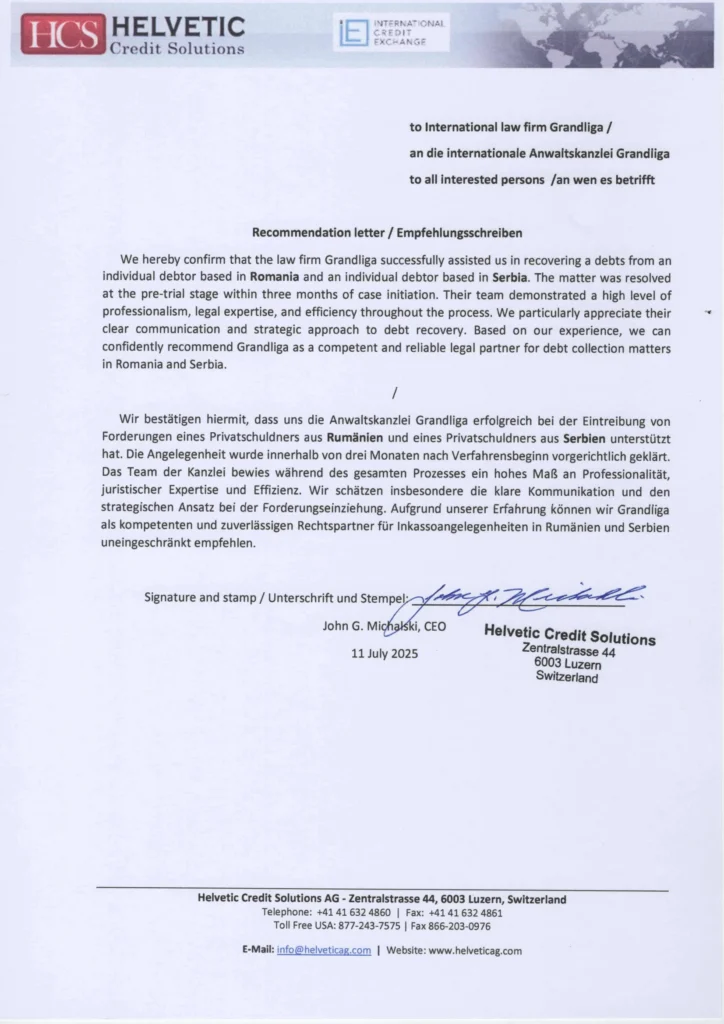
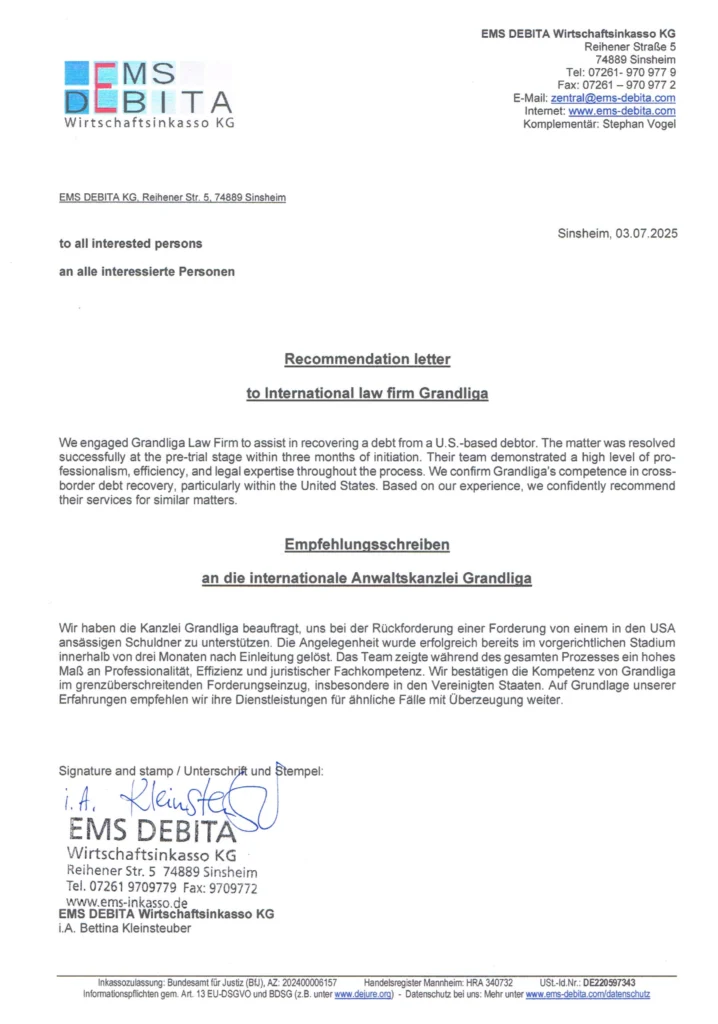
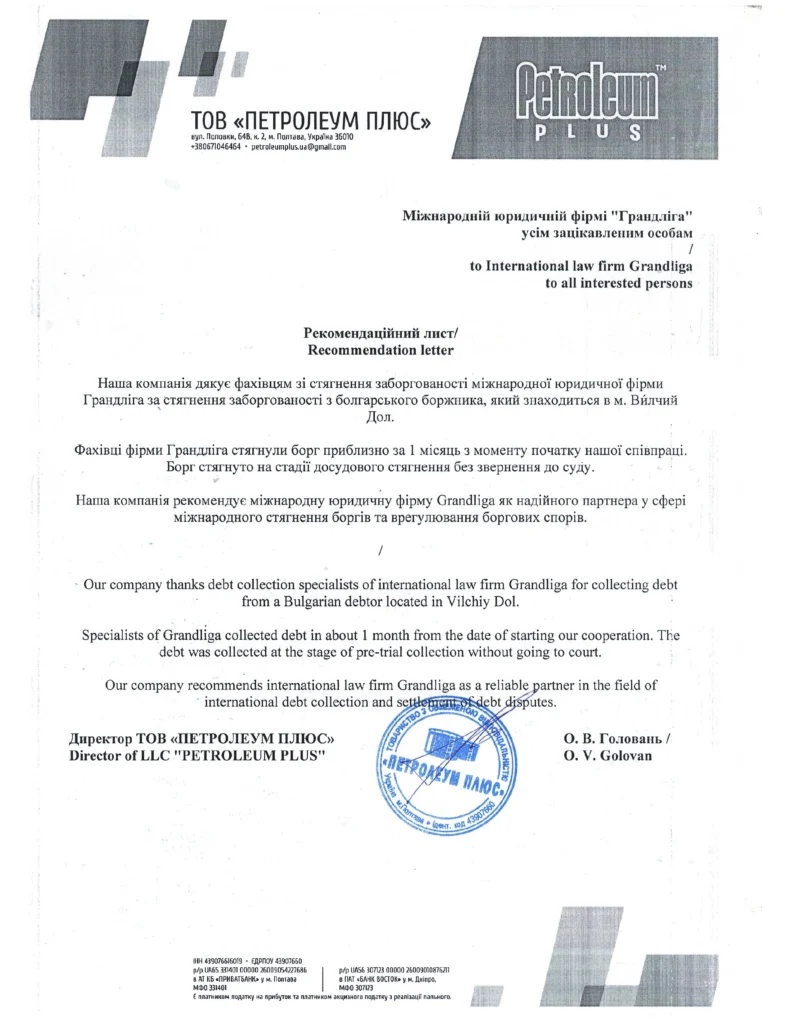
If you need assistance with debt collection in Guinea-Bissau, Grandliga can support the case at every stage: analysis of documents and the debtor, selection of the out-of-court strategy, preparation of a formal demand, verification of the limitation period, choice between ordinary court proceedings and an order for payment, recognition and enforcement of a foreign decision, compulsory enforcement, participation in insolvency proceedings and assessment of risks connected with the debtor’s assets. The work is structured around the creditor’s documents, the debtor’s status, the applicable procedure and the realistic prospects of enforcement.
# DEBT COLLECTION AGENCY GUINEA-BISSAU
 317
317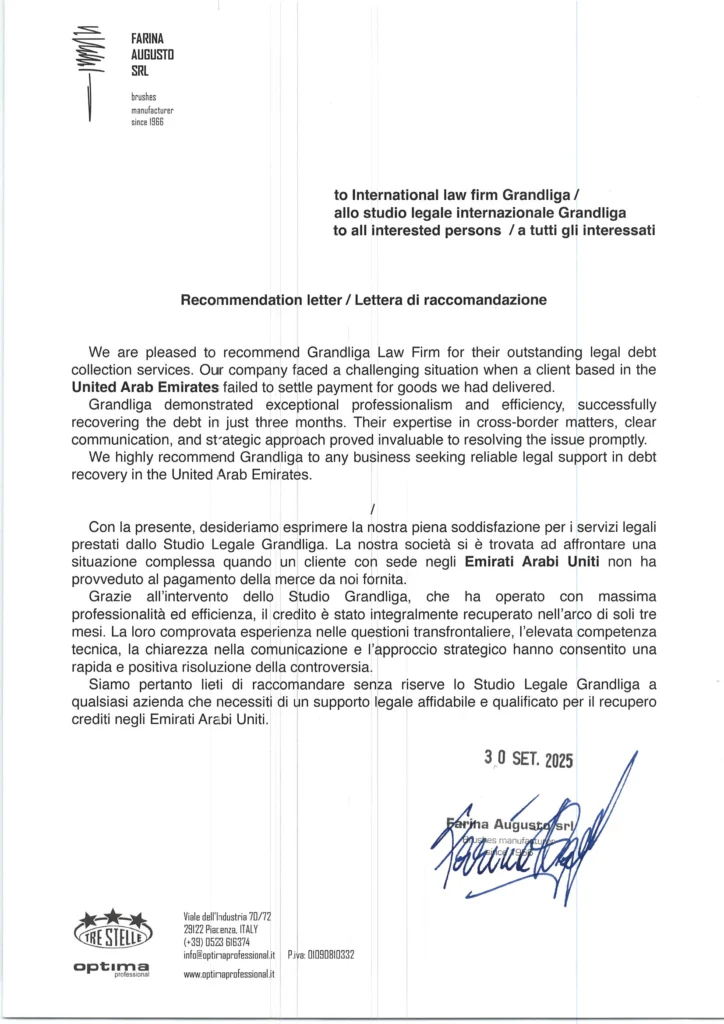


We will analyze and give recommendations