Let's discuss your case
We will analyze and give recommendations

Debt collection in Burkina Faso begins with a legal, financial and evidentiary assessment of the case. At this stage, it is necessary to verify the origin of the debt, whether the obligation is civil or commercial, the contract, invoices, delivery or service records, correspondence, any acknowledgment of debt, the exact identity of the debtor, its registered or residential address, its actual place of business, existing court or enforcement proceedings, and assets that can be identified in Burkina Faso.
In a case connected with Burkina Faso, debtor analysis should not be limited to general solvency. It is also important to determine where the contract was concluded, where the goods were delivered or services were provided, where payment was due, where the debtor actually operates, and what assets or claims against third parties may later be reached. These factors influence the choice of competent court, the type of procedure and the practical value of obtaining an enforceable title.
If the debtor continues its business activity, there is no obvious priority enforcement by other creditors, and the documents sufficiently support the claim, the creditor may begin the out-of-court debt collection stage. This stage includes a documented payment demand, written reminders, communication with persons authorized to decide on payment, and the search for a workable settlement of the debt.
Negotiations may cover full payment, payment by instalments, return of goods, set-off of mutual claims, assignment of a claim or another solution consistent with the contractual documents. Communications by mail, email, phone or messaging tools help organize the dialogue and preserve evidence of the steps taken. Notices that are intended to produce procedural effects must be made in the form required by the applicable rules.
The average duration of out-of-court collection is up to 60 days, unless the parties agree on instalments or another gradual payment arrangement. If the debtor does not pay, disputes the debt without sufficient grounds, avoids notices, reduces assets or the initial analysis shows that an enforceable title is needed, the creditor may proceed to court proceedings, an order for payment, enforcement measures or another formal procedure suitable for the debtor’s situation.
Burkina Faso belongs to the OHADA legal area. For a creditor, this means that national law of Burkina Faso and the uniform rules applicable to business law must be assessed together. National law remains important for court organization, filing of claims, service of procedural documents, certain remedies and enforcement of foreign court decisions. OHADA rules are especially relevant to commercial obligations, orders for payment, enforcement measures and collective debt settlement procedures.
Before initiating court collection, the creditor must verify the limitation period applicable to the claim. Under the civil law of Burkina Faso, the general limitation period is 30 years. For obligations arising from commercial transactions between merchants or between merchants and non-merchants, the uniform commercial rules applicable in the OHADA area provide a five-year period, unless a shorter special limitation period applies.
The effects of the expiration of the limitation period are invoked by the debtor before the competent court. Acknowledgment of the debt by the debtor, partial payment or another clear confirmation of the claim may interrupt the limitation period. After interruption, the period begins to run again from the beginning.
In commercial relations governed by OHADA rules, the parties may contractually shorten or extend the limitation period. It may not be reduced to less than one year or extended to more than ten years. The parties may also agree on additional grounds for suspension or interruption where the applicable regime allows it. In an international case, the nature of the debt, the status of the parties, the due date and evidence of acknowledgment should be reviewed before choosing the collection strategy.
Judicial debt collection in Burkina Faso may be carried out through ordinary court proceedings or through an order for payment when the claim meets the requirements of this simplified procedure. The choice depends on the nature of the debt, the likelihood of objections by the debtor, the strength of the evidence, the debtor’s residence or registered office, the place of performance of the obligation and the practical need to obtain an enforceable title quickly.
Ordinary court proceedings are generally initiated by serving a summons on the defendant. Through this act, the defendant is informed that a case has been brought against him and that he must appear before the court on the specified date or within the specified period. The court is seized by filing a copy of the summons with the court registry. This filing must be made within two months after service of the summons; otherwise, the summons lapses.
The summons must indicate the competent court, the date and time of the hearing, the subject of the claim, the facts and legal grounds, the evidence supporting the claim and the warning that, if the defendant fails to appear, a decision may be rendered against him on the basis of the claimant’s materials. The time limit for appearance is at least fifteen days from service. It is extended by fifteen days for persons located outside the territorial jurisdiction of the court and by two months for persons outside Burkina Faso.
Where the creditor is a foreign person or foreign company, the defendant may request, before raising other defenses, security for legal costs and possible damages. The amount is fixed by a court decision. A foreign creditor may be exempt from providing this security if he proves that immovable property owned by him in Burkina Faso is sufficient to cover possible costs and damages.
On the day of the hearing, the chairperson verifies whether sufficient time has passed since service of the summons for the defendant to prepare a defense. The court then hears the parties present or their lawyers. If the case is ready for consideration on the merits based on the explanations, submissions, statements and documents provided, it may be referred to a hearing or considered on the same day where the procedural conditions are met.
Cases in which the defendant does not appear may also be referred to a hearing if they are ready for consideration on the merits, unless the chairperson orders a new summons. If the case is not ready, it may be sent to the judge responsible for preparing the file.
The judge responsible for preparing the case may request additional submissions, order an expert examination, require or examine additional evidence, hear witnesses, verify the authenticity of documents and resolve procedural issues. Once these steps are completed, the file is sent to the chairperson of the court for a hearing on the merits.
At the hearing on the merits, the court examines the results of the preparatory steps, hears the parties and evaluates the evidence. It then issues a reasoned decision. This decision may serve as the basis for later enforcement, subject to the rules on remedies, notification and enforceability.
An order for payment is a simplified procedure for claims that are certain, liquidated and due. It may be used in particular for debts arising from contracts, negotiable instruments or checks where funds were absent or insufficient.
The creditor files an application with the competent court and attaches documents proving the existence, amount and due date of the debt. The application must identify the parties, state the exact amount claimed, set out the components of the debt and explain the basis of the claim. If the creditor has no residence or registered office within the jurisdiction of the court seized, he must indicate an address for procedural notifications within that jurisdiction.
If the application appears fully or partially justified, the court issues an order for payment for the accepted amount. If the application is rejected in whole or in part, the creditor cannot appeal that rejection within the simplified procedure, but may still bring the claim through ordinary court proceedings.
The application and the order for payment must be served on the debtor at the creditor’s initiative within three months from the date of the order. If service is not made within that period, the order becomes ineffective. The notice requires the debtor to pay within ten days or file an objection within the same period, with any applicable extensions based on distance.
If the order for payment was not personally served on the debtor, the right to object remains available until the expiry of ten days after the first personal service or, if no such service occurs, after the first enforcement measure that makes all or part of the debtor’s assets unavailable. If no objection is filed within the applicable period, the creditor may request that the order be given enforceable effect.
When an objection is filed, the court first attempts to reconcile the parties. If an agreement is reached, a reconciliation record is drawn up and may be made enforceable. If reconciliation is not achieved, the court examines the dispute and issues a decision that replaces the order for payment.
The decision of the court of first instance may be appealed to the court of appeal within two months from the date of the decision or, if the party was not present when it was announced, from the date of notification. In non-contentious matters, the appeal period is fifteen days. These periods are extended on the basis of distance for persons located outside the territorial jurisdiction of the court or outside Burkina Faso.
During the appeal period, enforcement of the challenged decision is generally suspended, except where provisional enforcement is provided by law or ordered by the court. An appeal to the Court of Cassation of Burkina Faso must be filed within two months. The period for cassation appeal and the appeal itself generally do not suspend enforcement, except in cases provided by law.
Where the creditor already has a decision issued by a foreign court, recognition and enforcement of foreign court decisions in Burkina Faso is a separate stage of collection. For a foreign court decision to be enforced in Burkina Faso, the creditor must obtain a declaration of enforceability from the competent court at the place where enforcement is to be pursued. The court examines the application in adversarial proceedings and may allow enforcement of the decision in whole or in part.
Once a court decision, an order for payment with enforceable effect, an enforceable reconciliation record or a foreign court decision declared enforceable can serve as the basis for collection, the creditor may begin enforcement proceedings. The period for submitting a court decision for compulsory enforcement is 30 years.
Compulsory enforcement requires an enforceable title and a claim that is certain, liquidated and due. Depending on the assets identified, the creditor’s claim may be satisfied through seizure of funds in bank accounts, seizure and sale of movable or immovable property, seizure of securities, attachment of claims against third parties or other applicable enforcement measures.
Before the seizure and sale of movable property, the debtor must be served with a payment demand granting a minimum period of eight days. Where the debtor is the state, a territorial authority or a public institution, compulsory enforcement and protective measures are subject to specific limits. In such cases, the collection strategy should take into account possible set-off, recording of the debt in public accounts or budgets and the limits connected with immunity from enforcement.
Another route may become relevant when the debtor’s financial condition makes individual recovery difficult and the case falls within collective proceedings. In Burkina Faso, this area is governed by OHADA rules on the collective settlement of liabilities and may involve, depending on the actual condition of the business, preventive settlement, judicial recovery or liquidation of assets.
A creditor may request the opening of collective proceedings when the claim is certain, liquidated and due, and the file shows that the debtor has ceased payments. If the competent court establishes this situation, it may order judicial recovery where a serious agreement or transfer of the business appears possible, or liquidation of assets where the company’s situation is irreversibly compromised.
After the opening of judicial recovery or liquidation of assets, creditors must file their claims with the body responsible for the proceedings. Creditors domiciled outside the territory of the state where the proceedings are opened have 90 days to file their claims. Filing a claim interrupts the limitation period for that debt.
Where the debtor’s available assets are not sufficient to satisfy creditors, certain acts carried out during the suspect period may be declared ineffective against the body of creditors. These acts may include gratuitous transfers of movable or immovable property, contracts in which the debtor’s obligations clearly exceed those of the other party, payments of debts not yet due, abnormal payments of due debts, real security granted for earlier debts and certain protective registrations.
Other acts that caused harm to the body of creditors may also be declared ineffective, including gratuitous acts carried out during the six months preceding the suspect period, transactions for value concluded with a person who knew that the debtor had ceased payments, or voluntary payments of due debts received by a creditor who knew of that situation.
Ineffectiveness of such acts allows the available estate to be restored for the proceedings. Depending on the type of act, this may lead to return of the property, payment of its value, loss of effect of a contract not yet performed, inclusion of the claim among liabilities or return to the estate of sums improperly received. This restoration increases the basis from which creditors may be paid according to the applicable order of priority.
In more serious situations, collective proceedings may also have consequences for legal or de facto managers of the business. Bad-faith acts, grossly imprudent management, irregular accounting, continuation of clearly loss-making activity, unjustified preferential treatment of certain creditors or reduction of the company’s assets may be examined from the standpoint of asset liability and other measures provided by law.
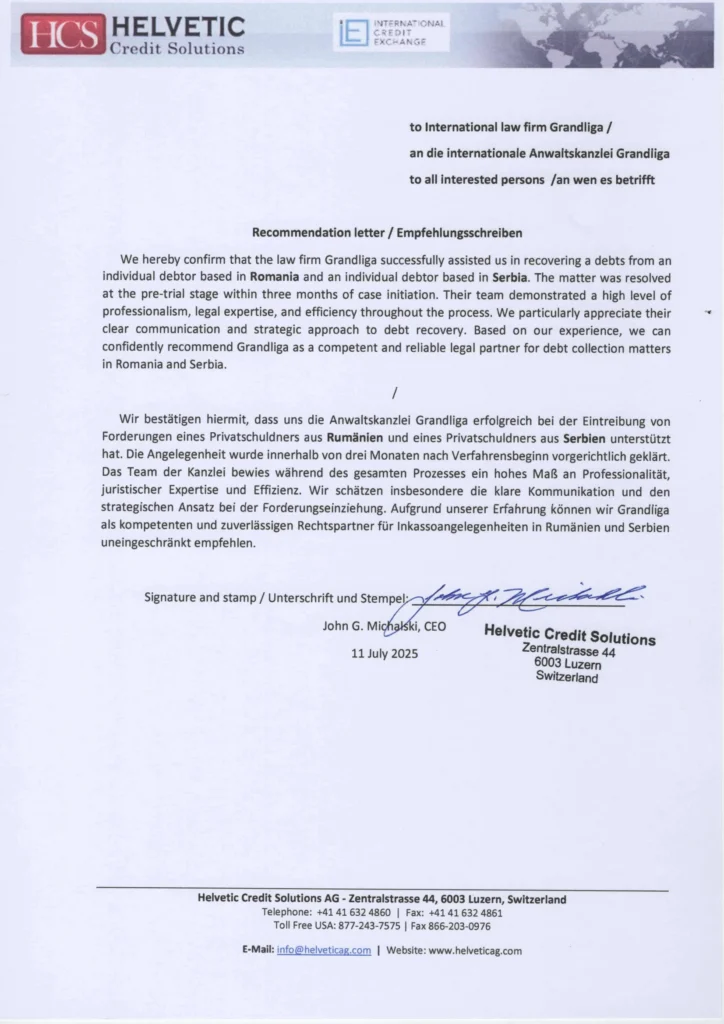
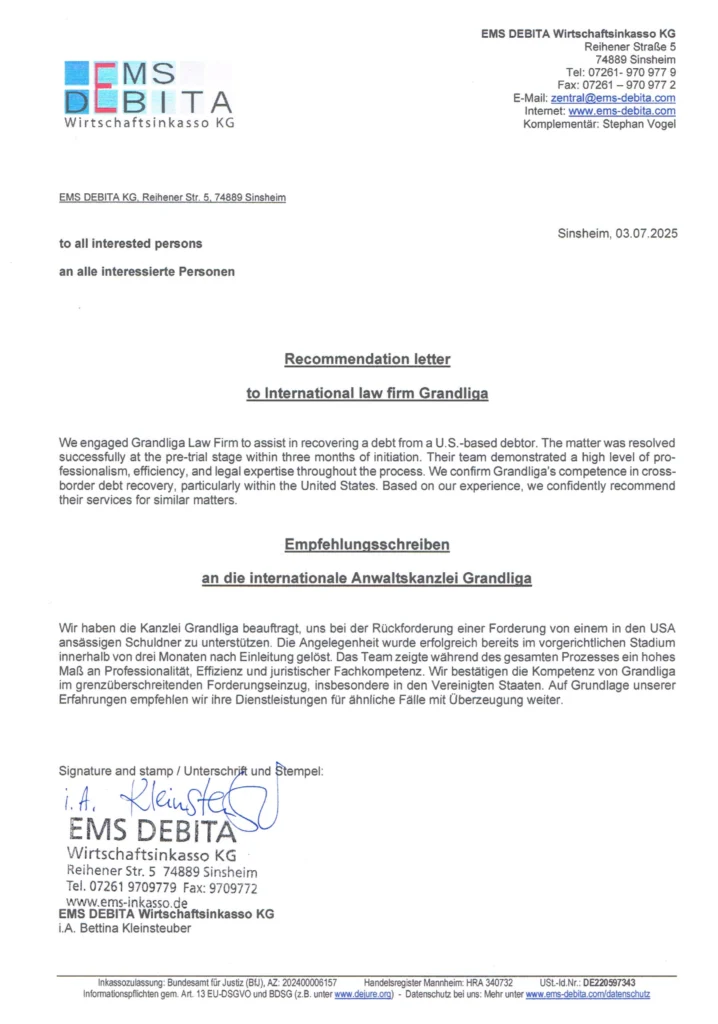
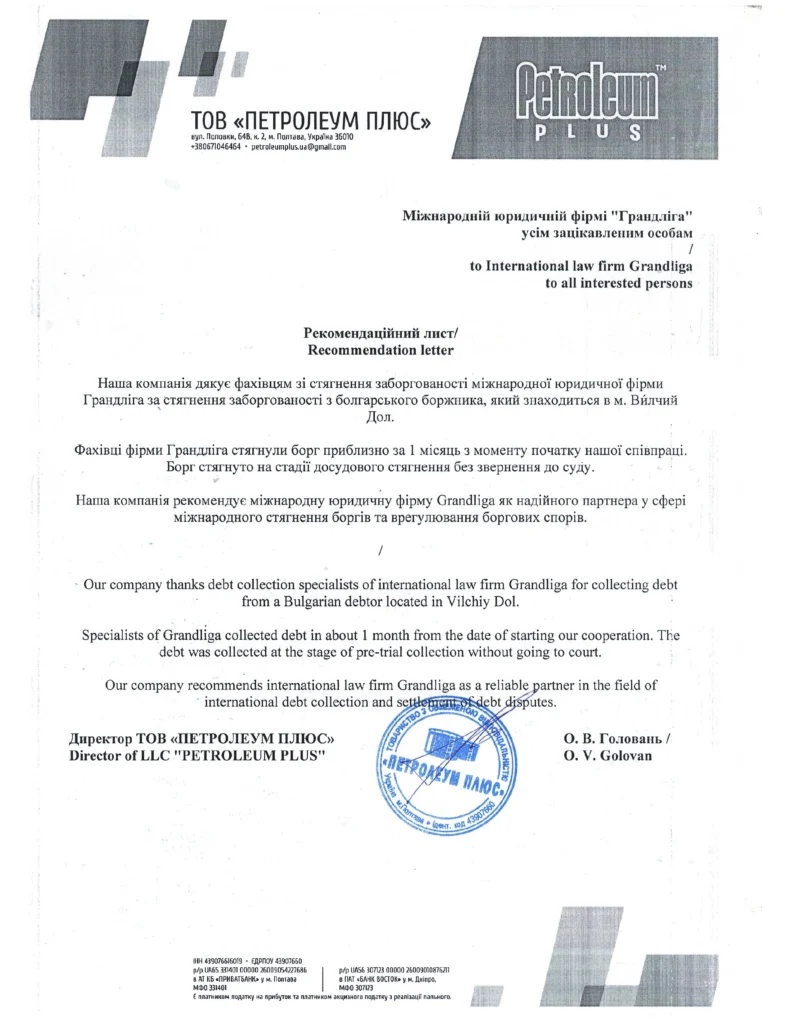
If your case concerns international debt collection in Burkina Faso, Grandliga can assist at every stage: analysis of the claim and the debtor, preparation of the payment demand, out-of-court negotiations, choice between ordinary court proceedings and an order for payment, organization of evidence, support with appeals, enforcement of foreign court decisions, compulsory enforcement, protective measures and collective proceedings. Our work is focused on building a strategy consistent with the available documents, the debtor’s status, national law of Burkina Faso and the applicable OHADA rules.
# DEBT COLLECTION AGENCY BURKINA FASO
 668
668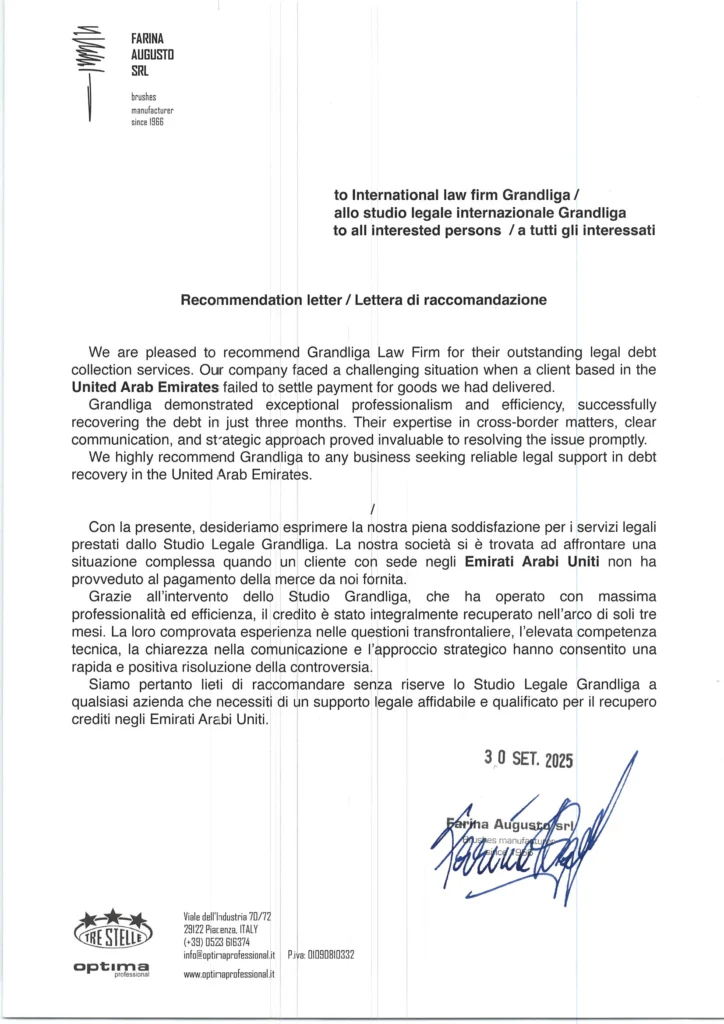


We will analyze and give recommendations