


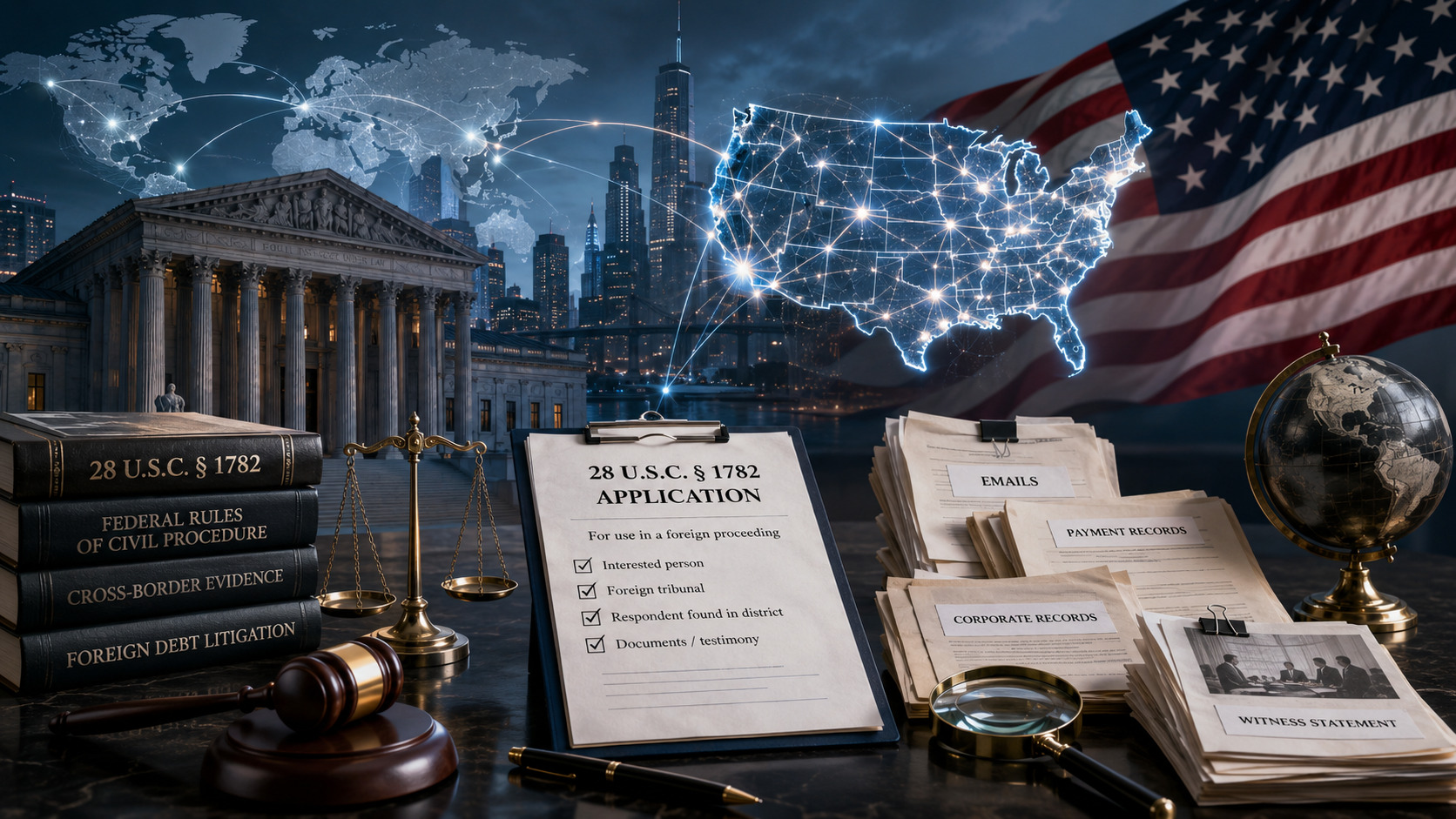
A creditor may be litigating a debt dispute in Germany, Poland, Italy, Ukraine or another country while a crucial witness, corporate affiliate or holder of relevant records is located in the United States. The underlying claim does not have to be tried by a U.S. court for American judicial assistance to become relevant.
Under 28 U.S.C. § 1782, a U.S. federal district court may, in qualifying circumstances, order a person within the relevant district to give testimony or produce documents or other evidence for use in a proceeding before a foreign or international tribunal. The application may be made by the foreign tribunal itself or by an “interested person,” a category that can include a party to the foreign proceeding. The statute also provides that, unless the court orders otherwise, evidence is obtained under the Federal Rules of Civil Procedure and that legally applicable privileges remain protected.
For an international creditor, this creates a potentially valuable procedural route when evidence relevant to a debt case has a meaningful U.S. connection. But § 1782 is not a general investigative licence. Meeting the statutory requirements gives a federal court authority to assist; it does not oblige the court to grant the requested discovery.
When can a foreign creditor use § 1782?
A § 1782 application requires several elements to line up.
The person or entity from whom discovery is sought must reside or be found in the federal district where the application is made. The applicant must qualify as an interested person or act on behalf of a qualifying tribunal. The request must seek evidence, such as testimony, documents or another thing, and that evidence must be intended for use in a proceeding before a qualifying foreign or international tribunal.
The last point is particularly important. A creditor cannot justify a request merely by saying that information discovered in the United States might someday prove commercially useful. There must be a sufficient connection between the evidence and an adjudicative proceeding abroad.
The Supreme Court addressed the scope of the statute in Intel Corp. v. Advanced Micro Devices, Inc., 542 U.S. 241 (2004). It held, among other things, that the foreign proceeding does not necessarily have to be pending or imminent when the application is filed. It must, however, be within reasonable contemplation. The Court also rejected a blanket rule requiring the requested evidence to be discoverable under the procedural law of the foreign country before § 1782 assistance can be granted.
For a creditor considering proceedings but not yet having filed a claim, this distinction can matter. There may be a legitimate opportunity to seek evidence before the foreign case formally begins, but a purely hypothetical future lawsuit is not enough. The applicant should be able to demonstrate a concrete contemplated proceeding and explain how the requested evidence is expected to be used in it.
What evidence can a U.S. court order?
The statutory language covers testimony or statements as well as documents and other things. In a commercial debt dispute, depending on the facts, potentially relevant material might include contractual communications, transaction records, correspondence concerning payments, records relating to the disputed transaction, or testimony from a person with direct knowledge of the relevant events.
The important point is not the label attached to the material but its relationship to the foreign proceeding.
Section 1782 also expressly states that, unless the court prescribes another procedure, discovery is conducted in accordance with the Federal Rules of Civil Procedure. At the same time, the statute does not override a legally applicable privilege. A request directed at privileged attorney-client communications, for example, does not become enforceable merely because it has been made under § 1782.
A well-prepared application therefore needs more than a long list of documents. It should explain why each material category is relevant to the foreign dispute and avoid demands that resemble an unrestricted search through the respondent’s records.
Meeting the statute does not guarantee discovery
Even where the statutory requirements are satisfied, the district court retains discretion.
In Intel, the Supreme Court identified four considerations that guide that discretion.
First, the court considers whether the person from whom discovery is sought is already a participant in the foreign proceeding. If the foreign tribunal itself can effectively order that participant to produce the evidence, the need for U.S. judicial assistance may be less compelling. By contrast, § 1782 can be particularly relevant where the evidence is held by a non-participant who is outside the foreign tribunal’s practical reach.
Second, the U.S. court may consider the nature of the foreign tribunal, the character of the proceedings and the foreign tribunal’s receptivity to U.S. judicial assistance.
Third, the court examines whether the application is an attempt to circumvent foreign proof-gathering restrictions or policies.
Fourth, requests that are unduly intrusive or burdensome may be rejected or narrowed.
This means that a technically eligible request can still fail because it is poorly designed. In a debt case, asking for every communication, every transaction and every record concerning a debtor over many years may create a very different discretionary analysis from a request tied to specific payments, contracts, transfers or factual issues already identified in the foreign dispute.
A foreign court does not need an identical discovery procedure
One of the most useful aspects of Intel for cross-border litigants is that § 1782 does not contain a general “foreign discoverability” requirement.
The fact that a foreign legal system would not allow a litigant to obtain the same material through an identical domestic discovery mechanism does not automatically bar a § 1782 application. The Supreme Court declined to write such a limitation into the statute.
That does not mean foreign procedural rules are irrelevant. A U.S. court can still consider whether an application attempts to circumvent a specific foreign restriction or policy. There is therefore an important difference between obtaining evidence that the foreign system does not independently provide a mechanism to compel and trying to evade an express prohibition imposed by the foreign tribunal or applicable law.
For a foreign creditor, the practical task is to explain the difference clearly.
Private international arbitration is a major limitation after ZF Automotive
A particularly important restriction was confirmed by the U.S. Supreme Court in ZF Automotive US, Inc. v. Luxshare, Ltd., 596 U.S. 619 (2022).
The Court unanimously held that the expression “foreign or international tribunal” in § 1782 reaches governmental or intergovernmental adjudicative bodies, not ordinary private adjudicatory bodies. The two arbitral panels before the Court therefore did not qualify.
This has direct consequences for international debt disputes.
A creditor should not assume that § 1782 is available simply because the underlying contract provides for international commercial arbitration. If the tribunal is a private arbitral body constituted by agreement of the parties, ZF Automotive may take the proceeding outside § 1782.
The analysis can be more complicated where an adjudicative body has been created or endowed with authority by one or more governments. The decisive question is not simply whether the proceeding is described as “arbitration,” but whether the body exercises governmental or intergovernmental authority within the meaning explained by the Supreme Court.
The nature of the foreign forum should therefore be checked before substantial resources are spent preparing a § 1782 application.
The correct federal district can determine whether the application works
Another trap is assuming that a company doing business somewhere in the United States can automatically be targeted in any convenient federal court.
Section 1782 gives authority to the district court for the district in which the respondent “resides or is found.” Federal appellate courts have not interpreted that phrase identically.
In In re del Valle Ruiz, 939 F.3d 520 (2d Cir. 2019), the Second Circuit adopted a relatively broad interpretation, holding that the statutory language extends to the limits of personal jurisdiction consistent with due process. The decision also linked specific jurisdiction in the § 1782 context to the relationship between the respondent’s forum contacts and the discovery sought.
The Fourth Circuit took a narrower approach in In re Eli Lilly & Co., 37 F.4th 160 (4th Cir. 2022). Eli Lilly sought discovery from Novartis Pharma AG for European patent proceedings. The Fourth Circuit upheld denial of the application and concluded that Novartis was not “found” in the Eastern District of Virginia because it lacked the required physical presence there. The court expressly declined to equate the statutory term automatically with the full modern constitutional test for personal jurisdiction.
For an international creditor, this is not an academic difference.
Before filing, counsel should determine:
- who actually possesses or controls the evidence;
- where that person or company resides or operates;
- which federal district would hear the application;
- which federal circuit’s precedent applies there; and
- whether the respondent’s connection with that district satisfies the controlling interpretation of “resides or is found.”
Choosing a district merely because it appears convenient can result in denial before the court ever reaches the usefulness of the requested evidence.
Can § 1782 reach documents stored outside the United States?
The physical location of electronic records can also be more complicated than it first appears.
Appellate authority has rejected a universal rule that documents are beyond § 1782 solely because the files themselves are physically stored outside the United States. The Second Circuit in del Valle Ruiz concluded that § 1782 can permit extraterritorial discovery where the responsive material is within the subpoenaed party’s possession, custody or control. The Eleventh Circuit reached a similar conclusion in Sergeeva v. Tripleton International Ltd., 834 F.3d 1194 (11th Cir. 2016), rejecting a categorical bar based solely on the location of responsive documents.
That does not mean every U.S. affiliate can automatically be forced to obtain records from every foreign group company.
Control, corporate relationships, burden, proportionality and the circumstances of the particular request still matter. The international location of the evidence may also influence the court’s discretionary assessment.
For a creditor, the better approach is to identify why the U.S. respondent actually has possession, custody or control of the records rather than relying only on the existence of a corporate group relationship.
Why § 1782 is not a general asset-tracing shortcut
The statute can be attractive in an international debt case because important evidence and asset-related information may overlap. That should not lead to the assumption that § 1782 creates a stand-alone American procedure for searching globally for everything a debtor owns.
The evidence must still be for use in a qualifying foreign proceeding.
Suppose a creditor is challenging an allegedly fraudulent transfer in a pending foreign court case and a U.S.-based person possesses communications directly concerning that transfer. A focused request connected to that issue is fundamentally different from asking a U.S. court to order broad disclosure about every bank account, company, transaction and asset ever associated with the debtor merely in the hope that something useful will appear.
A § 1782 strategy should therefore begin with the foreign case and the factual question that must be proved, not with an unrestricted wish list of information.
Where the broader objective is recovery against a debtor, § 1782 should be considered as one potential procedural tool within the larger strategy for debt collection in the USA, rather than as a substitute for ordinary litigation, recognition, enforcement or lawful asset investigation.
What should be prepared before filing?
A creditor considering § 1782 should normally establish the procedural foundation before drafting subpoenas.
The foreign proceeding should be identified precisely, including the tribunal, the parties, the relevant claims and the present procedural stage. If proceedings have not yet commenced, the applicant should be able to demonstrate why litigation is genuinely within reasonable contemplation.
The respondent must then be identified separately from the debtor. Often the most useful discovery target is not the debtor at all, but a non-party that possesses specific evidence needed for the foreign dispute.
The proposed discovery should be mapped to issues in that proceeding. Instead of requesting “all documents concerning the debtor,” an applicant is in a stronger practical position when it can explain why defined categories of documents or testimony bear on a particular contract, payment, transfer, representation, ownership issue or other disputed fact.
The appropriate federal district and governing circuit precedent should also be checked before filing. Where the respondent is a multinational corporation, simply pointing to a national U.S. presence may not answer the statutory question.
Finally, the applicant should anticipate the Intel factors rather than treating them as arguments to address only after an objection is filed. Receptivity of the foreign tribunal, possible circumvention concerns and burden can affect the court’s decision even after every threshold statutory requirement has been met.
Practical significance for an international creditor
Section 1782 can be unusually valuable because it allows a foreign dispute and an American source of evidence to be connected without moving the underlying merits of the debt claim into a U.S. court.
Its usefulness is greatest where the creditor can identify a specific evidentiary gap, a qualifying proceeding abroad, a proper U.S. discovery respondent, and a focused request that can survive discretionary review.
Its limits are equally important. Private commercial arbitration may fall outside the statute after ZF Automotive. The meaning of “resides or is found” can vary materially between federal circuits. A court may narrow or reject an excessive request. And § 1782 should not be presented as a general mechanism for speculative asset searches unrelated to a qualifying foreign adjudicative proceeding.
For cross-border debt cases, the practical priority is therefore to identify the U.S. evidentiary connection early. If relevant testimony or documents are held by a person or company linked to the United States, the creditor should determine the correct federal district, the nature of the foreign tribunal and the precise use of the evidence before deciding whether a § 1782 application is worth pursuing.


