
 Poland
The debt collection procedure in Poland begins with an assessment of the debtor’s legal status, solvency and available assets. For a Polish company, this usually includes checking the National Court Register KRS, the company’s representation rules, financial documents available in the register, signs of liquidation, restructuring or bankruptcy, and information on whether enforcement against the debtor has already been ineffective. If the debtor is a sole trader, the Central Register and Information on Business CEIDG is also relevant. At this stage, it is also necessary to assess whether the creditor has sufficient documentary evidence of the debt, such as a contract, invoices, delivery documents, correspondence, payment reminders, acknowledgement of debt or evidence of partial payment.
It is also important to assess whether the debtor may challenge the existence, amount or maturity of the debt. This preliminary analysis determines the safest strategy: amicable settlement, registration of the debt in available debtor information systems, a Polish payment order procedure, ordinary civil proceedings, a European payment order or enforcement of an already existing foreign judgment.
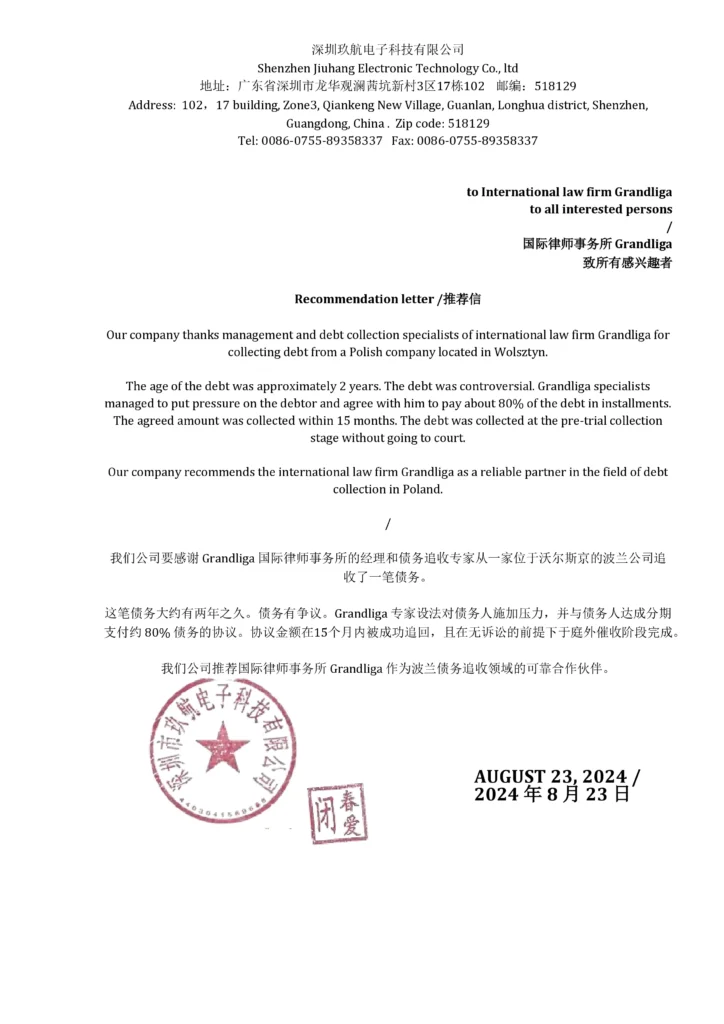
In the absence of active legal proceedings against the debtor or unenforced court decisions to collect the debt, and provided that the debtor continues to conduct business, amicable collection becomes the preferred route. This stage is based on persistent negotiations with the debtor in order to reach a mutually beneficial agreement regarding debt settlement. Settlement options may include payment of a creditor’s claim, return of goods, transfer of debt to a third party, or exchange of services or goods.
Interaction with the debtor begins with sending a demand through various channels, such as mail, email, telephone or instant messengers. This process involves actively interacting with the debtor in order to put pressure on him. The main task is to establish a dialogue with key decision makers in order to speed up the debt collection process.
An additional leverage at the amicable stage may be the use of Polish debtor information tools, but they should not be confused with each other. The Krajowy Rejestr Długów KRD is an economic information bureau used to exchange information about unpaid debts. The Krajowy Rejestr Zadłużonych KRZ is a separate public register connected with insolvency, restructuring and cases where enforcement has been unsuccessful. KRS and CEIDG are business registers used to verify the debtor’s legal status and representation. Proper selection of the register is important because the legal effect and practical value of each tool are different.
As a practical non-guaranteed estimate, out-of-court collection in Poland often takes about 30 to 60 days, but the actual duration depends on the debtor’s response, the quality of documents, the amount of the debt, the debtor’s solvency, the need to verify registers and whether the parties are negotiating a payment schedule or instalment plan. If the debtor ignores the demand, disputes the debt without reasonable grounds, hides assets or the preliminary assessment shows that negotiations are unlikely to work, the case should move to judicial debt collection without losing time.
The general limitation period under Polish civil law is six years, while claims for periodic payments and claims related to business activities are generally subject to a three-year limitation period, unless a special rule provides otherwise. For limitation periods of two years or longer, the period usually expires at the end of the calendar year. Polish law also does not allow the parties to shorten or extend statutory limitation periods by a legal act. In international trade, the 1974 UN Convention on the Limitation Period in the International Sale of Goods may be relevant, but its four-year limitation period applies only to claims arising from international sale of goods where the Convention is applicable, not to every international debt.
After the limitation period expires, the debtor may rely on limitation as a defence, which makes court recovery substantially more difficult. Before filing a claim, it should therefore be checked not only what the due date of the invoice or contract payment is, but also whether the limitation period was interrupted, for example by court action, enforcement action, mediation or acknowledgement of the claim by the debtor. If interruption occurred, the limitation period may start running again, which can be decisive for the recovery strategy.
Mediation or another out-of-court method of resolving the dispute is not a mandatory precondition for filing a debt claim in Poland. However, the statement of claim should include information on whether the parties attempted mediation or another amicable dispute resolution method, or explain why such an attempt was not made. For this reason, evidence of demand letters, settlement proposals and debtor responses should be kept, because these documents may be useful both for pre-trial negotiations and for court proceedings.
When planning court debt collection in Poland, court fees and translation costs should also be taken into account. In civil and commercial monetary claims, Polish court fees generally depend on the value of the claim, and higher-value disputes may be subject to a proportional fee. If the claimant does not pay the required court fee, the court may take no procedural action on the pleading or return it under the applicable procedural rules. For a foreign creditor, certified translations into Polish may also be required when documents are submitted to a Polish court.
Depending on the circumstances of the case and the cost of the claim, the following types of judicial debt collection in Poland are provided:
1. The procedure for issuing a payment order “Nakaz zapłaty” is one of the most important instruments for debt collection in Poland, but it is necessary to distinguish between different types of payment order proceedings. In practice, the main options are order-for-payment proceedings “postępowanie nakazowe”, writ-of-payment proceedings “postępowanie upominawcze” and electronic writ-of-payment proceedings “elektroniczne postępowanie upominawcze”, also known as EPU.
In order-for-payment proceedings, it is usually necessary to rely on documents with strong evidentiary value, such as an official document, an invoice accepted by the debtor, a demand for payment together with a written acknowledgement of debt, a bill of exchange, a cheque or other documents allowed by Polish civil procedure. This route is useful when the creditor has clear documentary evidence and wants to obtain a stronger procedural position at an early stage.
In writ-of-payment proceedings, the court may issue a payment order if the claim appears justified, the facts do not raise serious doubts and the case does not require a full evidentiary hearing at the initial stage. The court examines the case in a closed session without summoning the parties. If the debtor does not challenge the order within the applicable time limit, the payment order may become final and can be used for enforcement after the required enforceability steps.
If the debtor files the proper remedy against the payment order, the consequences depend on the type of payment order. In writ-of-payment proceedings, a statement of opposition may cause the order to lose force in the challenged part and the case continues as ordinary civil proceedings. In order-for-payment proceedings, the debtor files objections, and the procedural effect is different because the order may remain important as a security instrument until the dispute is examined by the court.
Electronic writ-of-payment proceedings EPU are conducted through the Polish e-court system and are designed for monetary claims pursued electronically. In EPU, documents are not physically attached in the same way as in ordinary proceedings; the evidence is described in the electronic claim. This procedure is useful for relatively straightforward monetary claims, but it is not suitable for every case, especially where service, evidence or cross-border circumstances make ordinary proceedings more appropriate.
2. Ordinary civil proceedings “Postępowanie zwykłe” are used when the debtor disputes the claim, when a payment order is challenged, or when the case requires a full examination of evidence. This route is also appropriate if the creditor does not have documents strong enough for order-for-payment proceedings or if the factual background is more complex, for example because the debtor raises set-off, defects in performance, limitation, lack of authority, improper delivery or other substantive objections.
Ordinary civil proceedings are conducted through written pleadings and hearings. The court may examine contracts, invoices, delivery documents, correspondence, witness evidence, expert opinions and other evidence relevant to the case. As a practical orientation, the first-instance stage may take from 6 months, but the duration depends on the court’s workload, service of documents, number of hearings, evidentiary motions, expert evidence, the debtor’s procedural conduct and whether foreign documents or translations are involved.
At the end of the case, the court issues a judgment “Wyrok”. If a party wishes to challenge the judgment, the appeal rules depend on proper service of the judgment and its written reasons. In general, an appeal is filed within two weeks from service of the judgment with written reasons, while in some situations the appeal period may be three weeks if the time limit for preparing written reasons has been extended and the court informs the party accordingly.
A cassation complaint is not an ordinary continuation of every debt collection case. It is an extraordinary remedy to the Supreme Court and is available only if statutory admissibility requirements are met. In property cases, cassation is generally not available where the value of the subject of appeal is below the statutory threshold. Therefore, in a standard debt recovery strategy, the enforceable judgment and the appeal stage should be treated as the main procedural focus, while cassation should be assessed only in cases where the legal and financial criteria make it available.
3. The European Payment Order “Europejski nakaz zapłaty” is a separate EU procedure for uncontested civil and commercial monetary claims in cross-border cases. It applies between EU Member States except Denmark and is based on standard forms. This procedure may be useful where the creditor and debtor are located in different EU Member States and the claim is due, monetary and not seriously disputed at the time of filing.
To obtain a European Payment Order, the creditor submits the standard application form to the competent court. The procedure does not require the claimant’s presence before the court at the initial stage. After the order is served on the debtor, the debtor has 30 days to lodge a statement of opposition. If no opposition is filed within the time limit, the European Payment Order becomes enforceable and may be used for cross-border enforcement within the EU framework.
If the debtor lodges a statement of opposition, the case does not simply remain an uncontested payment order matter. Depending on the claimant’s choice and the applicable procedural rules, it may continue before the competent civil court, continue under another available EU procedure or be discontinued. For this reason, it should be decided in advance whether the European Payment Order is the best option or whether a Polish national payment order, ordinary proceedings or enforcement of an existing judgment would be more effective.
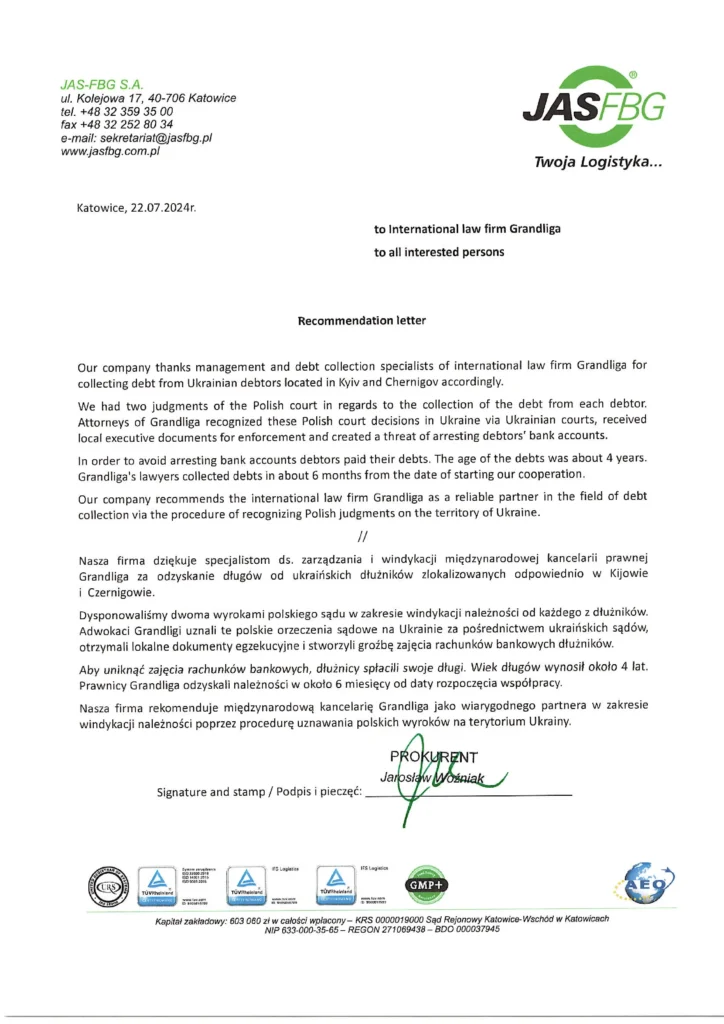
For international creditors, a separate issue is the recognition and enforcement of foreign judgments in Poland. If the creditor already has a judgment from another EU Member State in a civil or commercial matter, Regulation EU No. 1215/2012 Brussels I Recast is usually the key instrument. Under this Regulation, a judgment given in one Member State is recognised in other Member States without any special recognition procedure and, if enforceable in the state of origin, is enforceable in another Member State without a declaration of enforceability. For enforcement in Poland, the creditor will usually need an authentic copy of the judgment and the certificate issued under the Regulation, and Polish enforcement itself is then conducted under Polish enforcement rules.
Judgments from non-EU countries are treated differently. If no EU instrument or applicable international convention removes the need for a Polish procedure, a foreign judgment that is to be enforced in Poland normally requires a declaration of enforceability by a Polish court. It is usually necessary to provide an authenticated copy of the judgment, evidence that the judgment is final or enforceable in the country of origin, and certified Polish translations. This step is important in debt collection cases where the debtor’s assets are located in Poland but the creditor obtained the judgment abroad.
After receiving a final and enforceable title, if the debtor does not voluntarily comply with the decision, the creditor may initiate enforcement proceedings in Poland. Enforcement is conducted by court bailiffs acting within the Polish enforcement system. In the enforcement application, the creditor may indicate known assets and request specific enforcement methods, such as enforcement from bank accounts, receivables, movable property, remuneration, shares or other assets. Enforcement against real estate requires a clear creditor’s request and should be considered separately because it is more formal, slower and cost-sensitive.
The duration of enforcement proceedings cannot be reduced to one universal average. It depends on whether the creditor knows the debtor’s assets, whether bank accounts and receivables can be identified quickly, whether the debtor operates an active business, whether previous enforcement attempts were unsuccessful, whether real estate is involved and whether the debtor files procedural complaints. In practice, the most effective enforcement strategy is prepared before the bailiff stage: information about the debtor’s accounts, contractors, property, vehicles, receivables and business activity should be collected as early as possible.
If enforcement against a Polish limited liability company “spółka z ograniczoną odpowiedzialnością”, or sp. z o.o., turns out to be ineffective, the creditor may consider a separate claim against members of the management board under Article 299 of the Polish Commercial Companies Code. This mechanism is particularly important in debt collection against Polish sp. z o.o. companies because board members may be jointly and severally liable for the company’s obligations if enforcement against the company has failed.
The liability of management board members is not automatic in every case and should not be confused with a general rule that all directors of all Polish companies are liable for company debts. A board member may defend against liability by showing, for example, that a bankruptcy petition was filed in due time, that restructuring or arrangement proceedings were opened in time, that failure to file was not attributable to the board member, or that the creditor did not suffer damage as a result. For other corporate forms, including joint-stock companies, liability must be assessed under the specific statutory basis applicable to that form and to the type of claim.
If you need assistance with debt collection in Poland, our team can help assess the debtor, prepare a recovery strategy, organize pre-trial negotiations, support court proceedings, coordinate enforcement and analyze cross-border recognition or enforcement issues. Each case should be assessed based on the documents, limitation period, debtor’s legal status and the location of recoverable assets.