
 Cambodia
The process of debt collection in Cambodia begins with a legal and financial assessment of the debtor, the documents supporting the claim, and the practical possibility of turning the creditor’s claim into actual recovery. At this stage, it is important to verify the debtor’s correct identity, the address that can be used for service, ongoing business activity, known assets in Cambodia, existing court or enforcement proceedings, signs of insolvency, and possible objections concerning the contract, delivery, scope of services, amount claimed, limitation period or partial performance of the obligation.
If the debtor continues operating, has an identifiable address and there are no immediate signs of asset transfer, the first step may be a documented attempt to resolve the debt voluntarily. In Cambodia, this stage is useful not only for negotiating payment, but also for confirming whether the debtor acknowledges the obligation, disputes the amount, requests additional time, proposes a payment schedule, offers security, returns goods, accepts transfer of the debt to a third party or suggests another commercially acceptable settlement option.
Communication with the debtor should be organized through a formal payment request, written correspondence and preservation of evidence of sending, receipt and content of communications. For a foreign creditor, these materials have practical value because they may affect the choice between ordinary court proceedings, a payment order, asset preservation measures, enforcement of an existing title or insolvency proceedings.
The out-of-court stage is useful while there is a real possibility of payment, settlement or a meaningful acknowledgment of the debt. If the debtor avoids communication, disputes the obligation without sufficient documents, changes address, transfers assets, stops business activity or shows signs of financial inability, the strategy should move to judicial debt collection, evidence preparation and assessment of assets that may be targeted at the enforcement stage.
Before initiating court proceedings, it is advisable to assess the applicable limitation period. Under Cambodian civil law, the general limitation period for monetary claims is 5 years from the moment when the claim can be exercised. For certain claims relating to the price of goods sold or services provided by a manufacturer or merchant to a person who is not a merchant, the limitation period is 2 years. When a claim is finally established by a final court judgment, judicial settlement or another act with equivalent effect, the limitation period is 5 years from that final establishment, even if the original limitation period was shorter.
The Cambodian court applies limitation only when it is invoked by a party entitled to rely on it. The limitation period may be interrupted by filing a court action, participation in insolvency proceedings, an enforcement act, an asset preservation measure, partial payment, payment of interest, provision of security or another acknowledgment of the existence of the claim. After interruption, the limitation period starts running again under the applicable rules.
Cambodian law allows different routes for judicial debt collection, depending on the amount of the claim, the quality of the documents, the debtor’s expected position, the possibility of serving documents in Cambodia and the existence of assets that can be targeted. In practice, the creditor may consider ordinary court proceedings, small claims proceedings, a payment order, recognition and enforcement of a foreign court judgment, enforcement of an existing title, asset preservation measures and, where the debtor has serious financial inability, insolvency proceedings.
Ordinary court proceedings begin with filing a claim with the court. The claim should state the names and addresses of the parties, legal representatives, the content of the requested judgment, the facts necessary to identify the claim, the specific circumstances supporting the claim and the evidence related to each relevant point. If the claim does not meet the formal requirements or the required court costs have not been paid, the court may grant a period to correct the deficiencies; if they are not corrected, the claim may be dismissed.
When the claim complies with the law, a copy is served on the defendant and the court sets the date for preparatory proceedings. Unless special circumstances exist, this date should be set within 30 days from the filing of the claim. For the creditor, the correct indication of the debtor’s address and complete preparation of evidence are essential because problems with service, insufficient documents or unpaid procedural costs may delay or undermine the case.
If the plaintiff has no domicile, business establishment or other office in Cambodia, the defendant may ask the court to order the plaintiff to provide security for litigation costs. The defendant who files this motion may refuse to appear until the security is provided. The amount is determined based on the litigation costs that the defendant may have to bear. This issue is especially important for foreign creditors planning to file a claim directly before Cambodian courts.
During preparatory proceedings, the court organizes the parties’ positions, clarifies factual and legal issues, identifies evidence related to disputed matters and may encourage a judicial settlement. The parties may be invited to submit preparatory documents for oral arguments. These documents should contain allegations, evidence and responses to the allegations and evidence of the opposing party. If the defendant does not clearly deny the facts alleged by the plaintiff, those facts may be deemed admitted; if the defendant states that he or she does not know those facts, they are generally treated as denied.
After the preparatory proceedings are completed, the parties present the result of that stage during oral arguments, and the court proceeds to examine the necessary evidence. Late submission of allegations or evidence may be restricted when it is made at an inappropriate time and causes delay. Therefore, contracts, invoices, delivery documents, acceptance documents, correspondence, acknowledgments of debt, account statements, guarantees, powers of attorney and evidence of communication with the debtor should be prepared before the active court stage begins.
If the defendant does not appear on the first date of the preparatory proceedings, the court may immediately close that stage and set the first date for oral arguments. If the defendant does not appear on the date set for oral arguments, the court may deem the facts alleged by the plaintiff admitted and, if there is a legal basis for the claim, issue a default judgment. This consequence is applied with regard to whether the defendant disputed the plaintiff’s allegations at an earlier stage. The judgment should be rendered within one month after the conclusion of oral arguments, except in complex cases or special circumstances.
The small claims procedure applies to monetary claims not exceeding 1,000,000 riels. The claim may be filed in a simplified form, and unless special circumstances exist, the date for oral arguments should be set within 30 days after the filing. The purpose of the procedure is to resolve the dispute quickly, so the hearing should usually be completed on the first date set for oral arguments.
The parties should present all arguments and evidence before or on the date of oral arguments, and examination of evidence is limited to materials that can be examined immediately. The defendant may request transfer of the case to ordinary proceedings, provided that this is done before presenting arguments on the first date of oral arguments. The court may also transfer the case to ordinary proceedings if the conditions for small claims proceedings are not satisfied. As a rule, the court renders its decision immediately after the conclusion of oral arguments, and an ordinary appeal against the final decision in this procedure is not available, except for specific remedies provided for special situations.
A payment order may be used to claim payment of a fixed sum of money, provided that the order can be served on the debtor in Cambodia by a method allowed by law. The application should state the parties, addresses, the content of the requested decision, the facts necessary to identify the claim and the amount to be paid. When the requirements are met, the court may issue the order without summoning the debtor in advance and without hearing the debtor’s position.
The payment order should state that if the debtor does not file an objection within two weeks from service, the court may declare the order provisionally enforceable. Service has decisive practical importance: if the order cannot be delivered to the address provided by the creditor and the creditor does not provide another address within two months after being informed of the failed service, the application for the payment order is deemed dismissed.
If the debtor files a valid objection before the declaration of provisional enforceability, the order loses effect in the contested part, and the case is deemed to have been filed before the competent court at the time when the application for the payment order was submitted. If the debtor does not file an objection within two weeks, or if the objection is rejected and that rejection becomes final, the court declares the order provisionally enforceable, allowing the creditor to proceed to the enforcement stage under the applicable rules.
A judgment of the court of first instance may be appealed to the court of appeal within one month from the day when the party received notice of the written judgment. In civil and commercial matters, the possibility of appeal may depend on the amount of the claim and the procedural rules applicable to the specific type of decision. The appeal is filed in writing with the court that issued the judgment, which then transfers the appeal and the case file to the court of appeal.
A decision of the court of appeal may be challenged before the Supreme Court of Cambodia where legal grounds exist for that route. This appeal should be filed in writing with the court that issued the challenged decision within one month from receipt of notice of the written decision of the court of appeal. If the appeal itself does not include the grounds, the appellant should submit the written statement of grounds within 30 days after receiving notice that the appeal has been accepted. The Supreme Court reviews the case within the stated grounds and does not conduct a new full examination of the facts as a court of first instance.
Where the creditor already has a final foreign court judgment against the debtor or relating to assets located in Cambodia, the strategy should include recognition and enforcement of foreign court judgments. A final and binding foreign court judgment has effect in Cambodia only if the legal conditions are met: proper jurisdiction of the foreign court under law or an applicable international agreement, proper notice to the losing defendant or that defendant’s participation in the proceedings, compatibility of the content of the judgment and the procedure with Cambodian public order and good morals, and reciprocity between Cambodia and the state of the foreign court.
To enforce against assets in Cambodia, a Cambodian court judgment authorizing enforcement of the foreign judgment must be obtained. The Cambodian court does not retry the dispute on the merits as a new case; it checks whether the legal conditions for enforcement are satisfied. After the authorizing judgment becomes final and binding, the foreign judgment may be used as a title for enforcement of a foreign court judgment in Cambodia.
After a court judgment, enforceable payment order, judicial settlement, enforceable notarized document or foreign judgment authorized for enforcement in Cambodia becomes enforceable, the creditor may start compulsory enforcement. A claim established by a final judgment, judicial settlement or equivalent act is generally subject to a 5-year limitation period. Enforcement does not start automatically: a written motion should be filed, a copy of the enforcement title attached, and the parties, the title, the type and method of enforcement and, in direct enforcement, the assets to be targeted should be indicated.
Within enforcement proceedings in Cambodia, recovery may be directed against funds in accounts, movable property, immovable property, claims against third parties, securities, property rights and other legally attachable assets of the debtor. Specific information about accounts, real estate, registered property, contracts, claims against third parties and the debtor’s business activity increases the practical effectiveness of enforcement because it allows the creditor to formulate a more precise request and reduces the risk that a valid legal title remains without actual recovery.
An additional tool for protecting the creditor’s claim may be the debtor’s insolvency proceedings. Under Cambodian insolvency law, the procedure may be opened where the debtor is unable to fulfill one or more valid and due obligations, the aggregate amount of which exceeds 5,000,000 riels. The petition may be filed by the debtor, one or more creditors, the director of companies or the public prosecutor. The petition should state the debtor’s name and address, the petitioner’s details, the legal grounds, the facts and documents proving those grounds, and the information needed by the court to assess whether the proceedings should be opened.
Bankruptcy may serve as an additional recovery route where the debtor has stopped paying due obligations, has several creditors, transfers assets, reduces or stops business activity, or where individual enforcement no longer offers a realistic prospect of satisfaction. After the proceedings are opened, the insolvency estate is formed, consisting of the debtor’s assets, rights and claims, and creditors should submit their proofs of claim in accordance with the deadlines and instructions published in the proceedings.
In insolvency proceedings, certain transactions that prejudice creditors may be avoided by the court. These include a transaction made with intent to defraud creditors by placing assets outside the reach of recovery; a transaction made within 3 years before the opening of the proceedings without consideration received by the debtor, except for statutory exceptions; a transaction made within 1 year before the opening of the proceedings where the debtor’s obligation significantly exceeded the obligation of the other party; payment of a debt that was not yet due or provision of new or additional security to a related person within 1 year before the opening of the proceedings; payment of a debt that was not yet due or provision of new or additional security within 6 months before the opening of the proceedings; and certain transactions relating to subordinated or special claims made within 1 year before the opening of the proceedings.
As a result of avoidance, money paid, property transferred or proceeds from the sale of transferred property may be recovered and included in the insolvency estate. The person from whom money or property was recovered may have the right to restitution of the consideration provided, to the extent that it still exists separately among the assets of the estate, and may also file a claim as a creditor in the proceedings. For the creditor, this mechanism is important where non-payment is connected with asset transfers, selective payments, security granted shortly before insolvency or transactions with persons related to the debtor.
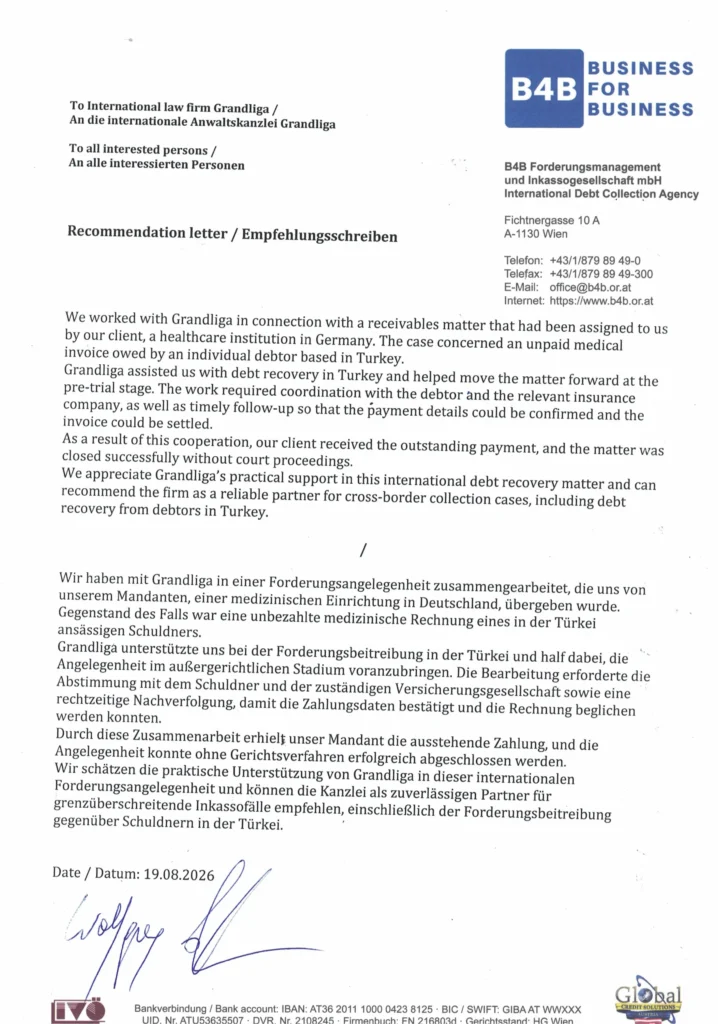
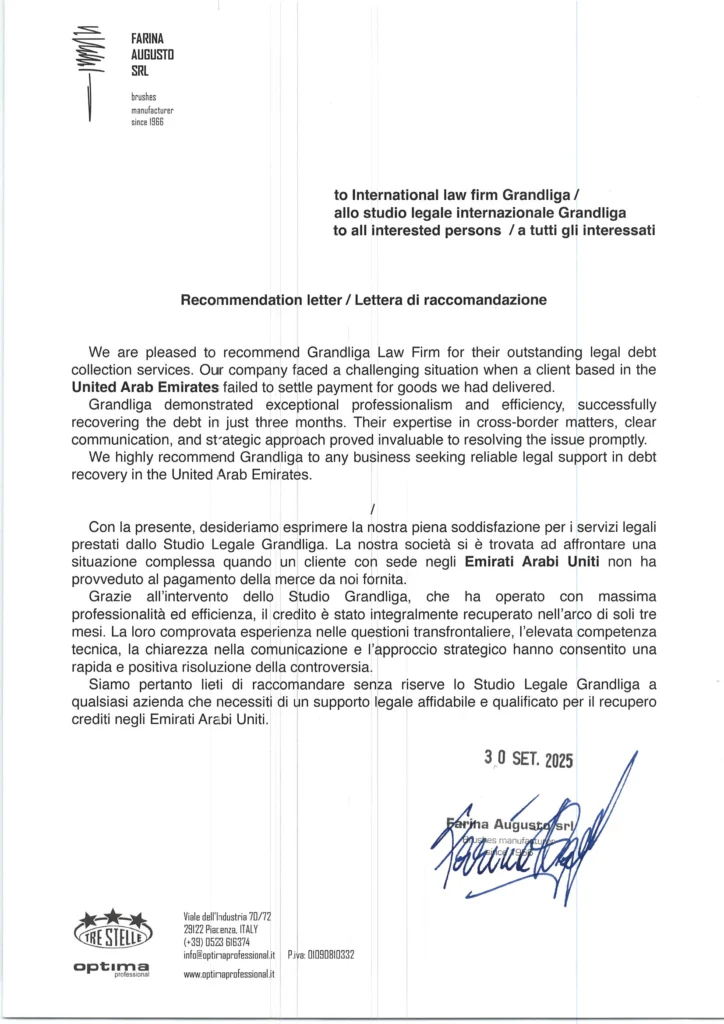
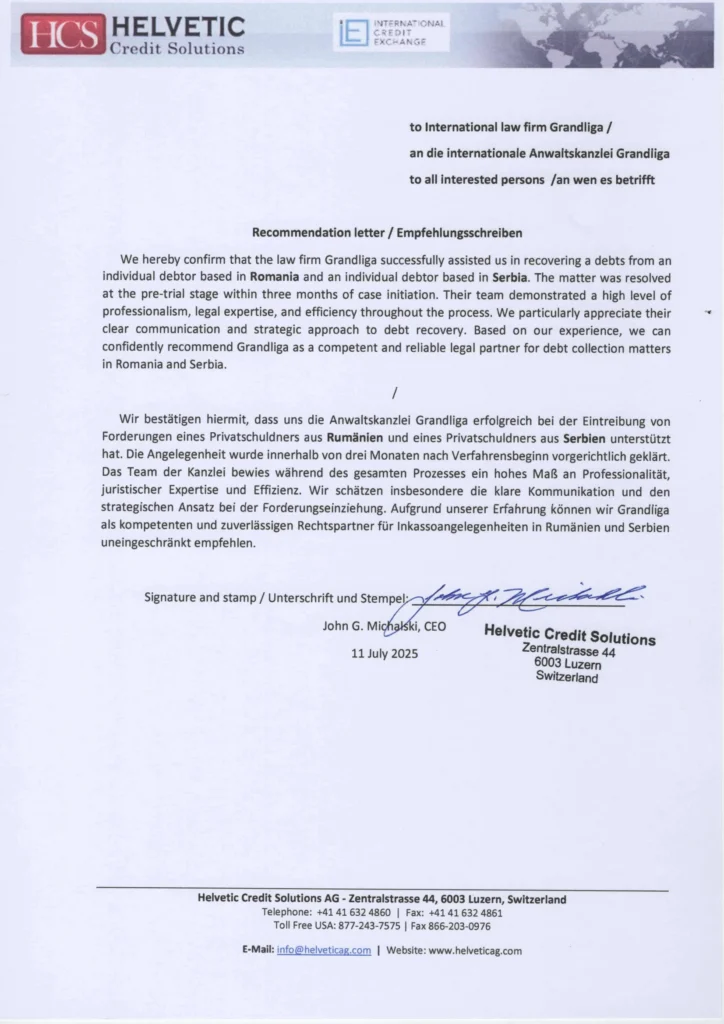
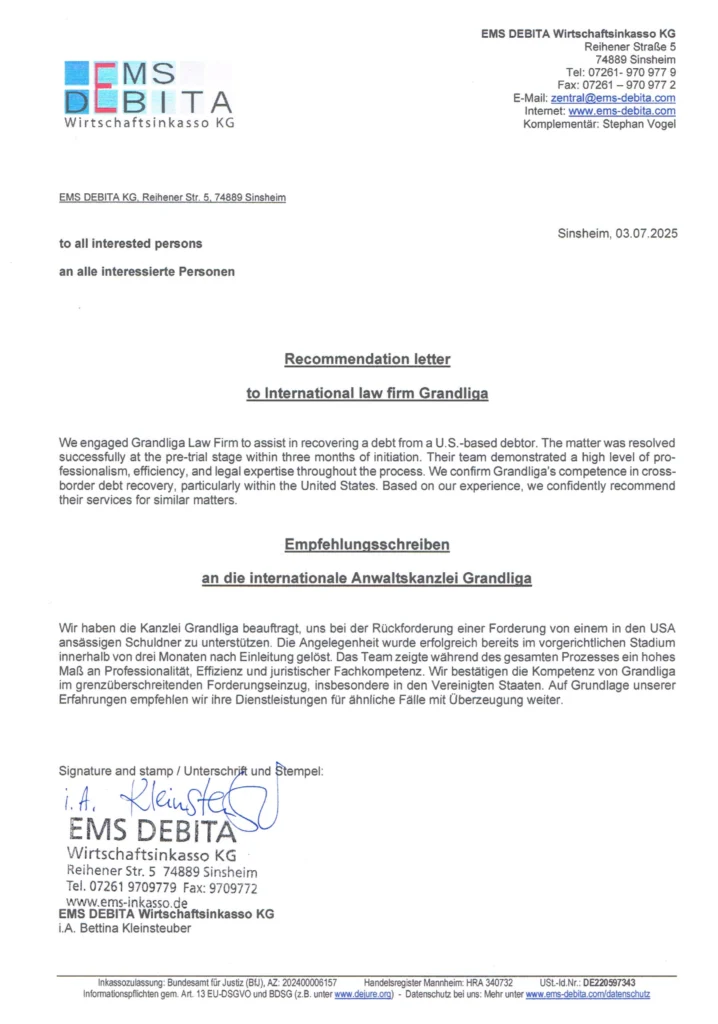
If you need support with debt collection in Cambodia, Grandliga can assist at all relevant stages: analysis of the debtor and assets, assessment of debt documents, preparation of an out-of-court strategy, negotiation of payment, selection of the appropriate court procedure, support in litigation, application for a payment order, recognition and enforcement of a foreign court judgment, initiation of enforcement proceedings and assessment of insolvency-related measures. The appropriate strategy depends on the nature of the claim, available evidence, the debtor’s address, assets located in Cambodia and the realistic possibility of turning a legal title into actual recovery.