Let's discuss your case
We will analyze and give recommendations
Debt collection in Peru should begin with a combined review of the debtor, the document that created the obligation and the assets that may allow real recovery. In a Peruvian commercial debt case, it is not enough to confirm only the outstanding amount. It is important to verify the debtor’s identification details, tax registration where applicable, current business activity, existing court or enforcement proceedings, available guarantees, the chain of invoices, purchase orders, delivery records, acceptance documents, business correspondence and any acknowledgement of the debt. If the obligation is supported by negotiable invoices, commercial securities, out-of-court settlements or notarized documents, this review also helps determine whether the creditor has a document that allows a more direct enforcement route.
If the debtor continues to operate, has verifiable communication channels and does not show clear signs of insolvency or serious disputes, the strategy may begin with a documented out-of-court stage. In Peru, this stage is useful not only as an attempt to obtain payment without litigation, but also as a way to record the debtor’s position, obtain full or partial acknowledgement of the obligation, agree on a payment schedule and prepare stronger evidence for a later claim or enforcement.
Out-of-court debt collection should be carried out through formal communications and structured negotiations. The creditor’s demand should identify the obligation, the amount claimed, the documents supporting the debt and the proposed method of payment. Depending on the debtor’s response, a settlement may include full payment, payment by instalments, acknowledgement of debt, return of goods, transfer of the obligation to a third party, set-off of mutual claims or provision of properly documented security.
The first contact with the debtor should be made through a channel that allows the creditor to preserve proof of the demand and of the debtor’s reaction, such as a letter, email, notarized notice, business correspondence or another verifiable method of communication. At this stage, it is important to identify the people with actual decision-making authority, confirm whether the debtor accepts or disputes the debt, assess whether there is a real payment proposal and preserve every acknowledgement, objection or promise of performance.
The average period for informal out-of-court collection may be up to 60 days, unless the parties agree on a longer repayment schedule. If the debtor does not respond, denies the obligation, offers unrealistic terms, conceals relevant information or the initial review shows that negotiations do not sufficiently protect the creditor, the next step should be preparing judicial debt collection or an enforcement route based on the available documents.
Before initiating legal action, the applicable limitation period must be determined. Under the Peruvian Civil Code, personal claims, real claims, claims arising from an enforceable judgment and claims for nullity of a legal act are subject to a 10-year limitation period, while a claim for payment for services provided outside an employment relationship is subject to a 3-year limitation period. The consequences of limitation apply when the debtor invokes them in the proceedings, so the creditor should verify the due date of the obligation, any acknowledgement of debt and any communications that may have interrupted the limitation period.
If the debt is documented by commercial securities, the time limits may be shorter and are governed by special rules. A direct action against the principal obligor and its guarantors is time-barred after 3 years from maturity; a recourse action against jointly liable parties and their guarantors is time-barred after 1 year; and a further recourse action is time-barred after 6 months. These terms are especially important where the debt is based on bills of exchange, promissory notes, cheques, negotiable invoices or other instruments used in commercial transactions.
In ordinary civil claims, after interruption, the limitation period starts running again according to the act that caused the interruption. Limitation may be interrupted by acknowledgement of the obligation, a demand placing the debtor in default, service of the claim or another act notifying the debtor, even if made before a court or authority without jurisdiction, as well as by a judicial objection based on set-off. For claims arising from commercial securities, the law provides separate rules on the calculation and nature of the time limits.
Peruvian law allows judicial debt collection through different procedural routes depending on the nature of the obligation, the amount claimed, the complexity of the dispute and the existence or absence of a document with enforcement force. If the creditor needs the court to establish the existence, enforceability or amount of the debt, the claim may be heard in ordinary, abbreviated or summary proceedings, depending on the case.
In ordinary proceedings, collection begins with the filing of a claim before the competent court. The judge reviews whether the claim meets the legal requirements, examines the evidence offered and, if the claim is admitted, serves it on the defendant so that the defendant can submit a response within thirty days.
In the response to the claim, the defendant must address each fact stated by the creditor. Silence, an evasive answer or a general denial may be assessed by the judge as acknowledgement of the facts, depending on the circumstances of the case. The defendant must also set out the facts on which the defence is based in a precise, orderly and clear manner.
If the defendant has been duly served and does not respond within the prescribed period, the defendant may be declared in default. This does not remove the judge’s duty to review the merits of the claim, the sufficiency of the documents and the consistency of the facts presented by the creditor.
If the judge considers that the case is ready to be decided, the judge may issue a judgment, except where the law requires certain elements to be proved by documents that have not been submitted, or where the facts stated in the claim do not provide sufficient conviction.
If the defendant appears and contests the claim, the judge may convene a conciliation hearing, determine the disputed issues and decide whether the proposed evidence is admitted or rejected. If no evidentiary activity is required, the court may proceed to an early decision. If evidence must be examined, the judge sets the date for the corresponding hearing.
In ordinary proceedings, the Peruvian Civil Procedure Code provides, among other time limits, ten days to offer additional evidence when the defendant’s response raises facts not stated in the claim, fifty days to hold the evidence hearing and fifty days to issue the judgment. Once the admitted evidence has been examined and the procedural issues necessary for the continuation of the case have been resolved, the judge closes the evidentiary stage and the case becomes ready for judgment. In the judgment, the judge assesses the debt claimed, the documents submitted, the defendant’s position, the evidence examined and the arguments of the parties, then declares the claim upheld, dismissed or partially upheld and, where appropriate, determines the enforceable amount, interest, court expenses and procedural costs.
Abbreviated proceedings may be used where the amount, subject matter and applicable procedural route allow the case to be handled more quickly than ordinary proceedings. In this route, the time limits are shorter: ten days to respond to the claim, five days to offer evidence if the response raises facts not stated in the claim, twenty days for the evidence hearing and twenty-five days to issue the judgment.
The judgment of the court of first instance may be challenged by appeal within the time limit applicable to the procedural route. In ordinary proceedings, the time limit for appealing a judgment is ten days; in abbreviated proceedings, the time limit is five days. The appeal allows the court of second instance to review the challenged judgment within the limits of the appeal and issue a decision confirming, modifying or reversing what the first judge decided.
The decision of the court of second instance may reach the Supreme Court of Peru through cassation review when the statutory conditions are met. In civil matters, this remedy is available against judgments and orders issued by higher courts acting as second-instance courts that end the case, where the claim exceeds five hundred procedural reference units or cannot be valued in money, the second-instance decision fully or partially reverses the first-instance decision, and the decision is not merely annulment-based. In exceptional cases, review may also be admitted when the Supreme Court considers it necessary for the development of case law.
The cassation filing is submitted through the court of second instance that issued the challenged decision within ten days from the day following notification, plus any distance period where applicable. If the second-instance court admits the filing, it sends the case file to the Supreme Court. The Civil Chamber of the Supreme Court decides on admissibility within twenty days. If the filing is declared admissible, the file remains in the chamber’s registry for ten days so that the parties may examine it and submit additional arguments. After the cassation hearing, the cassation judgment is issued within twenty days and is adopted with the concurring vote of four Supreme Court judges.
Where the creditor holds a document with enforcement force, the case may proceed through the single enforcement proceeding. This route is relevant for final court judgments, final arbitral awards, settlement records made in accordance with the law, commercial securities with an enforceable claim, certificates of ownership of securities represented by book entries, pre-secured evidence, acknowledged private documents, out-of-court settlements, unpaid rental documents, notarized instruments and other documents to which the law grants enforcement force.
In a single enforcement proceeding, the application is filed together with the enforcement document, and the court may issue an enforcement order requiring performance of the obligation. The debtor may object within five days from notification of the order, but the grounds for objection are limited by law. They include unenforceability or lack of liquidity of the obligation, formal invalidity or falsity of the document, completion of an incomplete commercial instrument contrary to the parties’ agreement, or extinction of the obligation claimed. For the creditor, this route may be decisive where the debt document is properly formed and allows a faster transition to enforcement measures.
If the creditor has already obtained a foreign court judgment, a foreign arbitral award or another decision issued outside Peru, the strategy for recognition and enforcement of foreign judgments should be assessed before filing a new claim based on the same debt. In Peru, this procedure allows a foreign decision to produce legal effects and become the basis for later measures against the debtor or assets located in the country.
For recognition, the relevant factors usually include the jurisdiction of the foreign court, proper service on the defendant, a real opportunity to defend the case, the final nature of the decision, the absence of pending proceedings in Peru between the same parties and on the same subject matter, compatibility with public order and reciprocity. In practice, the creditor also prepares the full legalized text of the decision, an official Spanish translation where required and documents proving that the decision is final and enforceable.
Once a Peruvian court judgment, an enforcement document or a recognized foreign decision can be enforced in Peru, the creditor moves to the enforcement stage. A claim arising from an enforceable judgment is subject to a 10-year limitation period. At this stage, the creditor’s claims may be satisfied through measures over the debtor’s funds, seizure and sale of movable and immovable property, action against securities, shares, company interests, claims against third parties and other legally attachable assets.
The practical value of enforcement depends on the early identification of assets, accounts, receivables, recent transactions and existing encumbrances. For this reason, in a commercial debt case in Peru, enforcement should be prepared from the initial review stage: a favourable judgment is more useful when the creditor already understands which assets may be targeted and which measures may protect the economic result of the procedure.
An alternative recovery route may be the ordinary insolvency proceeding involving the debtor. This mechanism is relevant where the debtor is a company in serious payment difficulty and individual recovery through negotiations, a claim or enforcement does not provide sufficient protection for the creditor. The creditor may request the opening of the proceeding where its due, payable and unpaid claims meet the statutory conditions, including exceeding the equivalent of fifty tax units and non-payment within the statutory period after maturity.
The insolvency proceeding in Peru is conducted before the competent administrative authority and includes, among other stages, commencement of the proceeding, publication, recognition of creditor claims and convening of the creditors’ meeting. For the creditor, recognition of the claim is a central step because it allows participation in the proceeding and protection of the creditor’s economic position against other commercial, labour, tax, family-support or social-security creditors.
If the debtor’s assets are insufficient to satisfy the claims in full, transactions and acts that improperly reduced the available estate may be reviewed. The court may declare encumbrances, transfers, contracts and other legal acts of the debtor ineffective against creditors, whether gratuitous or for value, if they were not connected with the normal development of the debtor’s activity, caused damage to the debtor’s property and were carried out within one year before the request to open the insolvency proceeding, the debtor’s summoning to the proceeding or the start of dissolution and liquidation.
Early payments of obligations not yet due, payments of due obligations made in a manner different from that agreed, transactions for value outside the ordinary course of business, set-offs between mutual obligations, creation of security for earlier debts, judicial or out-of-court enforcement after publication of the insolvency proceeding, mergers, absorptions or divisions that reduce the estate, and other transactions affecting the assets available to creditors may also be relevant.
The request to declare such acts ineffective is handled through summary proceedings and may be brought by the debtor’s management, the liquidator or one or more recognized creditors. If the request is upheld, the court orders the return of assets to the insolvency estate or the removal of established encumbrances, depending on the circumstances. This mechanism may increase the assets available to creditors, although actual recovery depends on asset value, priority of claims and the outcome of the proceeding.
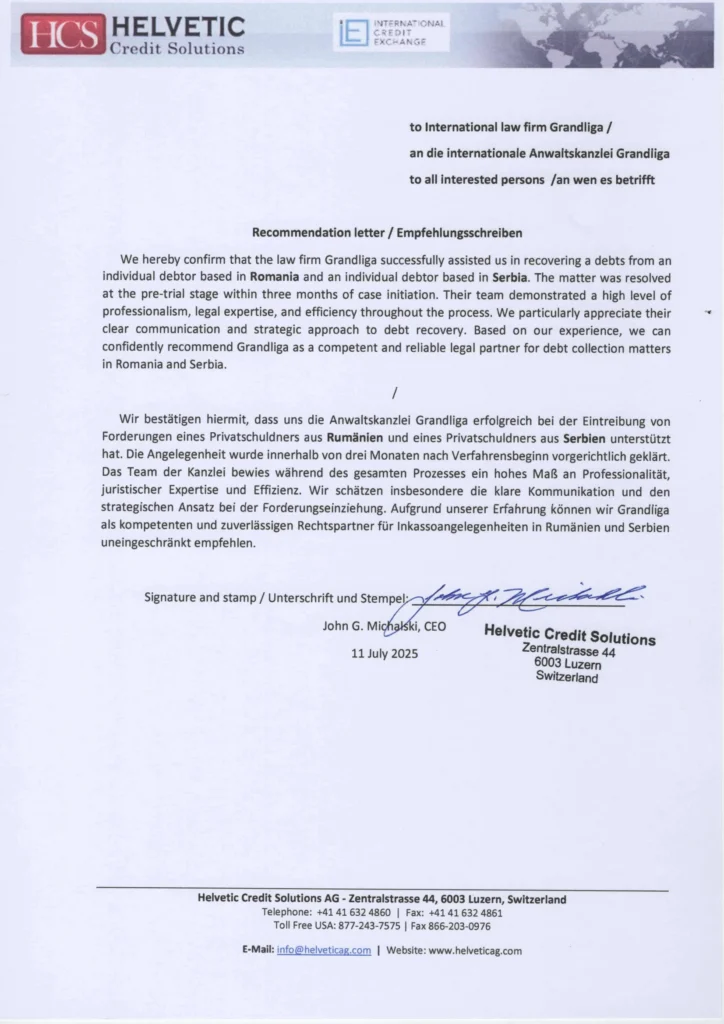
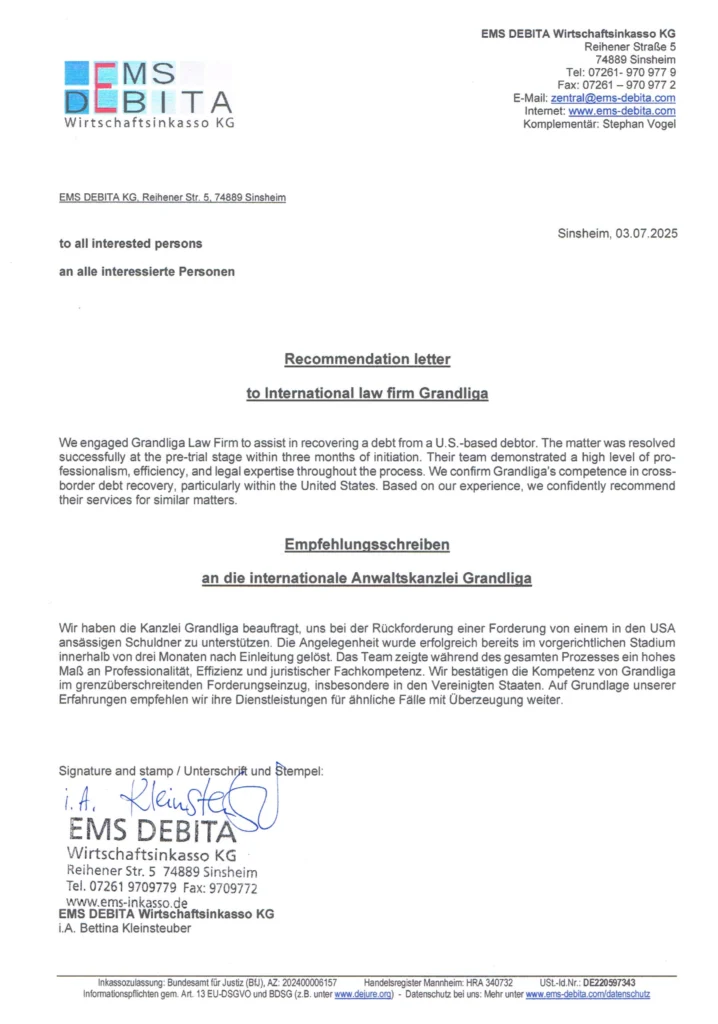
If you need support with debt collection in Peru, Grandliga can assist at every stage of the case: from the initial review of the debtor and documents to out-of-court negotiations, claim preparation, single enforcement proceedings, recognition of foreign decisions, enforcement and insolvency measures against a debtor in financial difficulty. Our work focuses on choosing a legally grounded recovery route, properly documenting the claim and coordinating the actions needed to protect the creditor’s interests in a domestic or international dispute.
# DEBT COLLECTION AGENCY PERU
 1178
1178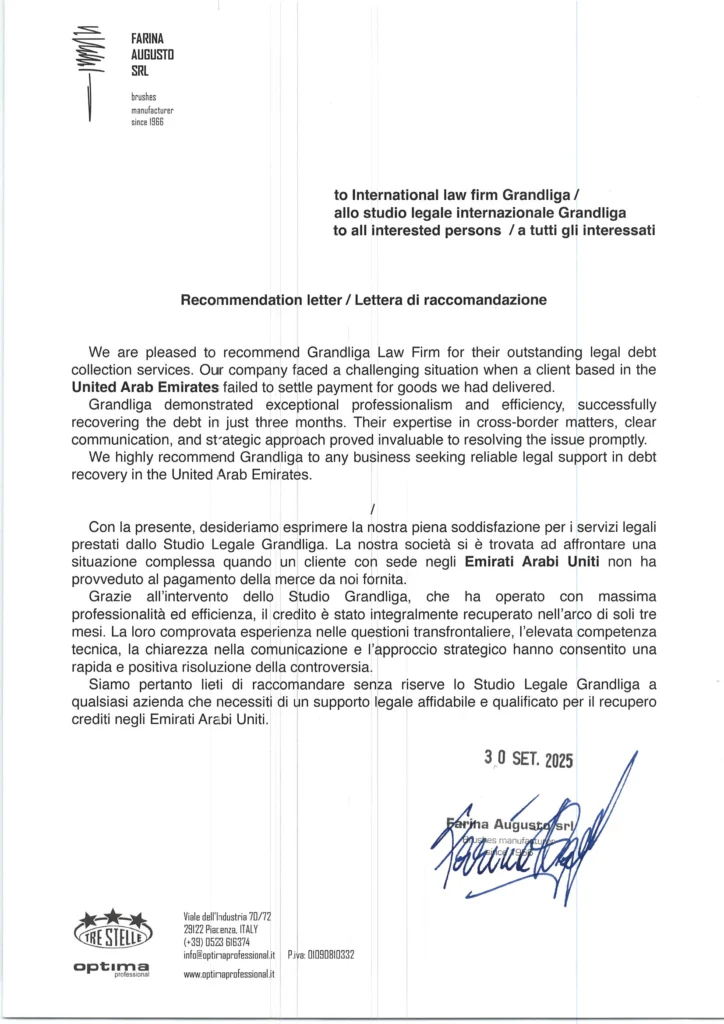

We will analyze and give recommendations