


Winning a judgment against a debtor does not necessarily give the creditor direct access to every asset that the debtor appears to control. This distinction becomes particularly important when the judgment debtor owns an interest in a Delaware limited liability company.
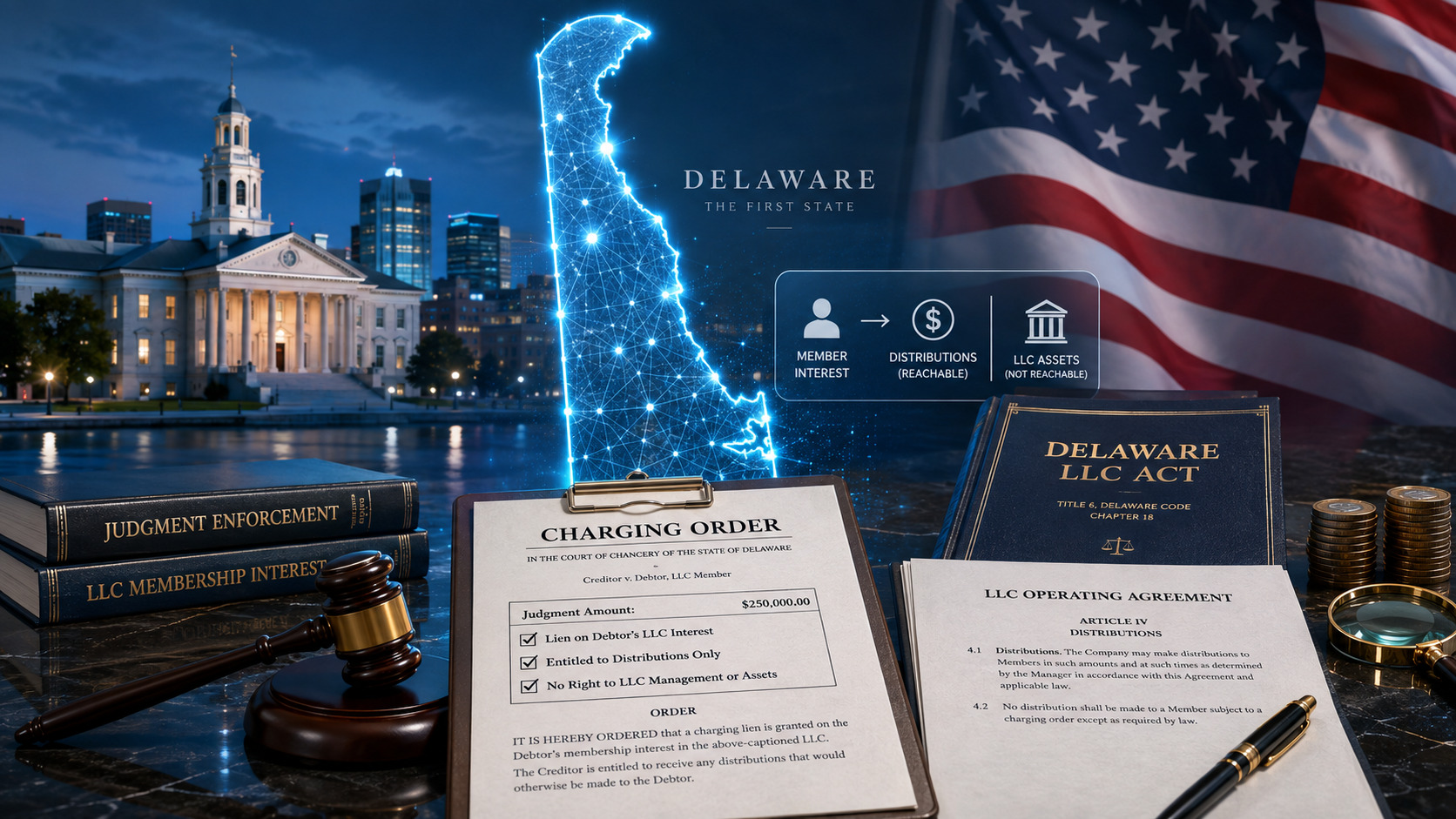
A Delaware LLC is legally separate from its members. If a debtor owns an LLC that holds real estate, cash, investments or other valuable property, the creditor generally cannot treat those assets as though they belonged directly to the debtor. Delaware law instead provides a specific remedy against the debtor’s LLC interest: the charging order.
For creditors involved in broader debt collection in the USA, this is an important example of why enforcement strategy must be examined at state level. A judgment may establish the debt, but the law governing a particular asset can determine what the creditor can actually reach.
The member does not own the LLC’s specific property
The starting point is § 18-701 of the Delaware Limited Liability Company Act.
The statute treats a member’s interest in a Delaware LLC as personal property. At the same time, it expressly provides that a member has no interest in specific property owned by the LLC.
This distinction has major practical consequences.
Suppose a judgment debtor is the sole member of a Delaware LLC. The LLC owns a commercial building worth several million dollars and maintains its own bank account. Even though the debtor controls the company, the building and the money in the LLC’s account are not automatically the debtor’s personal property.
A judgment against the individual member is therefore not, by itself, a judgment against the LLC.
The creditor must identify exactly what the judgment debtor owns. In this situation, the debtor owns an interest in the LLC, while the LLC owns the underlying assets.
That difference is the foundation of Delaware’s charging-order regime.
What a Delaware charging order gives the creditor
Under § 18-703(a), a judgment creditor of an LLC member or the member’s assignee may apply to a court with jurisdiction for an order charging the debtor’s LLC interest with payment of the judgment.
Once entered, the charging order constitutes a lien on the judgment debtor’s LLC interest.
However, the creditor’s statutory entitlement is narrowly defined. To the extent of the charging order, the creditor has the right to receive distributions that would otherwise have been paid to the judgment debtor.
For example, if the debtor would ordinarily receive a $50,000 distribution from the LLC, the charging order may redirect that distribution toward satisfaction of the judgment.
This does not mean that the creditor automatically becomes a member of the LLC, obtains voting rights or takes control of the company’s business.
More importantly, it does not give the creditor a general right to seize property owned by the LLC.
The charging order is the exclusive remedy against the LLC interest
Section 18-703(d) contains one of the most important protections in the Delaware statute.
It provides that entry of a charging order is the exclusive remedy by which a judgment creditor may satisfy a judgment from the debtor’s LLC interest. Attachment, garnishment, foreclosure and other legal or equitable remedies against that interest are not available.
Section 18-703(e) goes further. A creditor of a member has no right, merely because of that creditor relationship, to obtain possession of or exercise legal or equitable remedies with respect to property belonging to the LLC.
The scope of the rule should nevertheless be stated carefully.
It does not mean that a debtor who owns a Delaware LLC is immune from enforcement. Nor does it necessarily prevent a creditor from pursuing an independent claim against an LLC or another party where separate legal grounds for liability exist.
What the statute restricts is the creditor’s ability to use the debtor’s LLC interest as a route to bypass the legal separation between the member and the company.
The rule also applies to single-member Delaware LLCs
A particularly important feature of Delaware law is that the charging-order rule is not limited to companies with several members.
Section 18-703(d) expressly states that the rule applies whether the LLC has one member or more than one member.
That wording was added by the Delaware legislature in 2013. The amendment became effective on August 1, 2013 and removed potential uncertainty over whether a different enforcement approach should apply when the judgment debtor is the sole member of the LLC.
This matters because a single-member LLC can appear, from an economic perspective, to be almost indistinguishable from its owner. The owner may control the company, make all management decisions and receive all economic benefits.
Nevertheless, Delaware law does not eliminate the charging-order regime merely because there are no other members whose interests require protection.
A creditor should therefore not assume that sole ownership permits direct foreclosure on the LLC interest or seizure of the LLC’s underlying property.
A charging order may exist without producing immediate payment
The difference between obtaining a charging order and actually recovering money is illustrated by Delaware Acceptance Corporation v. Estate of Frank C. Metzner, Sr.
The creditors had obtained a charging order against distributions relating to interests in a family LLC. The LLC’s only asset was a home in which the debtors continued to live, and no distributions were made to them. As a result, although the charging order existed, there were no distributions available to redirect to the creditors.
The case later involved additional questions concerning the death of a member, continuation of the LLC and administration of the member’s estate. It should therefore not be read as establishing that every creditor facing a non-distributing LLC has the same options or outcome.
Its practical lesson is narrower but important: a charging order is an enforcement mechanism, not a guarantee of immediate recovery.
If the LLC retains its income, owns non-income-producing property or simply makes no distributions to the judgment debtor, the economic value of the charging order may be limited until circumstances change.
For this reason, an enforcement analysis should not stop after discovering that the debtor owns an LLC interest.
Can an LLC simply be used to hide assets from creditors?
The charging-order statute provides substantial protection for the legal separation between an LLC and its member, but that protection should not be confused with permission to use an entity fraudulently.
A significant Delaware decision on this issue is Manichaean Capital, LLC v. Exela Technologies, Inc.
The Delaware Court of Chancery considered allegations that entities in a corporate structure were being used to divert funds that would otherwise have flowed through an entity subject to a charging order.
The court recognized a carefully limited form of outsider reverse veil piercing under Delaware law. This doctrine may, in exceptional circumstances, allow a creditor to argue that the separateness of an entity should be disregarded so that the entity can be reached in connection with a judgment against its owner.
The decision does not create a routine exception to § 18-703.
The Court stressed that Delaware strongly respects corporate separateness and that reverse veil piercing should be reserved for exceptional circumstances. Relevant considerations include whether the entity is effectively the owner’s alter ego, whether the corporate structure is being used to perpetrate fraud or injustice, and whether innocent shareholders or creditors would be harmed.
In Manichaean Capital, the court found that the plaintiffs had sufficiently pleaded their reverse-veil-piercing claim to allow it to proceed at that stage of the litigation. The court did not treat ordinary nonpayment of a judgment as enough to disregard separate legal personality.
The same decision also illustrates the limits of attempts to bypass the charging-order statute. The court dismissed an unjust-enrichment claim that would have effectively created a separate route around the exclusive-remedy provision of § 18-703.
For creditors, the distinction is critical: a charging order cannot simply be avoided by relabelling an ordinary collection effort as an equitable claim. A genuinely independent basis for challenging misuse of the corporate form requires its own facts and legal analysis.
What an international creditor should examine
When a judgment debtor owns a Delaware LLC, the value of enforcement depends on more than the nominal value of the company.
The creditor should first establish who actually owns each relevant asset. Property belonging to the debtor personally must be distinguished from property held by the LLC or by other affiliated entities.
The creditor should also examine the debtor’s precise membership interest, including whether the debtor is the sole member, the percentage owned and the economic rights attached to that interest.
The LLC agreement may also be important. It can help clarify rights to distributions, management arrangements and other features of the debtor’s interest, although contractual provisions cannot simply eliminate statutory rights available to a judgment creditor.
Actual and historical distributions should be reviewed as well. A profitable company that regularly distributes funds may make a charging order commercially significant. An LLC that retains all earnings or holds a single illiquid asset may present a very different enforcement picture.
Corporate structure is another important issue. If money moves among related entities, the creditor may need to determine whether those transactions have legitimate commercial explanations or whether separate claims concerning fraudulent transfers, alter-ego liability or other misconduct require investigation.
For an international creditor, there may also be a preliminary question: whether a foreign judgment has first been recognized in the relevant United States jurisdiction. Recognition of a foreign-country judgment and enforcement against a Delaware LLC interest are separate legal stages and should not be treated as the same procedure. The broader process is discussed in Grandliga’s guide to debt collection in the USA.
What a creditor should not assume
Ownership of a Delaware LLC can create misleading expectations on both sides.
A creditor should not assume that:
- sole ownership of an LLC makes all company assets personal assets of the debtor;
- a judgment against the member automatically becomes enforceable against the LLC;
- obtaining a charging order guarantees prompt payment;
- a single-member LLC falls outside § 18-703;
- the charging-order rule creates absolute protection against genuinely independent claims based on fraud or misuse of the entity.
Likewise, a debtor should not assume that moving economic activity through an LLC automatically defeats enforcement. Delaware protects legal separateness, but its courts may examine exceptional allegations that an entity structure is being abused to perpetrate fraud or injustice.
Conclusion
A judgment against the owner of a Delaware LLC does not normally allow the creditor to seize the LLC’s property as though it belonged directly to the debtor.
Delaware law separates the member’s LLC interest from the company’s underlying assets. Under § 18-703, the principal statutory remedy against that membership interest is a charging order, which generally directs distributions otherwise payable to the judgment debtor toward satisfaction of the judgment.
The rule expressly applies to both single-member and multi-member LLCs.
For creditors, the practical challenge is therefore not simply to locate a Delaware LLC, but to understand what the debtor actually owns, whether the LLC makes distributions and whether there are any genuinely independent grounds for claims involving affiliated entities or transferred assets.
A successful judgment is only one part of the recovery process. Asset ownership, corporate structure and the law governing the particular enforcement mechanism can determine whether the judgment ultimately produces payment.


