


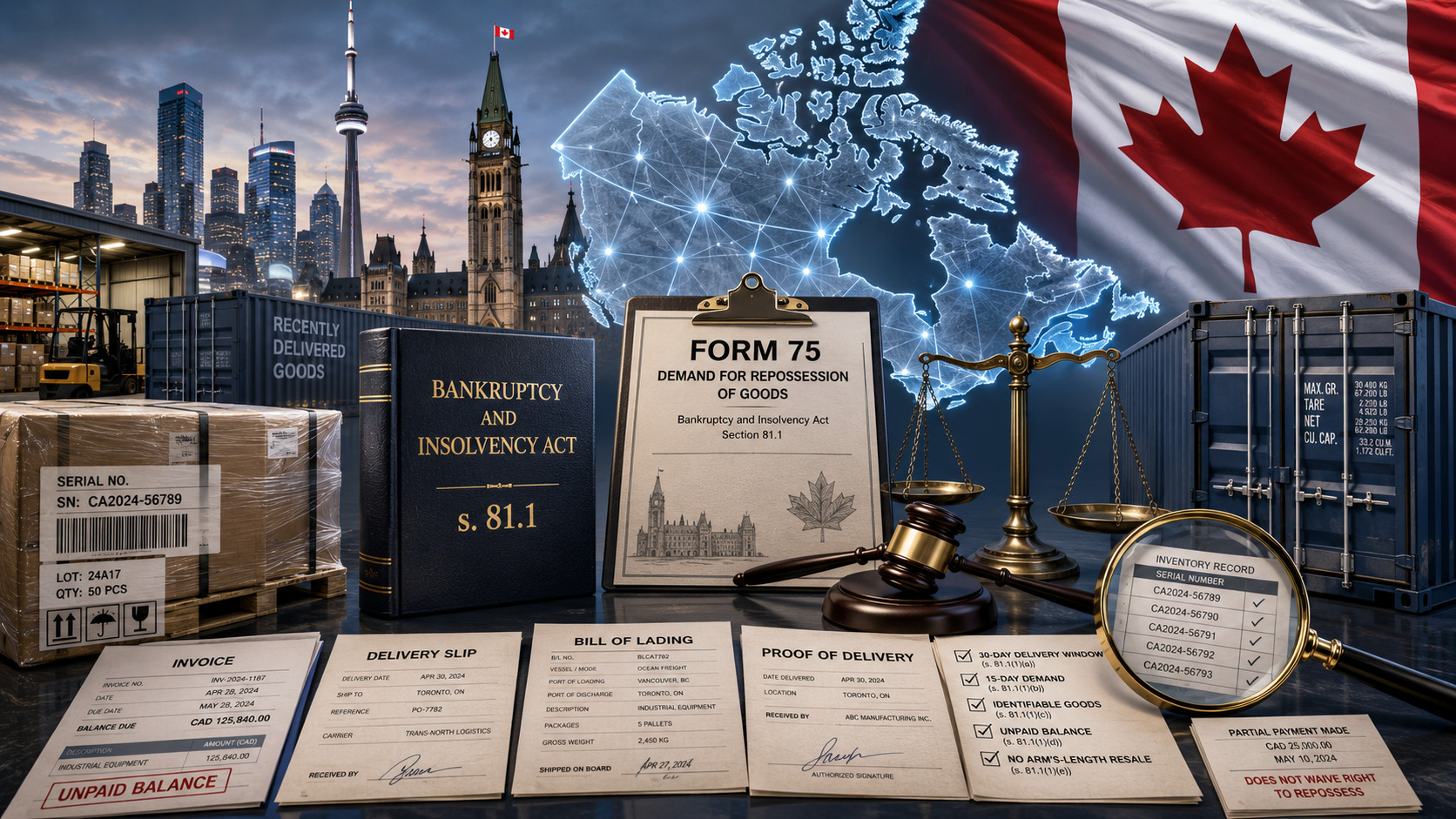
An overseas supplier ships equipment, components or finished goods to a Canadian customer on credit. The goods arrive, the invoice remains unpaid and, before the supplier can recover the debt in the ordinary way, the customer enters bankruptcy or receivership.
At that point, the supplier may appear to be in the same position as every other unpaid trade creditor: prove the debt and wait for whatever distribution the insolvency process produces.
Canadian federal law creates an important exception.
Under section 81.1 of the Bankruptcy and Insolvency Act, a qualifying unpaid supplier may be able to recover the actual goods it delivered rather than simply claim their unpaid price.
The remedy is potentially powerful because the supplier’s repossession right ranks ahead of other claims or rights against the purchaser in respect of those goods, subject to the statutory exception for a bona fide subsequent purchaser for value without notice.
But the right is deliberately narrow. A supplier can lose it because of timing, resale, a change in the condition of the goods, an inability to identify them, or even because the insolvency event is not the type of bankruptcy or receivership contemplated by the legislation.
A narrow exception for recently delivered goods
Section 81.1 applies where goods were sold and delivered for use in the purchaser’s business and the purchaser has not fully paid for them.
The legislation does not create a general right to reverse every unpaid sale after a customer becomes insolvent.
At the time the statutory demand is made, the goods must still:
- be in the possession of the purchaser, trustee or receiver;
- be identifiable as the goods delivered by the supplier and not fully paid for;
- be in the same state as when they were delivered;
- not have been resold at arm’s length; and
- not be subject to an agreement for sale at arm’s length.
The purchaser, trustee or receiver also has an alternative to releasing the goods: the outstanding balance may be paid forthwith after the demand is presented.
For a foreign supplier, this means that the commercial value of section 81.1 depends heavily on what has happened to the goods since delivery.
A packaged machine carrying a serial number may present a very different recovery opportunity from chemicals already consumed in manufacturing, components incorporated into finished products or inventory already committed to customers.
The 30-day / 15-day trap
Two different statutory periods have to be kept separate.
First, the goods generally must have been delivered within 30 days before the purchaser became bankrupt or became subject to a qualifying receivership.
Second, the supplier must present the prescribed written demand within 15 days after the bankruptcy or receivership begins.
These are not interchangeable deadlines.
Consider a supplier that delivered goods 20 days before a receiver was appointed. The delivery may fall within the 30-day window, but the supplier can still lose the federal repossession right by waiting more than 15 days after the receivership before acting.
The reverse can also occur. A supplier may react immediately after learning about the receivership, but goods delivered outside the applicable 30-day delivery period will generally not qualify under section 81.1.
There is another complication where the purchaser filed a notice of intention to make a proposal, or filed a proposal, after receiving the goods but before the later bankruptcy or receivership.
In that situation, subsection 81.1(4) changes the relevant reference point. The 30-day period is measured before the filing of the notice of intention or, where there was no notice of intention, before the filing of the proposal.
A creditor therefore should not calculate eligibility only from the date on which a receiver appears or the customer formally becomes bankrupt. Earlier restructuring filings may change the analysis.
The 15-day period is equally unforgiving. Subsection 81.1(5) provides that the right expires if it is not exercised within that period unless an extension is obtained before the period expires from the trustee, receiver or court.
Waiting for an internal credit committee, a foreign insurer or headquarters to approve the next step may therefore have a substantive legal cost.
The goods must still be identifiable
Identification is often the practical battle.
Suppose an overseas manufacturer shipped 200 individually numbered industrial devices to a Canadian distributor. If 80 remain unopened in the distributor’s warehouse and their serial numbers can be matched to the supplier’s shipping records, there may be a relatively clear factual path to identification.
The position is much harder where the supplier delivered bulk raw materials that were mixed with other stock, packaging that has already been used, components installed into another product or homogeneous inventory that cannot reliably be distinguished from goods supplied by someone else.
The statutory requirement is not simply that similar goods still exist. They must be identifiable as the goods delivered by the particular unpaid supplier.
This is why invoices alone may not be enough.
Purchase orders, delivery slips, bills of lading, warehouse records, serial numbers, batch numbers, photographs, pallet identifiers and electronic inventory records may become central evidence.
Stereo People shows why speed can matter more than perfect paperwork
The Alberta Court of Appeal addressed the identification problem in Royal Bank of Canada v Stereo People of Canada Ltd, 1996 ABCA 348.
The decision was made under an earlier version of section 81.1, so its historical timing rules should not be substituted for the current 30-day and 15-day framework. Its reasoning on the function of the demand and identification of goods, however, remains important and continues to be cited in Canadian bankruptcy-law materials.
The Court distinguished between giving notice of the claim and ultimately proving that the goods qualify.
It held that section 81.1 did not require every piece of identification evidence to accompany the demand itself. The supplier had to make a bona fide effort to provide transaction details and information relating to identification, but complete verification might only become possible after physical inspection of the inventory.
That distinction has an obvious practical consequence.
A supplier approaching the statutory deadline should not automatically postpone the demand merely because every serial number, warehouse location or supporting document has not yet been reconciled.
That does not mean that an incomplete or vague demand will always succeed. The supplier still has to satisfy the statutory requirements and ultimately identify the goods.
But Stereo People illustrates why section 81.1 is designed to operate quickly. The initial demand is a notice of the asserted repossession right, while the factual verification of the inventory may require additional work.
An agreement to resell the goods can defeat the remedy
Possession and physical identification are not the only issues.
Section 81.1 also excludes goods that have been resold at arm’s length or are already subject to an arm’s-length agreement for sale.
The distinction was important in ITI Education Corp., Re, 2002 NSSC 117.
A supplier sought the return of books it had supplied to an educational company in receivership. The books had not simply disappeared into an unidentified inventory pool. The problem was contractual: the debtor had agreements with students under which it was required to provide the relevant course materials.
The Nova Scotia Supreme Court concluded that the books were subject to an agreement for sale at arm’s length and therefore did not qualify for repossession under section 81.1.
For commercial suppliers, the practical lesson is broader than the particular facts of that case.
Finding the goods in a warehouse does not necessarily mean they remain available for repossession.
A supplier should also determine whether the purchaser has already entered into binding downstream transactions concerning those goods. Customer orders, distribution contracts and other sale commitments may affect the analysis even before the inventory physically leaves the premises.
Financial distress alone does not activate section 81.1
Another common mistake is to assume that section 81.1 becomes available whenever a Canadian customer is insolvent or an insolvency professional becomes involved.
The legislation is more specific.
For section 81.1, the current statutory definition of a receiver refers to a receiver within the meaning of subsection 243(2) of the Bankruptcy and Insolvency Act.
The distinction between different insolvency appointments has been examined by Canadian courts.
In Bruce Agra Foods Inc. v Everfresh Beverages Inc., the suppliers attempted to assert section 81.1 rights while an interim receiver was involved in a proposal proceeding. The Ontario court held that the statutory repossession right had not been triggered because the purchaser was not bankrupt and the particular interim receiver was not the receiver contemplated by the relevant provision.
The case arose under an earlier version of the legislation, but it demonstrates a continuing practical danger: the label “receiver” or the existence of a restructuring proceeding should not be treated as sufficient without examining the legal basis of the appointment and the current statutory definitions.
For an overseas creditor receiving an urgent email stating that a customer is “in receivership”, the first question should therefore be documentary.
Obtain the court order, identify the insolvency professional’s legal capacity and confirm the date on which the qualifying event occurred.
Those details can determine whether the 15-day period has started at all.
Form 75 is not an ordinary collection letter
A normal demand for payment is not a substitute for the statutory repossession demand.
The Office of the Superintendent of Bankruptcy publishes Form 75 — Demand for Repossession of Goods for use under paragraph 81.1(1)(a).
The form calls for the supplier to identify the purchaser and describe the goods sold and delivered. It also instructs the claimant to attach supporting sale documents such as invoices and delivery slips and to provide an appropriate description of the goods.
That makes document preservation part of the recovery strategy.
An international supplier should be ready to assemble, at short notice:
- the sales contract or purchase order;
- invoices;
- delivery slips and proof of delivery;
- shipping and customs records where relevant;
- serial, batch or product numbers;
- warehouse or inventory information;
- evidence of any partial payment; and
- correspondence showing the unpaid balance.
Electronic submission also requires attention to the formal requirements noted on Form 75.
The supplier bears its own expense of accessing and repossessing the goods, so physical recovery costs should also be considered before exercising the right.
Partial payment does not necessarily end the repossession right
Section 81.1 contains a specific rule where the purchaser has paid only part of the price.
The supplier may repossess a proportion of the goods corresponding to the unpaid amount.
Alternatively, the supplier may repossess all of the qualifying goods by paying back to the purchaser, trustee or receiver the amount of the partial payment previously received.
This can matter where the goods cannot sensibly be divided into economically equivalent portions.
A supplier should therefore not assume that receipt of a deposit or instalment automatically prevents section 81.1 from applying.
At the same time, repossession changes the supplier’s monetary position. Subsection 81.1(10) states that a supplier who repossesses goods under the section is not entitled to be paid for those goods.
The remedy is recovery of the qualifying property, not double recovery of both the goods and their price.
The remedy is still used in modern Canadian receiverships
Section 81.1 is not merely a historical provision found in older insolvency cases.
A recent example appears in the 2025 receivership proceedings involving Giftcraft Holdings and related companies.
In its First Report dated July 8, 2025, KPMG, acting as receiver, reported that the receivership had resulted in certain suppliers having potential rights under section 81.1 in relation to recently supplied goods.
The receiver had received one section 81.1 claim for approximately C$13,329. After reviewing the claim, the receiver consented to the return of the relevant goods subject to repayment of a deposit. The deposit was repaid and the supplier repossessed the goods.
The report is not a new appellate interpretation of section 81.1, and it should not be treated as precedent changing the statutory test.
Its value is practical.
It shows that the mechanism continues to be invoked and administered in current Canadian commercial receiverships, including proceedings involving substantial secured debt and significant numbers of trade suppliers.
For overseas sellers, the 30-day and 15-day periods are therefore not academic details. They can determine whether a supplier participates merely as an unpaid creditor or is able to recover recently delivered inventory itself.
What an overseas supplier should do first
When a Canadian customer enters bankruptcy or receivership shortly after receiving unpaid goods, the supplier should establish the chronology immediately.
The critical questions are:
- What is the exact date and legal nature of the bankruptcy or receivership?
- Was a notice of intention or proposal filed earlier?
- On what dates were the unpaid goods delivered?
- Where are the goods now?
- Can they be linked to the supplier’s invoices and delivery records?
- Are they still in the same state as on delivery?
- Have they been resold or committed under an arm’s-length sale agreement?
- Has any part of the purchase price already been paid?
- Who must receive Form 75?
- When does the applicable 15-day period expire?
These questions should be investigated before ordinary collection discussions consume the available statutory window.
If section 81.1 is unavailable — for example, because the statutory deadline has expired, the goods have been processed, resold or can no longer be identified — this does not mean that the supplier has lost the ability to recover the debt. It simply means that the special right to repossess the goods themselves is no longer available. The supplier must then consider other available remedies, including filing a claim in the insolvency proceedings, pursuing the debt through litigation, seeking interim or protective measures where appropriate, and enforcing against the debtor’s assets. For foreign creditors, these issues form part of the broader strategy for debt collection in Canada, particularly where the supplier is located outside Canada and must navigate Canadian court, enforcement and insolvency procedures simultaneously.
Conclusion
Section 81.1 of Canada’s Bankruptcy and Insolvency Act gives certain unpaid suppliers something more valuable than an ordinary claim for money: the possibility of recovering recently delivered goods themselves.
But the remedy is built around strict conditions.
The goods generally have to fall within the applicable 30-day delivery window, the prescribed demand must be made within 15 days after the qualifying bankruptcy or receivership, and the goods must still be identifiable, unchanged and outside an arm’s-length resale or sale agreement.
Canadian cases also show that neither imperfect paperwork nor the mere presence of an insolvency professional answers the question by itself. Identification can require further factual work, while the precise legal character of the insolvency proceeding may determine whether the statutory right has arisen at all.
For an international supplier, the practical rule is therefore simple: when a Canadian buyer becomes insolvent shortly after delivery, treat the inventory and the calendar as urgent evidence.
A delay of a few days can convert a potential right to recover the goods into an ordinary unpaid debt.


