


International trade payments normally have a clear commercial basis. Goods are supplied, the parties document the transaction, and payment follows the terms of the agreement.
Problems arise when the trade itself is fictitious. False commercial documentation can be used to create the appearance of a legitimate transaction and provide a formal basis for transferring money abroad.
A case published by China’s State Administration of Foreign Exchange (SAFE) shows how this can work in practice.
The USD 9.015 million case
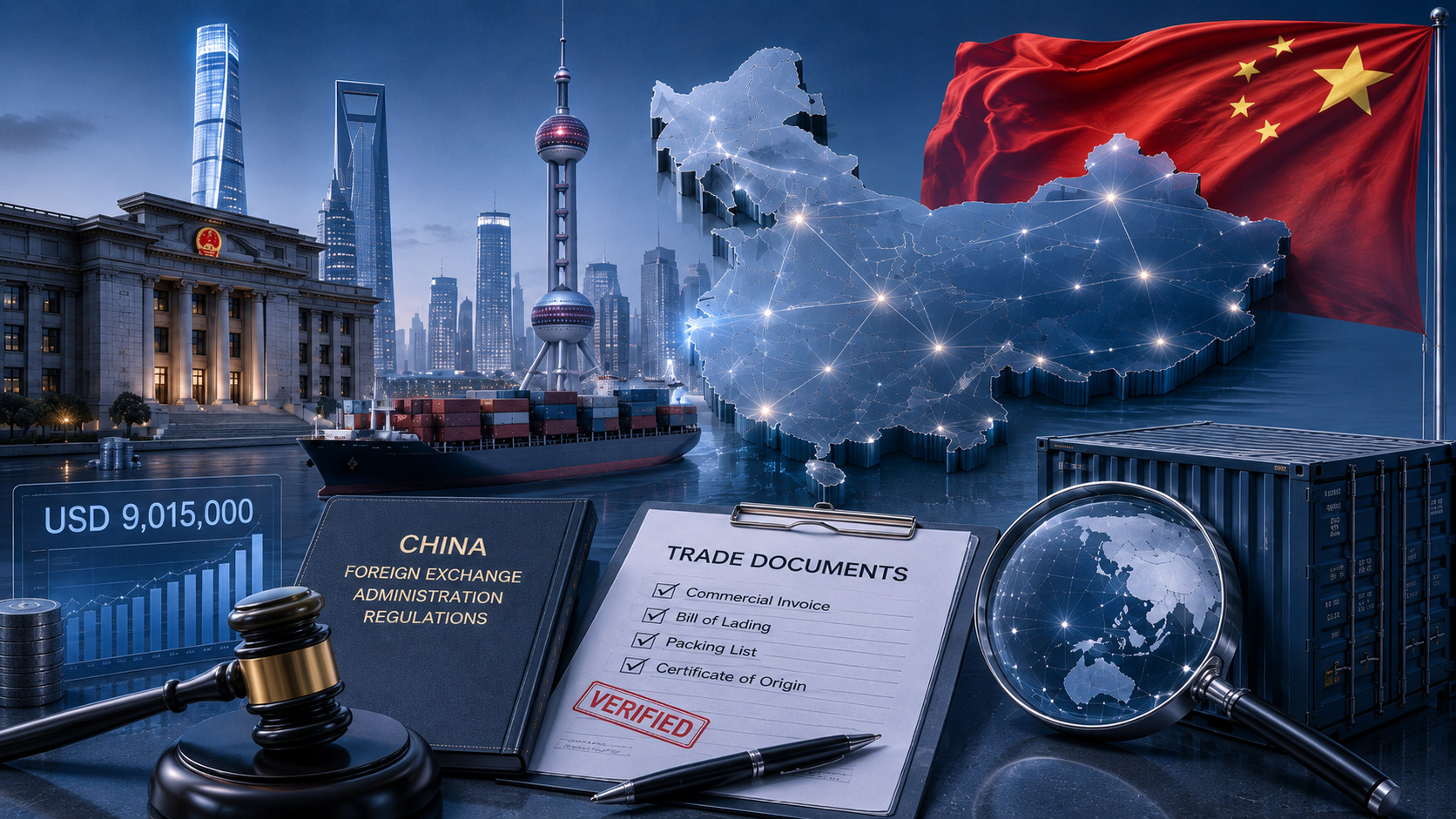
According to SAFE, in March 2016 Wenzhou Kecheng Trading Co., Ltd. fabricated the background of a trade transaction, submitted a false bill of lading and transferred USD 9.015 million abroad.
SAFE classified the conduct as foreign-exchange evasion. The authority found a violation of Article 12 of the Regulations of the People’s Republic of China on Foreign Exchange Administration and imposed a fine of RMB 2.921 million under Article 39.
The official notice does not provide detailed information about the goods, the overseas recipient or the internal structure of the transaction. What it does establish is that the trade background was fictitious and that false documentation was used in connection with the overseas payment.
Why the transaction was unlawful
Under Article 12 of China’s foreign-exchange regulations, current-account foreign-exchange receipts and payments must have a genuine and lawful transaction basis.
This is the central issue in cases of this kind.
A payment does not become legitimate simply because supporting documents exist. The commercial transaction behind those documents must also be real.
Financial institutions handling foreign-exchange transactions are expected to examine whether the documents are genuine and whether they correspond to the payment being made. SAFE may also review the underlying transaction when investigating possible violations.
In the Wenzhou case, the problem was therefore not just the false bill of lading itself. SAFE linked the document to a fabricated trade background and to the transfer of USD 9.015 million abroad.
Possible consequences
Article 39 of the Regulations provides sanctions for foreign-exchange evasion.
The foreign-exchange authority may require unlawfully transferred funds to be repatriated and may impose a fine of up to 30% of the amount involved. In serious cases, the fine may range from 30% to the full amount involved.
Where the conduct also constitutes a criminal offence, criminal liability may arise.
This does not mean that every mistake in a commercial document amounts to foreign-exchange evasion. A genuine clerical error, a contractual dispute and an intentionally fabricated transaction are legally very different situations.
The key issue is whether false or misleading documentation was deliberately used to create a fictitious basis for the movement of funds.
Risks for foreign counterparties
Although the penalty in this case was imposed on the Chinese company, foreign counterparties should also be cautious when asked to participate in unusual payment arrangements.
A foreign company may face problems if it agrees to issue documents that do not reflect the real transaction, accepts payment for goods or services that were not actually supplied, or receives funds through a structure that differs materially from the underlying contract.
Such inconsistencies can create regulatory and banking risks. They may also become important later if the parties enter into a commercial dispute.
When pursuing debt collection in China, the ability to show the real contractual relationship, the actual performance of the transaction and the basis of the outstanding payment may become critical.
For this reason, foreign companies should be particularly careful when a counterparty asks them to change the stated purpose of a payment, backdate documents, describe a transaction differently from what actually occurred, or involve an unrelated offshore recipient.
What companies should do
The practical rule is simple: the transaction described on paper should correspond to the transaction that actually took place.
Before accepting a significant cross-border payment, companies should make sure that the commercial structure is clear, the parties to the transaction are correctly identified and the payment has an understandable business purpose.
If the proposed payment arrangement looks different from the underlying deal, or if additional documents are being created only to facilitate the transfer of money, that should be treated as a warning sign.
The Wenzhou case demonstrates that false trade documentation is not merely a paperwork issue. When it is used to create a fictitious basis for an overseas payment, it can lead to foreign-exchange enforcement and substantial financial penalties.
For international businesses dealing with Chinese counterparties, the safest approach is to ensure that the commercial transaction, the supporting documentation and the movement of funds all reflect the same economic reality.


