
 Turkey

The debt collection procedure in Turkey begins with a legal and financial assessment of the debtor, the type of debt and the documents confirming the creditor’s claim. At this stage, it is important to verify the debtor’s exact legal name, trade registry data where available, business activity, address for notification, possible enforcement files, pending court cases, asset indicators and the likelihood that the debtor will object to the claim. This assessment determines whether it is advisable to start with amicable collection, ordinary enforcement without judgment, court proceedings, provisional attachment, enforcement of a foreign judgment or bankruptcy-related measures.
If the debtor does not have current court cases or outstanding court decisions on debt collection, and he is actively engaged in commercial activities, then it is advisable to use the stage of amicable debt collection.
This stage involves active negotiations with the debtor to reach an agreement regarding payment of the creditor’s claims or other possible settlement options (for example, return of goods, transfer of debt to a third party, exchange of services or goods).
Interaction with the debtor begins immediately after sending the notification by mail, email, telephone or instant messengers. This process involves intensive communication with the debtor in order to apply constant pressure. The main task is to establish contact with key decision makers to achieve speedy debt repayment.
For case-management purposes, up to 60 days is generally allocated to the informal out-of-court recovery stage, except where an installment plan for repayment has been agreed. This 60-day period is a practical operational benchmark and not a statutory deadline under Turkish law. If the out-of-court stage does not produce a practical result or the initial assessment shows that it is not appropriate for the case, it is advisable to proceed with the formal recovery procedures available under Turkish law.
Before initiating legal action in Turkey, it is advisable to check the applicable limitation period. Under the Turkish Code of Obligations, the general limitation period is 10 years unless a special rule provides otherwise. Some receivables, including certain periodic payments, rent, interest and claims arising from agency, commission, mandate or similar relationships, may be subject to a 5-year limitation period. The limitation period generally starts when the receivable becomes due. The parties cannot extend or shorten statutory limitation periods by contract.
The limitation period may be interrupted if the debtor acknowledges the debt, pays interest, makes a partial payment, provides a pledge or appoints a guarantor. It may also be interrupted when the creditor brings a claim before a court or arbitral tribunal, initiates enforcement proceedings or files the claim in bankruptcy proceedings. If the limitation period is interrupted, a new period begins to run under the rules of the Turkish Code of Obligations.
Collection of receivables in Turkey is usually carried out through two main legal routes: enforcement proceedings without a prior court judgment and enforcement proceedings based on a court decision. In addition, in cases involving foreign court judgments, the creditor may first need recognition and enforcement proceedings in Turkey before the judgment can be executed against the debtor’s assets.
Enforcement proceedings without a prior court judgment may be used for many monetary claims where the creditor starts the process before the enforcement office and requests the issuance of a payment order. This ordinary route should be distinguished from the Central Tracking System established under Law No. 7155. The Central Tracking System is designed for monetary receivables arising from subscription agreements and from goods or services supplied to consumers for the performance of such subscription agreements where the amount is reflected in an invoice. Therefore, ordinary commercial invoice debts should not automatically be treated as Central Tracking System claims.
The payment order is served on the debtor, and the debtor generally has seven days from proper notification to pay the debt or file an objection. For Turkish companies and other entities subject to mandatory electronic notification, service may be made through the electronic notification system. If the debtor does not object within the required period, the enforcement route may continue and the creditor may proceed to compulsory collection measures.
If the debtor files an objection in time, the ordinary enforcement proceedings are usually suspended. The creditor may then seek continuation of the process by using the appropriate legal remedy, depending on the evidence available. In practice, this may involve an action for annulment of the objection or, where the creditor has documents that meet the requirements of enforcement law, a request for removal of the objection before the enforcement court. The one-year period for bringing an annulment action should be distinguished from the general limitation period for the underlying receivable.
The creditor may also choose the court claim route from the beginning, or move to litigation after the debtor’s objection has stopped ordinary enforcement. The choice between direct enforcement and litigation depends on the type of documents, the debtor’s expected objections, the amount of the claim, the need for interim protection and whether mandatory mediation applies.
If the objection is annulled and the statutory conditions are met, the creditor may continue the enforcement proceedings and may request enforcement denial compensation against the debtor. This compensation is generally not less than 20% of the amount accepted or awarded in the relevant objection dispute. A similar bad-faith compensation risk may arise for the creditor if the action is rejected and the court finds that the creditor acted in bad faith. Therefore, the 20% compensation rule should be assessed together with the quality of evidence, the amount claimed and the debtor’s objection.
Enforcement proceedings based on a court decision are used where the creditor needs a judgment confirming the debt or where the debtor’s objection makes direct enforcement ineffective. Since 2019, mandatory mediation has applied as a lawsuit condition for commercial cases where the subject matter is a monetary payment or a compensation claim. This means that many commercial debt disputes must first pass through the mediation stage before a lawsuit is filed with the competent commercial court.
If a commercial monetary claim subject to mandatory mediation is filed directly in court without completing the mediation stage, the lawsuit may be rejected on procedural grounds. The mediator must normally finalize the process within six weeks from appointment, and this period may be extended by a maximum of two additional weeks in mandatory circumstances. If the parties reach a settlement, the mediation agreement may become an important basis for voluntary performance or further enforcement steps.
In cases where there is a risk that the debtor may hide assets, transfer property or make enforcement ineffective, the creditor may consider provisional attachment in Turkey. Under Turkish enforcement law, a creditor of an unsecured and due monetary receivable may request provisional attachment over the debtor’s movable property, immovable property, receivables and other rights. For receivables that are not yet due, provisional attachment is possible only in specific situations, for example where the debtor has no certain domicile or where the debtor is attempting to hide assets, dispose of property or evade obligations. This measure is especially relevant in cross-border debt collection where delay may reduce the practical value of a later judgment or enforcement file.
The judicial process is carried out through a trial where the parties are summoned to hear their positions on the case. The law does not set specific time limits for proceedings, but the court must not allow unnecessary delays, act economically and without undue and disproportionate burden on the parties. In this regard, the period depends on the workload of the court and in practice can be six months or more. As a result of the court proceedings, the court issues a reasoned decision. The decision becomes final when the available appeal remedies are not used within the legal period or when the higher courts complete their review. For debt recovery purposes, it is important to distinguish a first-instance decision from a decision that has become final and enforceable under the applicable procedural rules.
A party that is not satisfied with the decision of the court of first instance may usually file an appeal within two weeks from proper notification of the reasoned decision. Filing an appeal does not automatically mean that enforcement will be impossible in every case; however, the effect of appeal on enforcement and any stay of execution may depend on the type of decision, the stage of the proceedings and whether security is provided. The law does not set a universal fixed period for the appellate court’s review.
The decision of the regional appellate court may, where the statutory conditions are met, be challenged before the Court of Cassation within two weeks from notification. For 2026, the civil cassation monetary threshold under the Code of Civil Procedure is 682,000 Turkish lira. If the value of the claim is below the applicable threshold or the decision falls within a category that is final by law, cassation review may not be available.
If the creditor already has a foreign court judgment, it cannot normally be enforced directly against assets in Turkey without a Turkish enforcement decision. Under Law No. 5718 on Private International and Procedural Law, final foreign civil judgments may be enforced in Turkey after a competent Turkish court grants an enforcement decision. The application should include the foreign judgment, proof that the judgment is final under the law of the issuing state, and certified translations. The Turkish court examines statutory enforcement conditions, including reciprocity, finality, proper service and defence rights, absence of exclusive Turkish jurisdiction issues and compatibility with Turkish public order.
After the creditor obtains a judgment or a Turkish enforcement decision for a foreign judgment, and the debtor does not comply voluntarily, the creditor may start judgment-based enforcement proceedings. The enforcement office serves an enforcement order on the debtor. In monetary debt cases, the debtor is generally given seven days to pay the amount stated in the enforcement order or to take legally available steps, including providing security where a stay of execution is requested under the applicable procedural rules.
If the debtor does not pay and enforcement continues, the debtor may be required to submit an asset declaration sufficient for enforcement purposes. If the debtor fails to provide the required asset declaration, the creditor may request coercive measures before the enforcement court. Under Article 76 of the Enforcement and Bankruptcy Law, a debtor who does not submit an asset declaration may be subject, upon the creditor’s request and by decision of the enforcement court judge, to coercive imprisonment until the declaration is made, but this measure may not exceed three months.
If the debtor does not pay within the required period and no effective stay of execution is obtained, the creditor may request compulsory enforcement against the debtor’s assets. This may include attachment of bank accounts, receivables, movable property, immovable property and other enforceable rights, followed by sale or liquidation procedures where necessary to satisfy the creditor’s claim.
At the enforcement stage, it is also important to review whether the debtor transferred assets to third parties in order to reduce the creditor’s chances of recovery. If the debtor has made transactions intended to prejudice creditors, Turkish law may allow the creditor to challenge such disposals and seek measures that restore the practical possibility of enforcement against the transferred assets or their value.
If the creditor is a foreign company or foreign individual, Turkish law may require a security deposit for litigation or enforcement-related expenses and possible losses of the opposing party. The amount is determined by the competent court or authority in the specific case. In practice, a 25% estimate of the claim amount may be used as a conservative budgeting reference, but it should not be presented as a fixed statutory rate. A foreign creditor may be exempt from security based on reciprocity or an applicable international treaty, including the 1954 Hague Convention on Civil Procedure where its conditions are met.
According to the HCCH status table, the 1954 Hague Convention on Civil Procedure has 49 Contracting Parties. Türkiye is a party to the Convention. Examples of Contracting Parties include Spain, Germany, Portugal, France, Italy, Poland, Ukraine, Kazakhstan, Uzbekistan, Japan, Switzerland, Sweden, the Netherlands, Austria, Belgium, Romania, the Czech Republic and Slovakia. The list of treaty-based exemptions should be checked by reference to the current HCCH status table and any applicable bilateral treaty or reciprocity practice before the security issue is assessed in a particular case.
If ordinary enforcement or judgment-based enforcement does not lead to recovery, the creditor may consider bankruptcy proceedings, but this route is not suitable for every debtor. In Turkey, bankruptcy is mainly relevant for merchants, commercial companies and other persons subject to bankruptcy under commercial and enforcement law. For non-commercial individual debtors, asset-based enforcement is usually the more appropriate route.
The liability of shareholders, partners, directors or managers for company debts in Turkey depends on the legal form of the debtor, the nature of the debt and the role of the person involved in the company’s management. For private commercial debts, the general rule for limited liability companies and joint stock companies is that the company is liable with its own assets, while direct recovery from shareholders or partners is limited. Broader personal exposure may arise in specific situations, especially in relation to certain public debts or where a person has separate statutory or contractual liability.
For this reason, in private commercial debt cases the practical focus is often on the debtor company’s assets, receivables, bank accounts, real estate, movable property and transactions that may have been made to remove assets from the reach of creditors. If the debtor has no attachable assets, it is advisable to assess whether bankruptcy, provisional attachment, challenge of suspicious transfers or enforcement of a foreign judgment in Turkey can improve the recovery position.
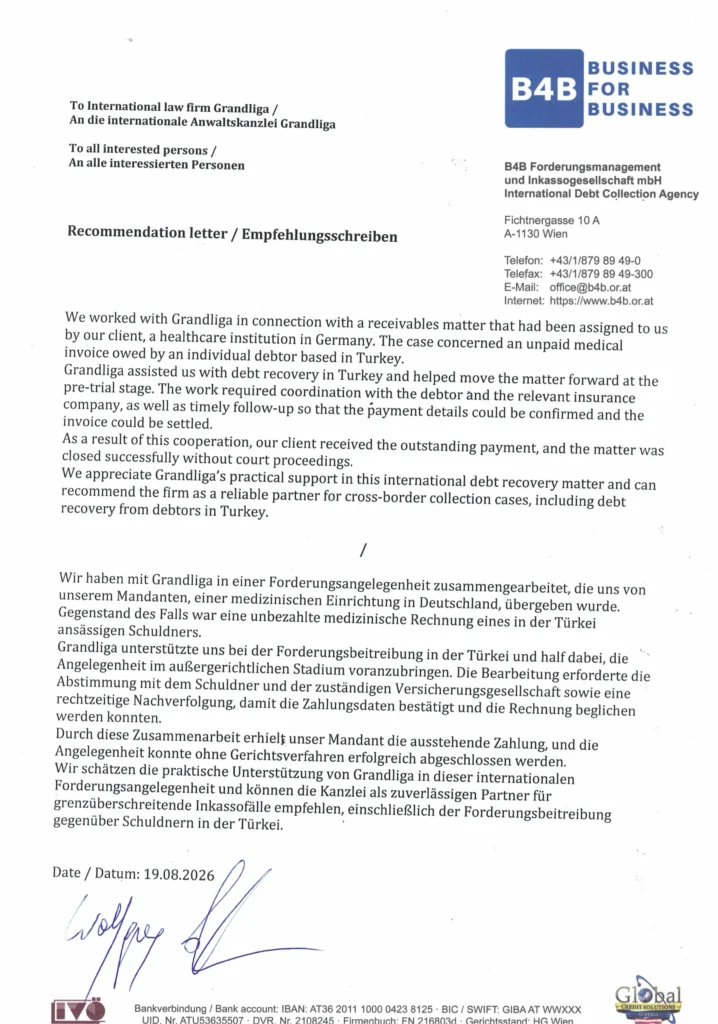
If you need support with international debt collection in Turkey, Grandliga can assist with document analysis, debtor assessment, selection of the appropriate recovery route, coordination with Turkish lawyers and enforcement-related actions. The strategy should be based on the debtor’s status, available evidence, limitation period, assets, possible objections and whether the case requires mediation, court proceedings, enforcement without judgment, recognition of a foreign judgment or bankruptcy-related measures.