
 Cayman Islands
Debt collection in the Cayman Islands often requires a corporate and asset-focused strategy from the very beginning. The jurisdiction is widely used for companies, investment structures, holding entities, funds and other corporate vehicles, so it should first be determined who the debtor is, what legal status it has, where its registered office is located and whether it has assets or enforceable interests that can realistically support recovery.
For commercial creditors, the key issue is not limited to the existence of an unpaid invoice or contractual debt. It is also important to determine whether the debtor is an active Cayman Islands entity, whether it is connected with regulated financial activity, whether public records reveal relevant security documents or asset-related information, and whether the claim should start with negotiation, litigation, enforcement planning or an insolvency-based route. This early assessment helps avoid a formal claim against a company that has no recoverable assets and allows the creditor to choose a procedure that matches the debtor’s financial position.
Once the debtor’s status, assets and commercial position are understood, the creditor can move to the first practical recovery stage: direct pre-court communication with the debtor.
Pre-court debt collection in the Cayman Islands usually starts with a written demand to the debtor. For an ordinary commercial debt, this demand is used to open formal communication, identify the debtor’s position, request payment and determine whether the dispute can be resolved without court proceedings. The letter may describe the amount due, the basis of the claim, the payment deadline and the creditor’s proposed next steps if the debt remains unpaid.
The content of the demand can be adapted to the situation. If the debtor accepts the debt but cannot pay immediately, the parties may discuss a payment schedule, partial repayment, security, acknowledgement of liability, settlement terms or another commercial solution. In some cases, the creditor may also consider set-off or another practical arrangement if there are mutual obligations between the parties. The purpose of this stage is not only to request payment, but also to understand whether the debtor is willing to engage, whether the debt is disputed and whether a negotiated solution is realistic.
If the debtor ignores the demand, delays without a clear reason, gives inconsistent explanations or uses negotiations only to postpone payment, the next legal steps should be considered. For a Cayman Islands company, a formal statutory demand may become relevant in an insolvency context, but it should be used carefully and not as a substitute for ordinary litigation where the debt is genuinely disputed on substantial grounds.
Before moving from pre-court recovery to litigation or another formal procedure, it should be reviewed whether the claim is still within the applicable limitation period.
The limitation period for debt collection in the Cayman Islands depends on the legal basis of the claim. A claim founded on a simple contract is generally subject to a six-year period from the date when the cause of action accrued. A claim based on a specialty is generally subject to a twelve-year period. An action to enforce an award, where the submission is not made by an instrument under seal, is generally subject to a six-year period. An action upon a judgment is also generally subject to a six-year period from the date when the judgment became enforceable.
For certain loans without a fixed or determinable repayment date, the limitation period may start from the date of a written demand for repayment. If the debtor acknowledges a debt or other liquidated money claim, or makes a payment in respect of it, the right of action is treated as accruing from the date of that acknowledgement or payment. The acknowledgement must be in writing and signed by the person making it. A current limitation period may be extended by further acknowledgements or payments, but a claim that is already time-barred is not revived by a later acknowledgement or payment.
If the claim is connected with fraud, deliberate concealment of a relevant fact or relief from the consequences of a mistake, the limitation period may not begin to run until the creditor has discovered, or could with reasonable diligence have discovered, the relevant fraud, concealment or mistake. After the applicable limitation position is clear, the creditor can choose the appropriate court route for formal debt recovery.
Judicial debt collection in the Cayman Islands is usually handled through the Summary Court or the Grand Court, depending on the value and nature of the claim. The Summary Court deals with civil monetary claims up to CI$20,000. Larger corporate and commercial claims are usually brought before the Grand Court, which has unlimited civil jurisdiction.
For commercial creditors, the Grand Court is often the main forum because cross-border corporate debts usually exceed the Summary Court limit. Claims connected with investment structures, regulated entities, financial instruments, shareholders, funds or complex corporate arrangements may also fall within the practical scope of the Financial Services Division.
This choice of forum determines the procedural route, the level of detail required in the claim and the further steps available to the creditor.
In ordinary proceedings before the Grand Court, the creditor starts the claim by filing and serving the appropriate originating process. The claim should identify the debt, the contractual or commercial basis of liability, the amount due, interest, costs and the relief sought. If the statement of claim is not served with the writ, it must generally be served within 14 days after the debtor gives notice of intention to defend.
Once the statement of claim has been served, the debtor must generally serve a defence within 14 days after the time limited for acknowledging service or within 14 days after service of the statement of claim, whichever is later. If the debtor files a defence, the creditor may serve a reply within 14 days after service of the defence. After pleadings are closed, the plaintiff must usually take out a summons for directions within one month, returnable in not less than 14 days.
If the claim is defended, the case may move through directions, discovery, witness evidence, interlocutory applications and trial. A straightforward debt claim can be resolved earlier if the debtor does not respond or has no real defence, but contested commercial cases in the Grand Court may take around 18 months to 2 years to reach trial, and complex cases can take longer.
If the debtor does not respond to the claim within the required procedural time, the creditor may proceed with default judgment. This route is relevant where the claim has been properly served, the response period has expired and the debtor has not taken the necessary steps to defend the proceedings. For a liquidated debt claim, the judgment may cover the principal debt, interest if properly claimed, and fixed costs.
If the debtor responds but the defence has no real prospect of success, the creditor may apply for summary judgment instead of waiting for a full trial. The application is made by summons supported by affidavit evidence, and the summons, affidavit and exhibits must be served on the debtor at least 10 clear days before the return date. At the hearing, the Court may enter judgment, dismiss the application, or allow the debtor to defend the claim, including on conditions such as security or procedural directions.
Both routes are intended for cases where a full trial is unnecessary because the debtor has either failed to engage with the proceedings or has not shown a realistically arguable defence. They depend on proper service, accurate court documents and evidence that clearly supports the creditor’s claim.
Small civil claims before the Summary Court may be relevant where the monetary value of the claim does not exceed CI$20,000. This route can be used for lower-value unpaid invoices, service contracts, supply disputes or other straightforward commercial debts involving a Cayman Islands debtor. Higher-value or more complex corporate claims are usually dealt with by the Grand Court.
Whether the claim is heard in the Summary Court or in ordinary proceedings before the Grand Court, the first-instance stage ends with the Court either granting judgment, dismissing the claim or making another appropriate order. If judgment is granted in favour of the creditor, the debtor may comply voluntarily, while the creditor may also prepare for enforcement if payment is not made.
Appeals in Cayman Islands debt cases depend on the court that made the decision and the type of order. A civil decision of the Summary Court may be appealed to the Grand Court. However, special leave is required for certain decisions, including a consent judgment, an award of interest only, an order for costs only or an interlocutory order.
A decision of the Grand Court may be appealed to the Cayman Islands Court of Appeal. Final judgments generally may be appealed as of right, while most interlocutory decisions require leave to appeal. If leave is not required, the notice of appeal must be filed and served within 14 days from the date when the judgment or order was filed. If leave is required, it should be requested when judgment is given or by summons or motion within 14 days from the date when the judgment or order was filed.
If the Grand Court grants leave, the appellant’s notice of appeal must be filed within 14 days from the order granting leave. If the Grand Court refuses leave, the applicant may apply to the Court of Appeal within seven days from the refusal. Filing an appeal does not automatically stay enforcement of the judgment, so a party that wants to suspend enforcement must seek a stay of execution.
A further appeal from the Cayman Islands Court of Appeal may go to the Judicial Committee of the Privy Council. Depending on the case, this may be as of right, with leave of the Court of Appeal or with special leave from the Privy Council. Where leave is sought from the Court of Appeal, it should be requested within 21 days from the date when the Court of Appeal’s decision was filed. The Privy Council is the final appellate court for the Cayman Islands.
If a creditor has already obtained a court judgment outside the Cayman Islands, but the debtor, shares, receivables or other assets are connected with the jurisdiction, the creditor cannot usually move directly to local enforcement. The judgment first needs to be made enforceable in the Cayman Islands through the appropriate procedure for recognition and enforcement of foreign judgments.
Certain foreign money judgments may be registered in the Grand Court if the statutory requirements are met. The judgment must be final and conclusive, and the application for registration is generally made within six years from the date of the judgment or, where there has been an appeal, from the date of the last judgment in those proceedings.
Statutory registration is not available for every foreign judgment. If the judgment does not fall within the reciprocal enforcement regime, it may be necessary to bring a common law claim based on the foreign judgment. In practical terms, this means that the foreign judgment becomes the basis of a new Cayman Islands claim, rather than being automatically enforced as a local judgment.
The debtor may challenge recognition or enforcement on limited grounds, including lack of jurisdiction of the foreign court, improper notice, fraud, public policy or breach of natural justice. For this reason, the foreign court’s jurisdiction, service history, appeal status and the exact monetary terms of the judgment should be reviewed before starting enforcement in the Cayman Islands.
If the contract between the creditor and the debtor contains an arbitration clause, the dispute may need to be resolved before the agreed arbitral tribunal rather than through ordinary court proceedings. After the creditor obtains an arbitral award, the next step may be to make that award enforceable against the debtor or its assets in the Cayman Islands.
Enforcement of foreign arbitral awards should be treated separately from the enforcement of foreign court judgments. A creditor with an arbitral award may apply to the Grand Court to enforce the award under the applicable statutory regime. The duly authenticated or certified award, the arbitration agreement and a certified English translation should be prepared if the award or agreement is in another language.
The court may allow the award to be enforced in the same manner as a judgment or order of the court. This can be particularly useful where the debtor is a Cayman Islands company or has assets connected with the jurisdiction. Once leave to enforce is granted, the creditor can move to the enforcement stage unless the debtor successfully resists enforcement.
The debtor may object on recognised grounds, such as invalidity of the arbitration agreement, lack of proper notice, excess of jurisdiction by the tribunal, procedural irregularity, the award not yet being binding, the award being set aside or suspended at the seat, non-arbitrability or public policy. These objections are not a rehearing of the underlying commercial dispute, but they can affect whether the award can be enforced in the Cayman Islands.
Compulsory enforcement begins when the creditor has a Cayman Islands judgment or a foreign judgment or arbitral award that has become enforceable in the Cayman Islands. A money judgment may be enforced against the debtor’s goods, debts owed to the debtor, land, shares, income or other property interests, depending on the available assets and the enforcement order used.
Common enforcement measures include a writ of fieri facias against goods, garnishee proceedings against third parties who owe money to the debtor, charging orders over land or other assets, attachment of earnings and, in appropriate cases, sequestration or committal. If the debtor is a company, a charging order over shares or another identifiable asset may be more useful than a general execution step where no physical assets are available.
Enforcement should be selected according to the type of asset. Bank balances, receivables, shares, real estate, contractual rights and income streams may require different procedures. If enforcement against known assets is ineffective, it may need to be considered whether the debtor’s failure to satisfy the judgment supports an insolvency route.
Winding up may become part of the recovery strategy where a Cayman Islands company is unable to pay its debts. A company may be treated as unable to pay its debts if a creditor owed more than one hundred Cayman Islands dollars serves a statutory demand at the company’s registered office and the company neglects for three weeks to pay, secure or compound the debt to the creditor’s satisfaction. A company may also be treated as unable to pay if execution or another process issued on a judgment is returned unsatisfied.
This remedy is powerful, but it should not be used as ordinary pressure where the debt is genuinely disputed on substantial grounds. If the debtor has a real and substantial defence, a winding-up petition may be challenged and may create procedural risk for the creditor. The insolvency route is more appropriate where the debt is clear, due, unpaid and the company’s inability or refusal to pay can be properly demonstrated.
If a winding-up order is made, the company is placed into a court-supervised liquidation process. The liquidator can investigate assets, liabilities, creditor claims and prior transactions. For a creditor, this route may be useful where individual enforcement is unlikely to work, where assets may have been moved, or where the debtor’s financial position requires collective insolvency treatment rather than ordinary litigation.
A Cayman Islands company that is or is likely to become unable to pay its debts may apply to the Court for the appointment of a restructuring officer if it intends to present a compromise or arrangement to creditors. This is a separate procedure from immediate liquidation and is designed to give the company a court-supervised restructuring framework.
For creditors, the appointment of a restructuring officer can change the recovery route. Proceedings against the company may be stayed, and new proceedings or winding-up steps may require the Court’s permission. This can delay ordinary recovery steps, but it also creates a structured process in which creditors may evaluate the proposed compromise, the company’s financial position and the expected return compared with liquidation.
A secured creditor remains entitled to enforce its security without leave of the Court and without reference to the restructuring officer. This distinction is important because unsecured, secured, contingent and disputed creditors may have different practical positions in the restructuring process.
If, during liquidation, it becomes clear that the company’s assets may be insufficient to satisfy creditor claims, the liquidator may need to review transactions made before the insolvency process began. This may include transfers of assets, payments to selected creditors, disposals of property for insufficient value or other transactions that reduced the company’s estate. In this context, challenging debtor transactions may become relevant.
These claims are usually pursued within the insolvency process, not as a standalone shortcut for every unpaid commercial debt. The purpose is to protect the creditor body by returning value to the company’s estate or reversing transactions that improperly removed assets from the reach of creditors. The practical result may improve the pool available for distribution, but it does not guarantee full payment to any individual creditor.
Fraudulent conduct may also have consequences for persons involved in the company’s affairs where the legal threshold is met. This should be treated carefully and only where the facts support it. In an ordinary debt case, a distinction should be made between non-payment, commercial failure and conduct that may justify transaction challenges or personal consequences in an insolvency context.
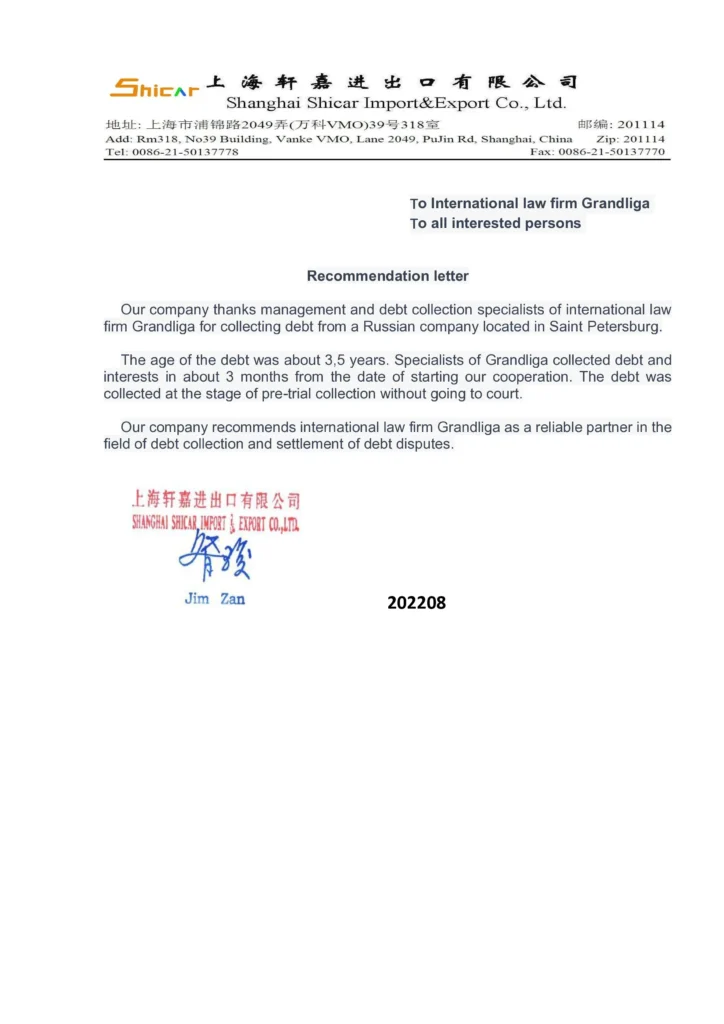
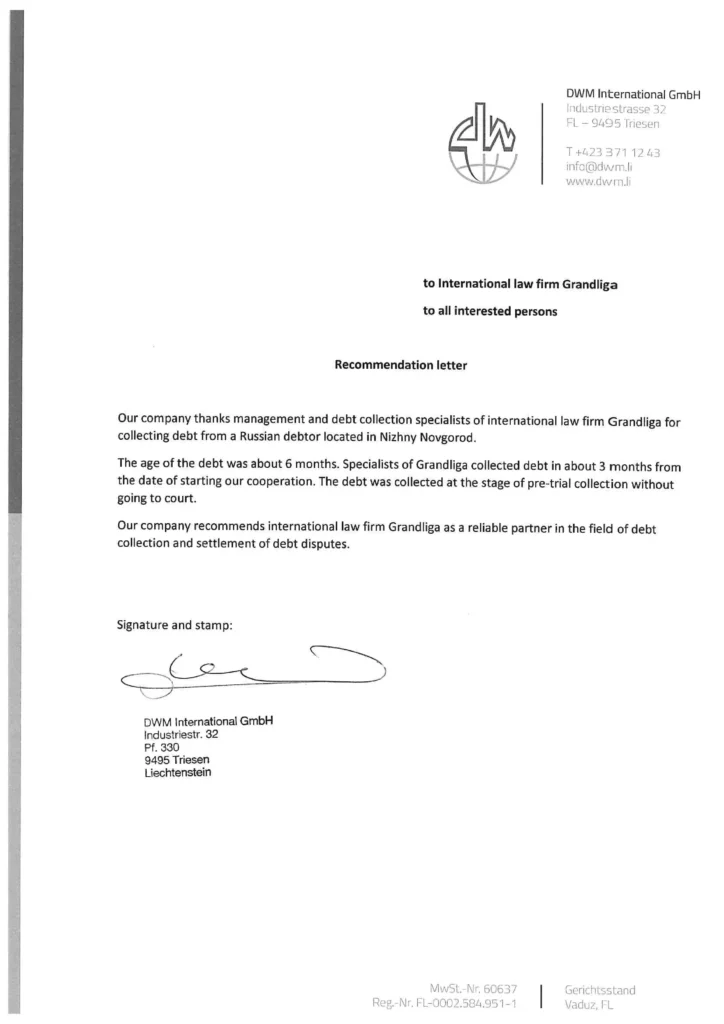
Grandliga assists creditors with debt collection in the Cayman Islands in commercial and corporate cases involving Cayman Islands companies, investment structures, holding entities and cross-border debtors. The work may include debtor verification, pre-court communication, settlement strategy, preparation of court proceedings, recognition of foreign judgments, enforcement of arbitral awards, compulsory enforcement and insolvency-related steps where legally appropriate.
For a corporate creditor, the most effective route depends on the nature of the debt, the debtor’s status, the value of the claim, the available assets and the risk of a genuine dispute. Grandliga can help structure the recovery strategy, coordinate the necessary legal steps and select a proportionate approach for negotiation, litigation, enforcement or insolvency proceedings.